7. Street Fighter IV (2008)
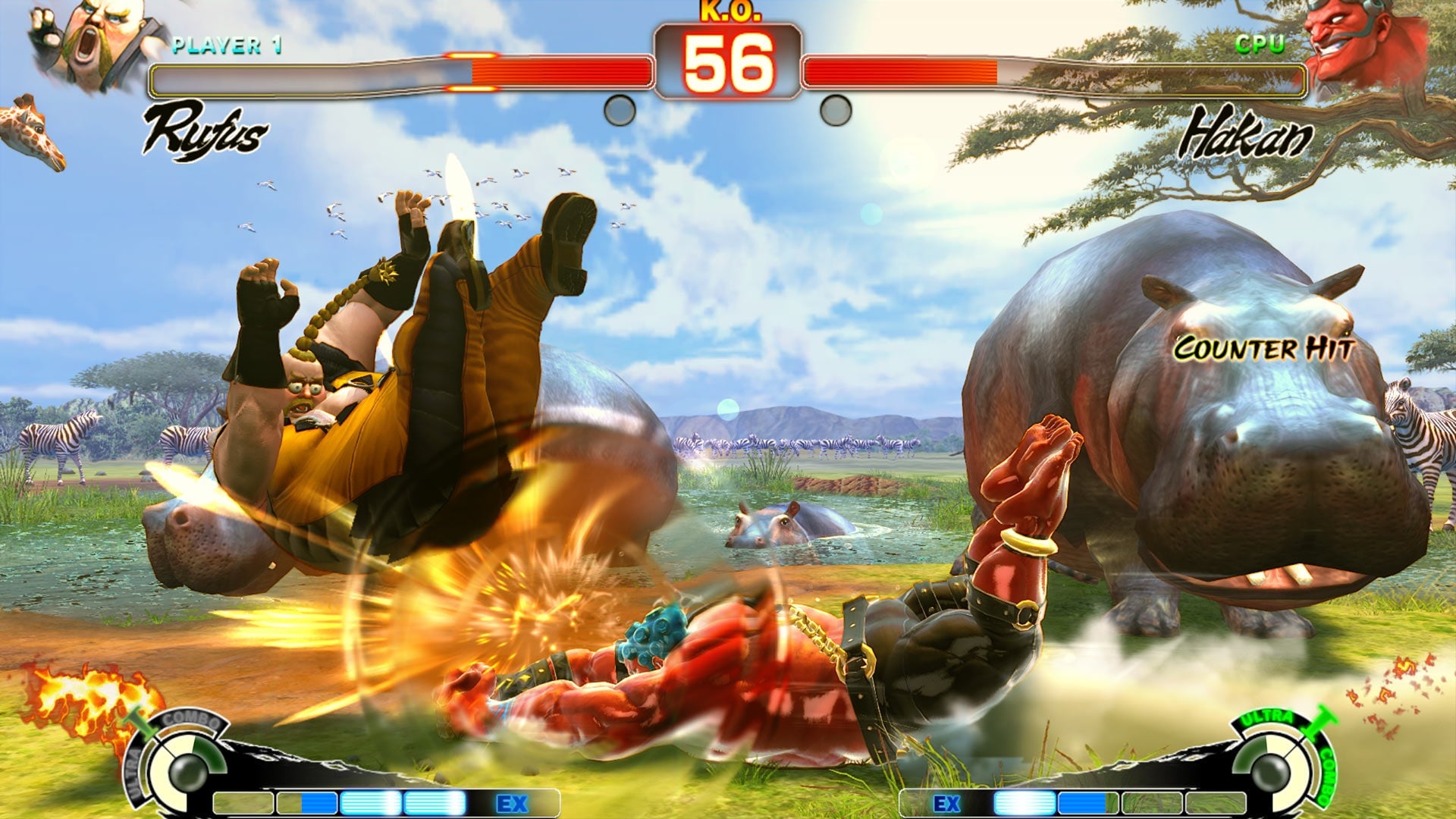
When Street Fighter IV launched in 2008, it had a lot to prove after the series’ nine-year, post-Third Strike slumber.
Street Fighter IV finally took the mainline series into 3D while retaining its signature 2D fighting gameplay. Your mileage may vary on the actual execution of bringing these characters to 3D (I think SF4 looks downright homely compared to its two more recent sequels), but Street Fighter IV managed to capture the precision of 2D fighting with a 3D art style.
It’s big, too. By the time we reached Ultra Street Fighter IV in 2014, we had what was probably one of the most feature-rich fighting games on the market, with a huge roster of 44 playable characters that included many of the series’ most popular faces.
Street Fighter IV’s most significant gameplay addition came in “focus attacks,” which felt like a precursor to Street Fighter 6‘s drive impacts. Holding two buttons charged up a powerful blow that not only had armor, but would crumple the enemy and leave them open to follow-up attacks. You could also cancel these into a dash, and this “focus attack dash cancel“ (FADC) was the basis of most of the game’s more advanced, and perhaps overly difficult, combos. Focus attacks, powerful both offensively and defensively, dominated the Street Fighter IV meta, and how much you enjoy this one might boil down to how cool you are with that.
But the most interesting aspect of Street Fighter IV is how it affected fighting games on a macro scale. They were kinda dead for much of the 2000s until Capcom swooped in and revitalized a genre (and community) that was on life support. The current renaissance can be traced directly back to the explosive popularity of Street Fighter IV, a true comeback king. — Kenneth Shepard
Revisions:
Street Fighter IV (2008)
Super Street Fighter IV (2010)
Super Street Fighter IV: Arcade Edition (2010)
Ultra Street Fighter IV (2014)