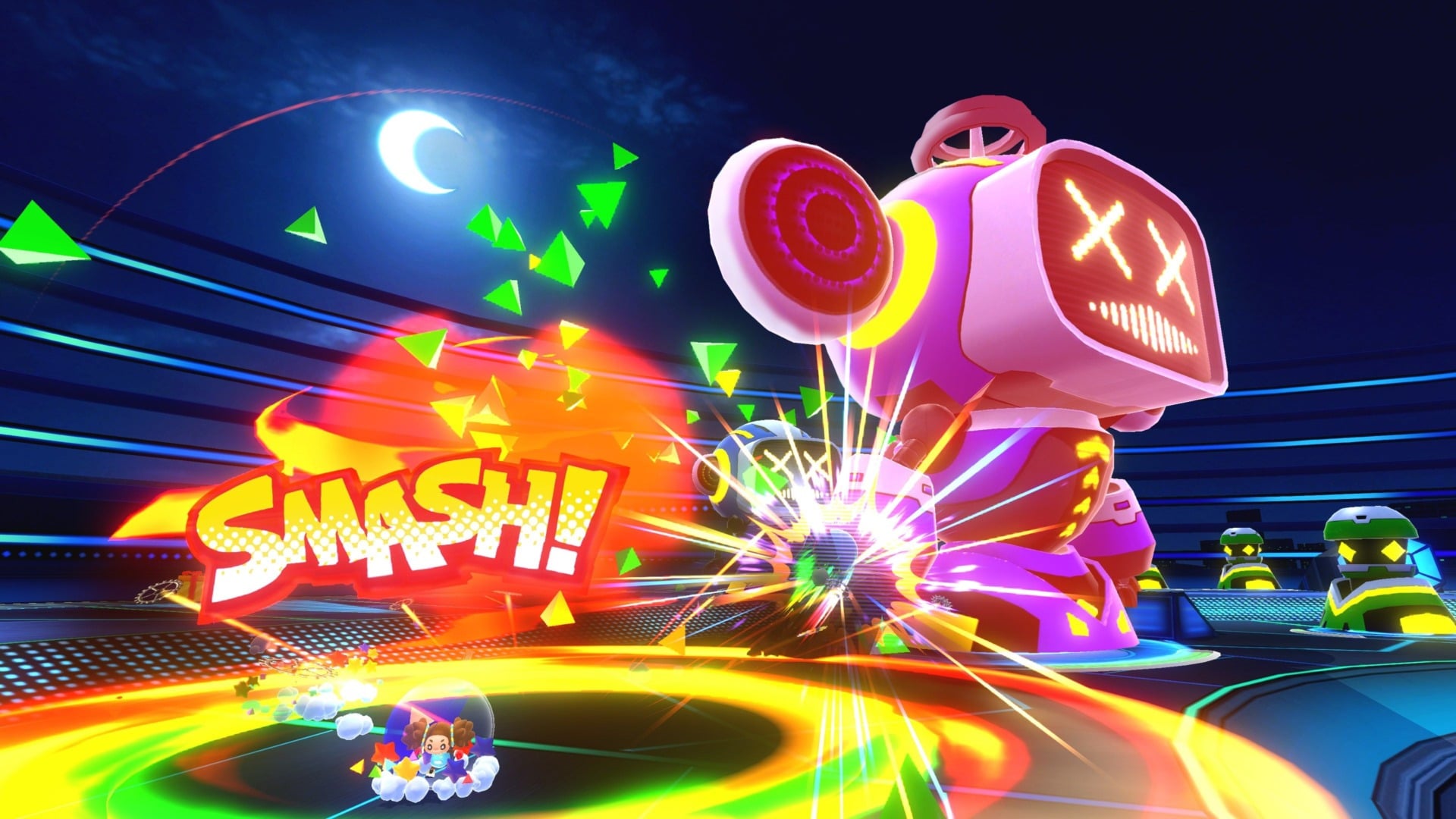
I play the original 2001 Super Monkey Ball almost every day, and if you’ll allow me one brag, I’m pretty good at it. Sometimes I play to jumpstart my brain in the morning, sometimes to unwind during my lunch break, sometimes to fill some time in the evening. Usually, I choose the fifty-stage-long Expert difficulty, and see how far I can make it without using a continue. There’s rarely an explicit goal here—I’m just hanging out in one of the best games ever made.
Super Monkey Ball is so good that not returning to it habitually feels like doing it a disservice. The game feels perfect, looks perfect, and is astonishingly easy to pick up and play: spend five seconds with it and you’ll understand quite literally everything about its design. You’re a guy in a ball; there’s a goal at the end of a floating obstacle course; a timer is ticking down. Use the control stick to move. That’s it. Every pixel of what’s onscreen, from the level geometry to the character animations to the HUD, is designed with an elegant, utilitarian exactitude, relaying a constant stream of complex information to players while keeping their focus squarely on the center of the frame.
This is crucial, because Super Monkey Ball demands undivided, unbending attention. It is a molecular video game. The movement—which occupies more or less the entirety of the game’s mechanical space—is so precise that an errant two-millimeter nudge of the control stick can instantly change (or ruin) your approach to any given obstacle. In my twenty years with Super Monkey Ball, no run has felt remotely similar. Stages I’ve navigated hundreds of times constantly present new, unexpected, exciting challenges. In any other game, this would be impressive. In a game with exactly one verb, it’s a marvel.
Buy Super Monkey Ball: Banana Rumble: Amazon | Best Buy | Humble Bundle
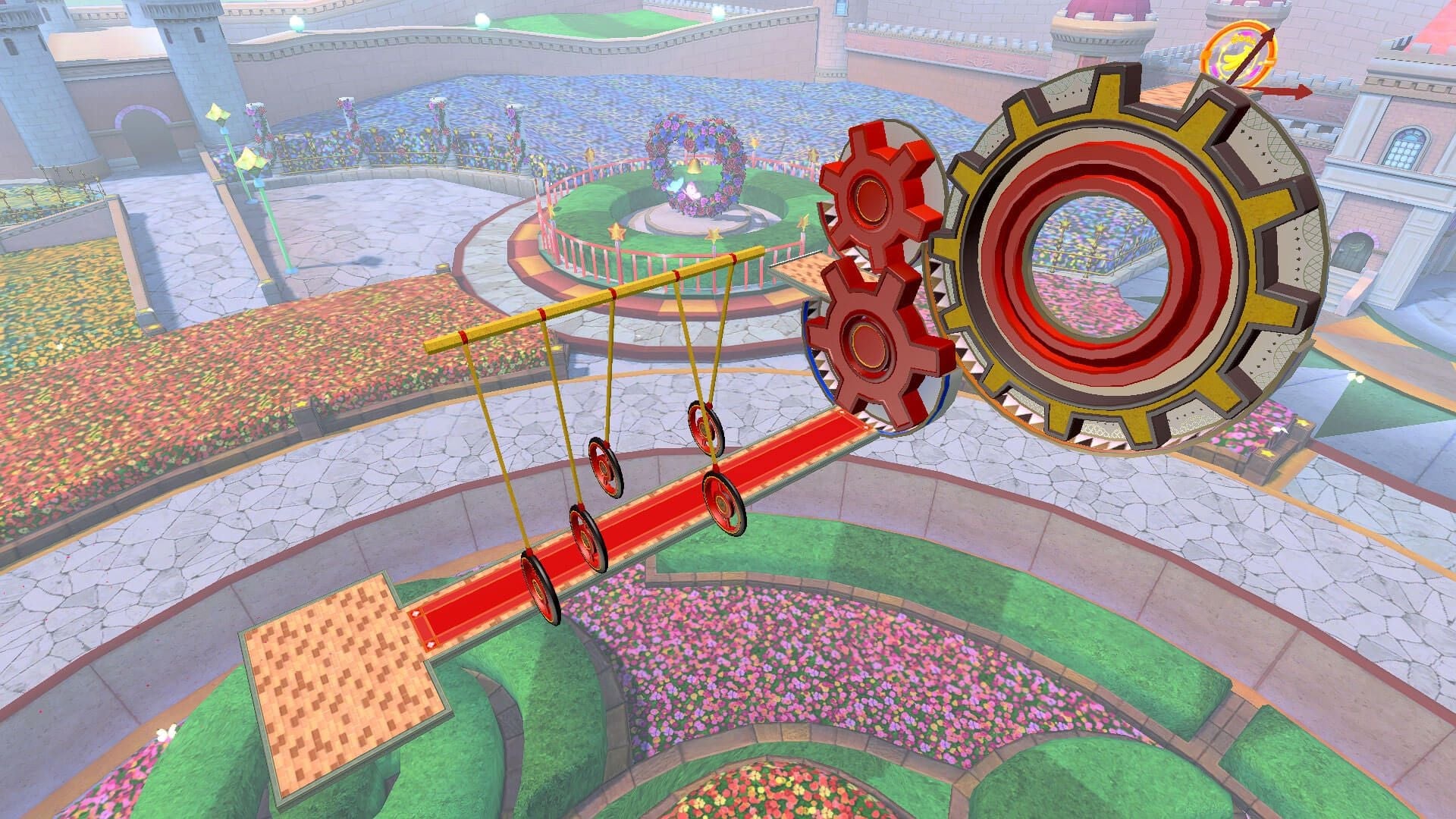
It’s also a hard act to follow. Not long after the 2002 release of Super Monkey Ball 2—a great game, though hurt somewhat by its occasional prioritization of mazes and puzzles over brass-tacks platforming—the wheels began falling off. Save for a couple small blips on the radar (here’s to you, 2012’s Super Monkey Ball: Banana Splitz), the series has spent the majority of its lifespan in a steady state of decline, each entry drifting further away from the rigor and creativity of the GameCube duology. I was almost ready to leave it for dead after 2021’s Super Monkey Ball: Banana Mania, a remake of the first two games that tampered with their physics, flattened their structure, removed multiplayer modes, and introduced a slew of control and camera issues.
Now, practically out of nowhere, into our laps falls Banana Rumble, the first non-remake series entry since 2012. I booted up my review copy with tempered expectations. I’d been burned many times before. Recently, even. Imagine my relief when it wound up being the best Super Monkey Ball game in over twenty years.
The Meat
In almost every way that matters, Banana Rumble goes back to the drawing board. No more jumping, no more minigame bloat, no more micromanaging the camera. Motion controls are available, but they’re off by default, their toggle squirreled away in a labyrinthine options menu.
The mere presence of a labyrinthine options menu should be encouraging to anyone who was frustrated by Banana Mania’s sparse customizability. Rest easy, veteran ballers: Banana Rumble allows for adjustments to, among other things, input display, automatic camera speed, manual camera speed, stick dead zones for both character and camera control, stage tilt severity, and stage tilt speed. (I tested those latter two, and they don’t seem to have any bearing on physics.) If you’re hankering for a more traditional setup, do what I did and disable the manual camera entirely while cranking automatic tracking up to the max. Congratulations, you’re playing Monkey Ball just like mama used to make.
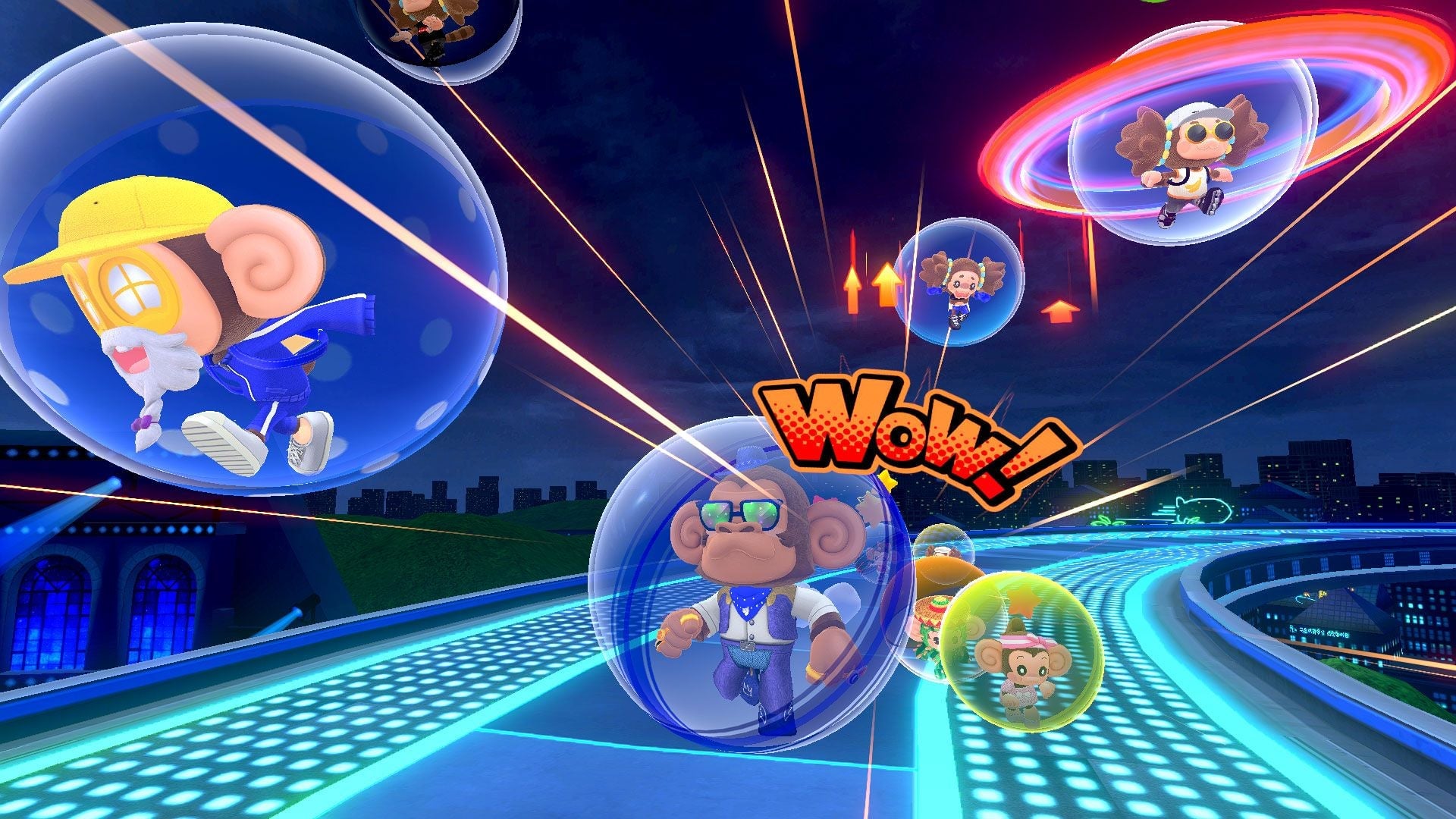
Even out of the box, a good chunk of this game is mama’s Monkey Ball, albeit with some significant adjustments to the formula—mostly for better, occasionally for worse. The creamy nougat center is Adventure Mode: 200 miniature platforming gauntlets, none longer than sixty seconds. These are evenly split into twenty worlds, the first ten of which comprise the story, the remaining ten of which are for “the real heads.” (As is series tradition, the story here is hopelessly dumb and I spent the entire game wishing it would go away. We’re back, baby!)
Super Monkey Ball lives and dies by the strength of its level design. At its very best, each individual stage pushes you toward some new, minute understanding of the game’s physics, brutally ramping up difficulty in tandem. At its worst, you get something like Super Monkey Ball 3D, where every course is a flat, dinky, Denny’s kids’ menu maze that doesn’t teach you anything about anything, let alone itself. Banana Rumble, thankfully, falls into the former camp the vast majority of the time. A handful of stages are designed as brainteasers first and raw execution checks second, but even then, there’s an almost total lack of homogeneity. Levels feel distinct and, for the first time in I can’t remember how long, genuinely difficult. Banana Rumble actually cares about how you play it; it wants you to fastidiously consider every curve, edge, and gap in its geometry.
There’s one key addition to the game’s movement that fundamentally alters this relationship: the spin dash, a clear nod to Sonic the Hedgehog’s iconic maneuver of the same name. In Sonic, spin dashes let players effectively build momentum from a total standstill, the speed of their snap forward dependant on how many times a button is pressed in rapid succession. Prior to Banana Rumble’s release, I assumed its spin dash would function identically, and was worried. Much of Super Monkey Ball’s tension arises from the various ways it asks players to negotiate slopes, and the ability to quickly reverse course with a burst movement option would, if not negate that tension, diminish it considerably.
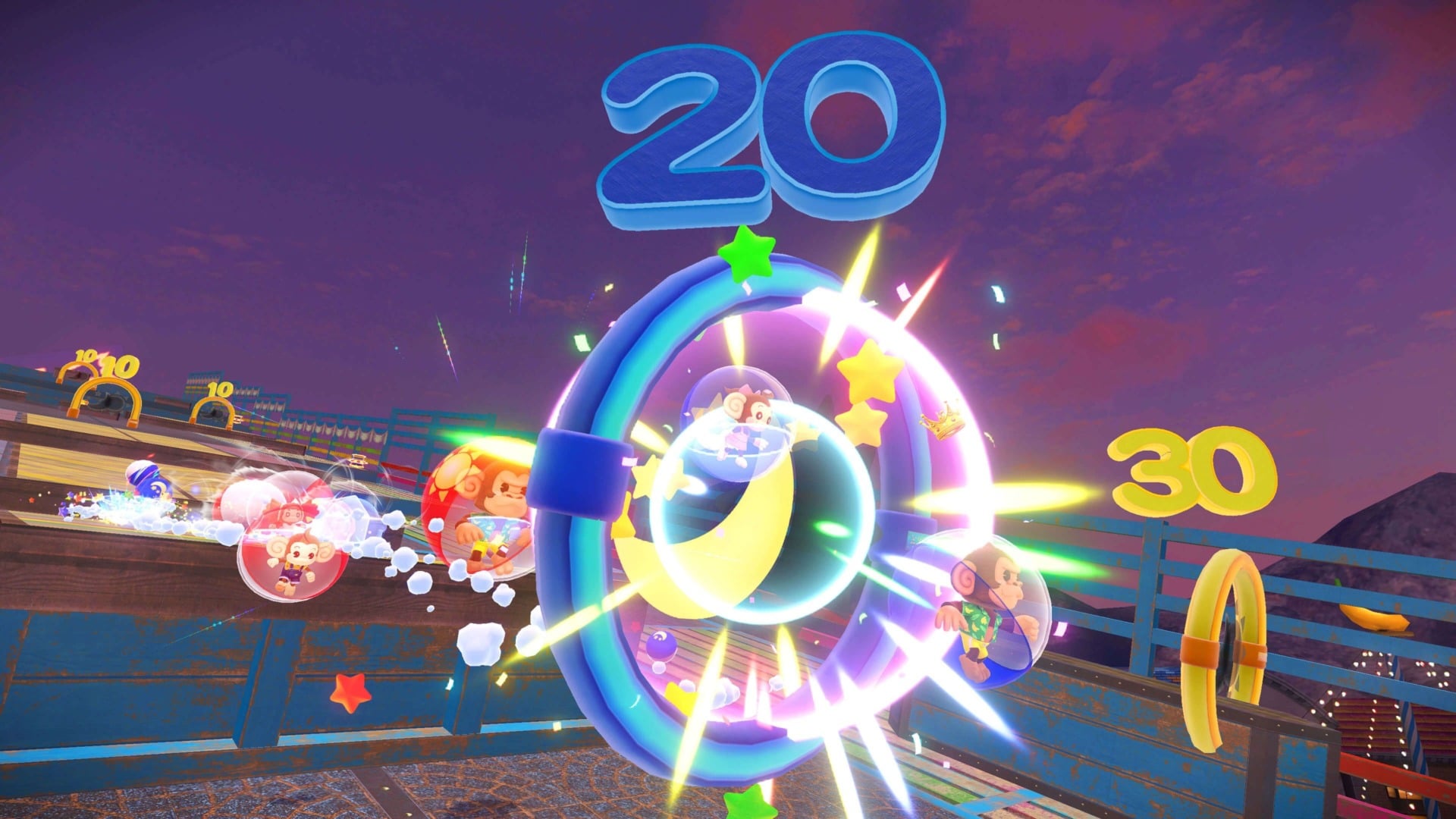
Luckily, the good folks at Sega were two steps ahead of me. The spin dash in Banana Rumble is a momentum extender, not a momentum generator. Try using it while stopped and it won’t send you anywhere. You need to be moving, and once you’ve built a bit of speed, you can use the spin dash to move way farther. A beautiful little nesting doll of commitments.
I’m still not sure this series really needs anything more than its fundamental control scheme. The purist in me wants to deride the spin dash, regardless of its implementation—why complicate something so pristine? But maybe I’m approaching this the wrong way. Maybe it isn’t a question of what Super Monkey Ball needs, but of what Super Monkey Ball wants. Super Monkey Ball needs a ball, a level and a timer like we need food, water and shelter. But what it wants is momentum. It wants you to delicately chain multiple precise inputs into seamless, buttery propulsion, and it wants you to invest in that propulsion. No time to renege; roll (yup) with it and see what happens. The spin dash aligns with this ethos perfectly. If this were the first Super Monkey Ball game, I’d probably want it to show up in all the future ones, too.
And it’s not like Banana Rumble doesn’t make good on the spin dash’s promise. Many levels are explicitly designed around it, and many more are subtly designed around it. Once I began using the dash more liberally, slingshotting simians through the air just to see where they’d end up, the game revealed its hand. There are shortcuts tucked into every nook and cranny of Banana Rumble if you know where to look. Working out alternate solutions to courses has always been one of the most rewarding challenges of Super Monkey Ball, and here we have a game built for it from the ground up. At times, these shortcuts can feel cheap, but for every level trivialized by the spin dash there are ten more that demand stringent, high-stakes applications of it.
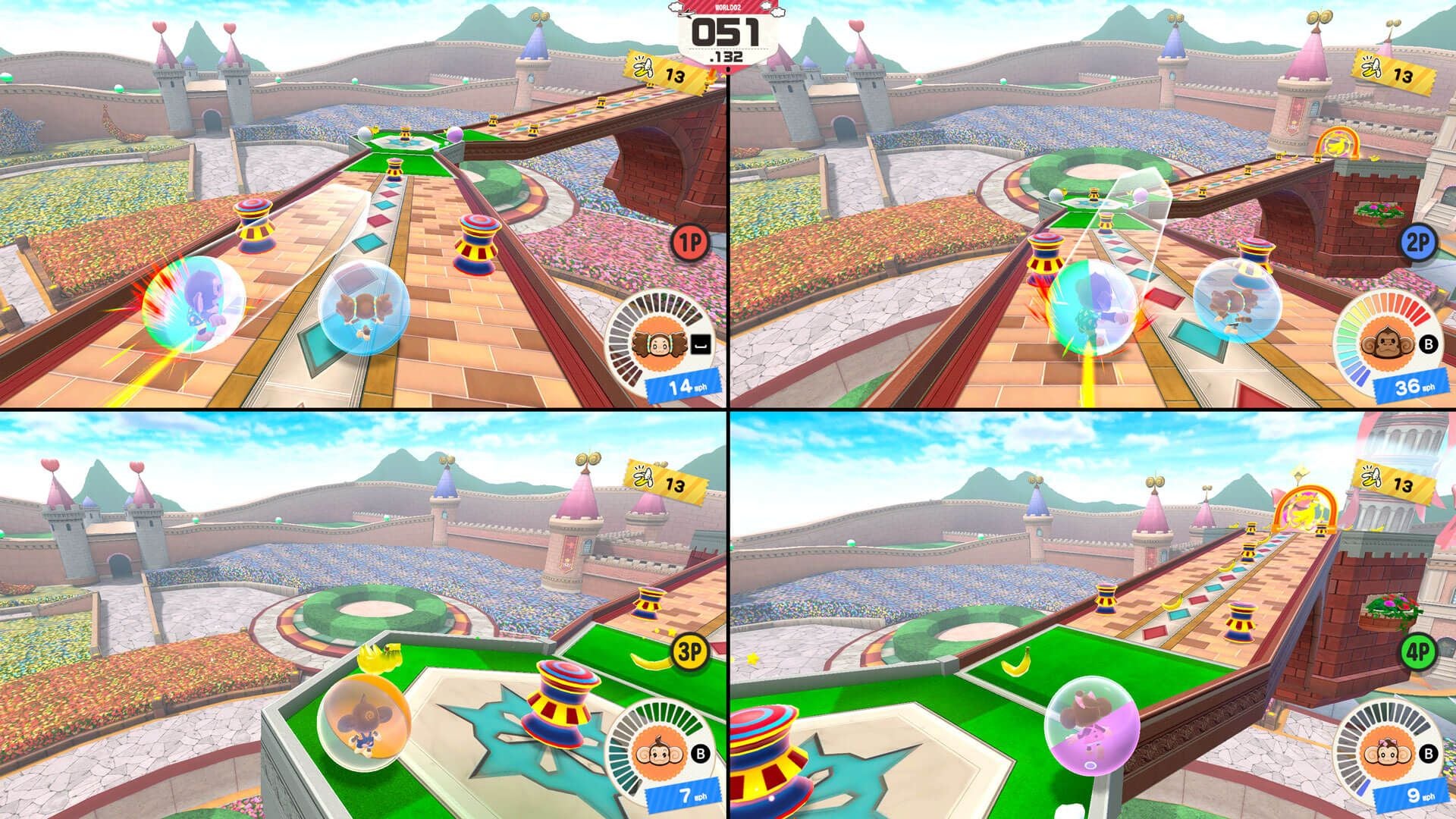
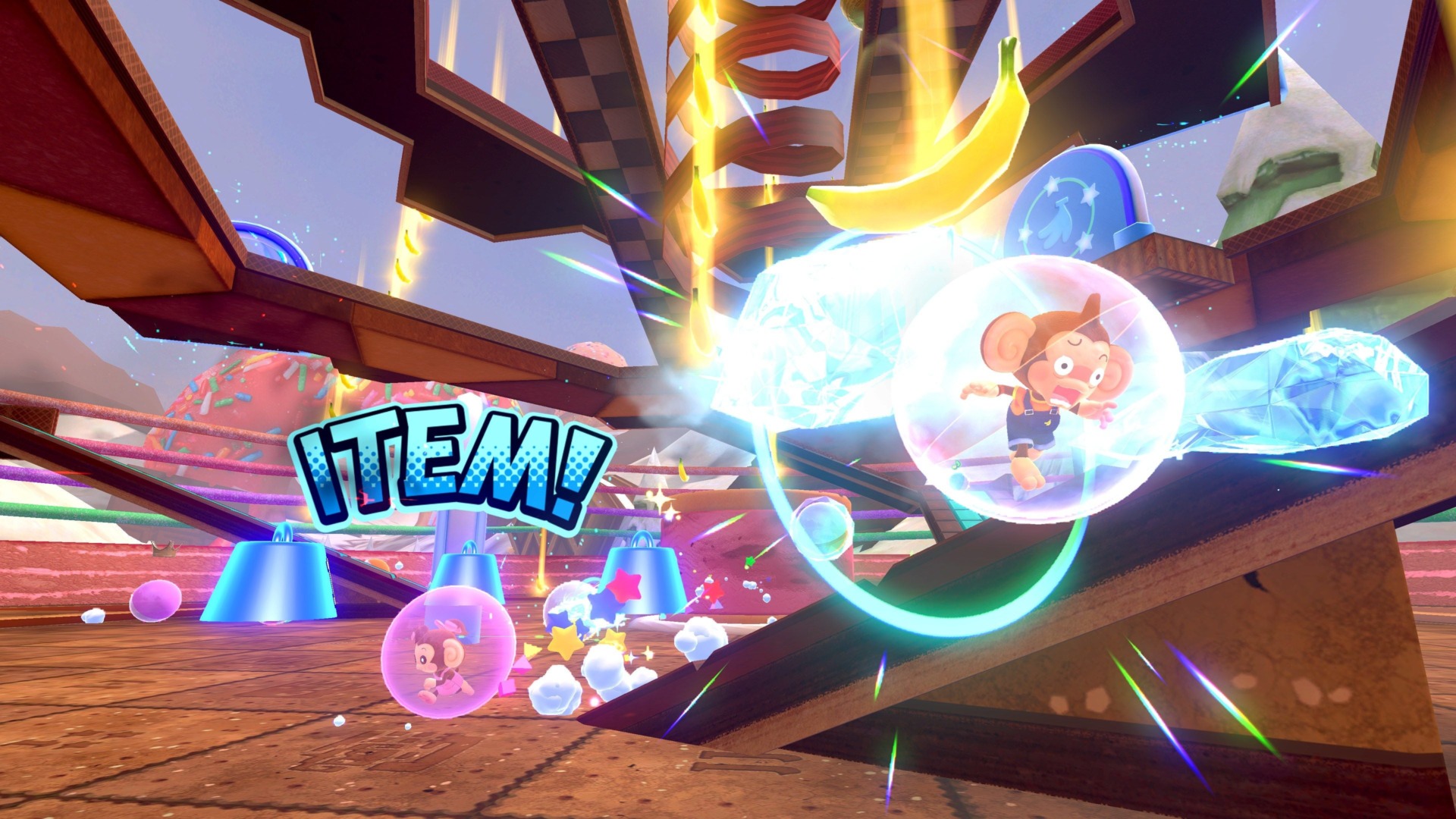
Rounding out Banana Rumble’s core modes are a number of multiplayer games, only a couple of which resemble past series staples. Gone are the likes of Monkey Golf, Monkey Bowling, Monkey Billiards, and—sigh—Monkey Target. Monkey Race (rebranded here as just “Race”) returns, alongside a few others that all scan as attempts to court the Fall Guys platformer-as-battle-royale audience. None of them are especially captivating, though I guess they automatically outclass Fall Guys by virtue of not making you feel like you’re swimming laps through a tar pit. I respect that these minigames all preserve and iterate upon Banana Rumble’s core movement (including the spin dash) instead of adopting entirely new control schemes (the standard in past Super Monkey Balls), but they all come out the other end feeling a bit samey. Race, the most barebones, is also the best, for precisely that reason.
Super Monkey Ball: Banana Rumble
-
Back of the box quote
“Fun enough to play, good enough to like.”
-
Type of game
Ball rolling; you roll a ball.
-
Liked
Inventive, rigorous level design, momentum-first platforming, replayability.
-
Disliked
Lack of an arcade mode, misguided progression, occasional tedium.
-
Played
7 hours to complete the 200 main stages, 20 more hours of hanging out.
The real jewel here is multiplayer Adventure Mode, making a triumphant return (with online functionality to boot) after a decades-long absence. This was always one of the better showcases for the series’ versatility: put multiple people in the same course side-by-side and their approaches to it will almost immediately diverge in a thousand tiny ways. Skill makes a difference, sure, but personal expression moreso. With enough players, it’s a conversation.
The Potatoes
The original Super Monkey Ball is an arcade game. This is true both literally (the game first released as a cabinet several months before it landed on the GameCube) and structurally. Its progression systems demand knowledge of how its levels work not only individually, but together: avoiding a game over on higher difficulties means devising meticulous strategies that maximize both efficiency and banana accumulation (100 bananas grant an extra life, and the game has, for my money, one of the greatest 1-up sound effects in the medium). For instance, certain levels can be skipped with warp goals, but doing so may put your banana counter at a deficit—something you’ll regret when you’re teetering on the precipice of a wire-thin path with ten seconds on the clock and zero lives to spare. These competing tensions cultivate a holistic understanding of the game. Conquering it means conquering all of it.
2024’s Banana Rumble is not an arcade game, because arcade games don’t really get made anymore, and as with every Super Monkey Ball that’s not an arcade game, it works overtime to reshape and justify its design outside of an arcade framework. There are no game overs, because there are no lives. There are no high scores, because stages are played in isolation instead of as a group (with the exception of time attack mode, which I love, but it doesn’t do much to make the stages feel like they’re actually operating in concert). But the game still has bananas, and it still keeps track of your best times.
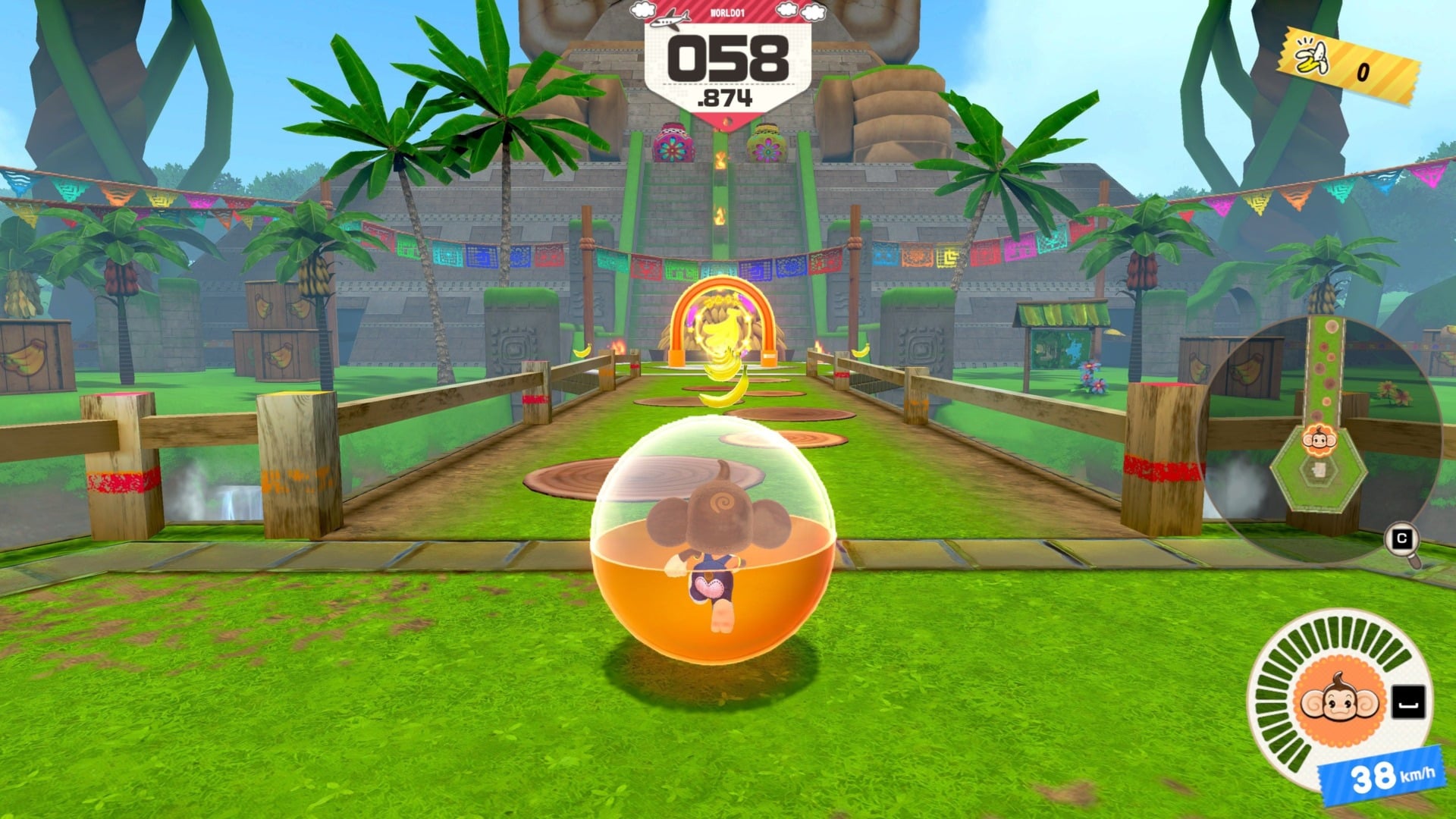
It solves this in two ways, the first of which is pretty crafty. Each level now has three sub-challenges (which the game dubs “missions”): a par time, a par banana count, and a single “golden banana” placed in a particularly tricky location. Depending on which one you tackle, your approach to the level will fundamentally change, in ways that almost recall the sensation of routing classic Super Monkey Ball difficulties. It’s somewhat disappointing that the game needs to prescribe these challenges in lieu of letting them emerge organically; on the other hand, it also means that each level effectively has three smaller levels folded into it, and I was consistently surprised and impressed by how much they required me to alter my gameplan.
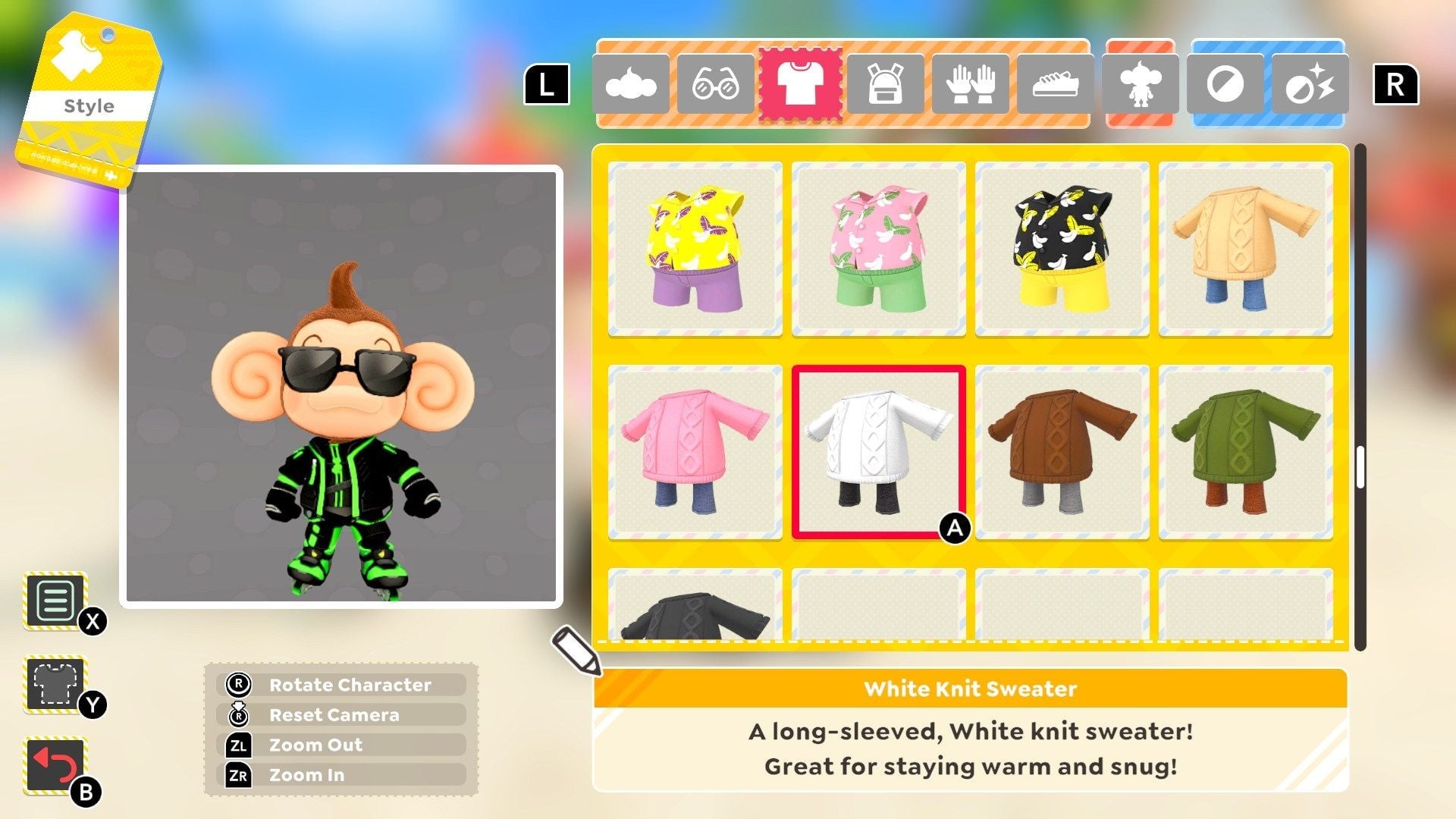
The second solution is a bit clunkier. Instead of a traditional scoring system, Banana Rumble awards points based on story and mission completion. These points are primarily used as currency in an in-game cosmetics shop, where you can play dress-up with your characters, purchase new frames for photo mode, and just generally accomplish fuck all. This is, bluntly, meaningless, and I can’t help but feel ambivalent about the fact that most of the game’s progression terminates here, in something almost completely dislodged from the skills and knowledge it asks you to build elsewhere. Banana Rumble dangles the carrot and then reveals that it’s actually cotton candy; the last thing a game this lean needs is empty calories.
We’ve established what Super Monkey Ball needs; we’ve established what Super Monkey Ball wants; now, finally, we arrive at the million dollar question. What do I want? On some level, I know I just want the first Super Monkey Ball. I want elegantly paced arcade modes and intrinsically meaningful scoring systems and an unvarnished, elemental control scheme. I don’t want partitioned stages or games-as-a-service-adjacent cosmetics shops or a dozen different characters with unique stat spreads.
But these are all trees; what about the forest? What precisely about Super Monkey Ball makes me return to it day after day, year after year? The answer is embarrassingly simple: it’s a fun video game. What I really want when I play Super Monkey Ball is to play a fun goddamn video game. And what better choice? Super Monkey Ball is the stripped down essence of fun video games. It lets you do one thing, and that thing is fun, to the greatest extent that any one thing in a video game could be.
Banana Rumble is fun. I love playing it. I thought I was mostly done playing it until, about 300 words into this review, something unexpected happened: I got The Itch. I’d beaten all the levels, but I wanted to beat them again. I wanted to take a crack at the missions, which I’d largely dismissed as frivolous on my first run. I wanted to go for some records in time attack, especially pre-release, when the sparse competition would all but guarantee me a spot in the top 5. (As of right now, 6:03 a.m. on June 23rd, 2024, I have Giant Bomb’s Dan Ryckert beaten by two seconds on the world 1 leaderboards. Dan, if you’re reading this: your move.) The game works, in all the ways I expect it to. Maybe not in all the ways I want it to, but so what? Banana Rumble doesn’t need to be perfect. It just needs to be good. And for Super Monkey Ball, “perfect” and “good” are very nearly the same thing.
Buy Super Monkey Ball: Banana Rumble: Amazon | Best Buy | Humble Bundle
.