Video games change a lot between announcement and release, but most of that happens under the hood. What the game looks like is usually set in stone. But that’s not true of every video game, and it certainly wasn’t true for Borderlands and Team Fortress 2, games that looked very different by the time they shipped.
Yes, that actually happened. Here’s how.
Borderlands
It’s tough to imagine Gearbox Software’s Diablo-style shooter without its striking and cartoonish look, but for years, the game relied on a far more pedestrian aesthetic. I even saw a playable demo of Borderlands at E3 one year, prior to the game’s art change. Needless to say, it didn’t leave a big impression.
Here’s the drastic change, side-by-side:
Gearbox outlined what happened in a Game Developers Conference talk in 2010, but in short, players were confusing Borderlands with Fallout 3 and Rage; the art was too similar. Borderlands’ style had been developed with the terms “serious,” “gritty,” and “realistic.” It’s not a surprise Borderlands looked the way it did.
“There can be something a little sterile and cold about contemporary super normal mapped games,” said art director Brian Bartel in an interview with IGN.
“I wanted something a little more human and warm—something that lets you really see the artists’ hand in the work. You should feel the art in the way that good concept art moves you. That was the genesis of the concept art style. As I sort of tested it with the artists I could see that they just lit up and got extremely excited about the idea.”
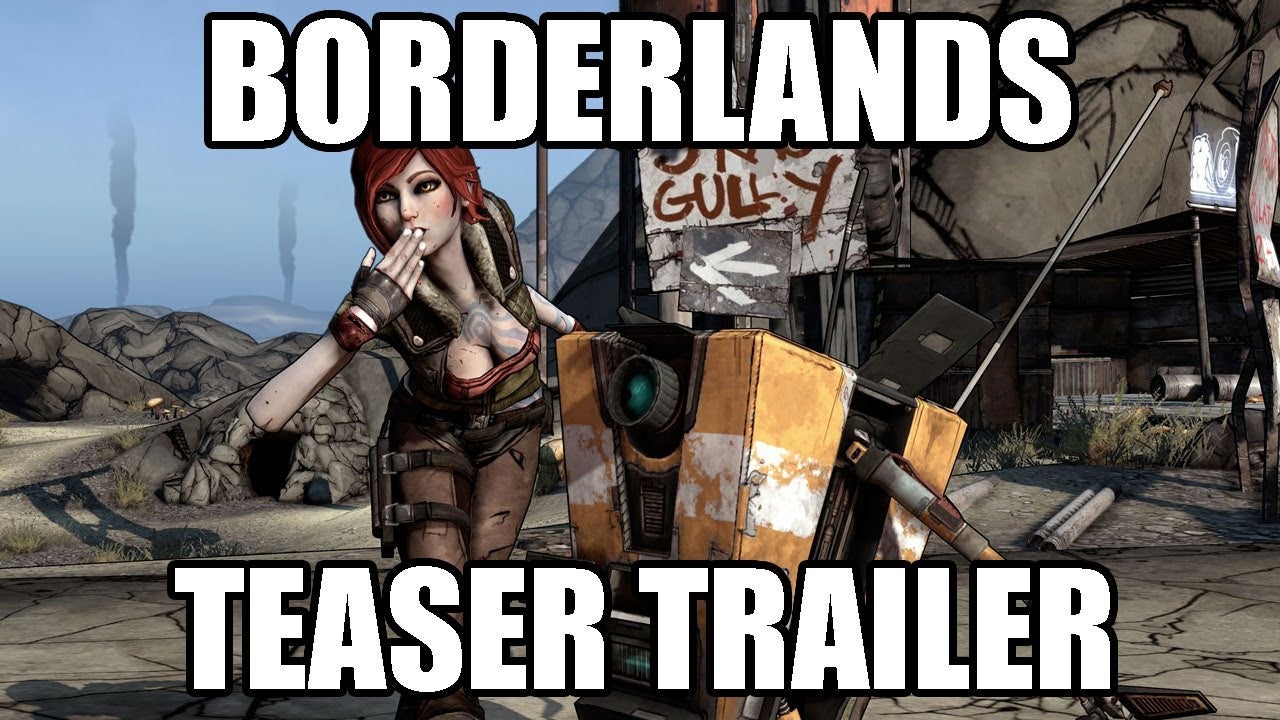
The new art premiered in this teaser trailer:
For inspiration, the developers looked towards the game’s concept art, which depicted a much more visually eccentric game, and the short film CodeHunters
The creator of CodeHunters, Ben Hibon, was both impressed but upset by how closely Borderlands seemed to ape his short, especially since he was, at one point, contacted to work on Borderlands. Here’s what he told Pound of Flesh:
“I was contacted by Gearbox prior to the re-design of the game—in 2008,” said Hibon. “They asked me if I would be interested to direct/design some cut-scenes for them. We exchanged a few emails but the project didn’t materialize in the end. I didn’t think much of it at the time—until I saw the final game in 2009. To be absolutely clear—I have never created or designed anything for Gearbox or Borderlands. Gearbox saw my work and decided to reproduce it—make it their own—without my help or my consent. The hardest part for me when this happened was understanding why they wouldn’t ask me directly. We were already talking about doing some work together—it made no sense.”
Gearbox CEO Randy Pitchord acknowledged the connection to Kotaku in 2010.
For more, I recommend GameSpot’s excellent writeup of Gearbox’s GDC talk.
Team Fortress 2
The success of Half-Life allowed Valve to make bold decisions. One of those included announcing Team Fortress 2 in 1999 and not shipping it until 2007. Over those many years, the game radically changed, not least of which was the art.
Here’s how drastic it was:
Like Borderlands, Team Fortress 2 was featured at E3 in a previous form.
Team Fortress began as a Quake mod, with Team Fortress 2 moving to Valve’s modified version of the Quake engine, GoldSrc. Valve ended up contracting the mod’s creators—Robin Walker and John Cook—before bringing it all in-house.
Per a GameSpot news story from June 1998:
Valve LLC announced last week that it had acquired the Australian developer TF Software Pty. Ltd., the creators of Team Fortress, perhaps the most popular team-oriented multiplayer module for Quake available over the Internet.
Sierra Studios and Valve will be shipping Team Fortress 2 as a Half-Life expansion pack later in the year (after the release of the anticipated first-person shooter this summer).
“We looked at all of the different game platforms we could host TF 2 on,” added Robin Walker, lead designer of Team Fortress 2. “Half-Life’s advanced technology, as well as its flexibility for extensions, with features like client-side DLL support and add-on controllable HUD’s (Heads Up Display), meant we could do things with Team Fortress 2 that wouldn’t be possible on any other system.”
Obviously, Team Fortress 2 did not ship shortly after Half-Life. Being in-house at Valve gave Walker and Cook an opportunity to rethink what the game could be, eventually giving it the subtitle Brotherhood of Arms. The game was delayed multiple times, but when the game was pushed back in 2000, it went dark.
Here’s some footage of the abandoned game:
Nothing would be heard about Team Fortress 2 for another four years.
It’s not as though Walker and Cook were twiddling their thumbs in that time.
Per a Rock Paper Shotgun interview from 2007, after it re-debuted:
Walker: Well, we worked on TF2 a lot. We tried three or four different version of things we called TF2. And we all worked on Half-Life 2 and Episode One. Valve’s a small enough company that everyone works on everything. So it hasn’t been all TF2
They weren’t worried about how long it was taking, either:
The arc of TF2 is something that’s probably familiar to a lot of amateur developers or designers. When we got here the first thing we built was overly complex, very hard core, almost impenetrable to anyone who wasn’t familiar with FPSs in general. And as we found as we played it, wasn’t more fun because of it. I think one of the things we’ve learned as designers over the time we’ve been here is to better preserve our ideas while still making them more understandable. We’re personally very proud that TF2 is the best product we’ve produced at doing this, where we don’t think we’ve sacrificed any of the depths or complexity that we wanted, but at the same time players can sit down in front of it and have fun without really understanding half of what’s going on. Most things that happen tend to be visually understandable at face value.
Though still Team Fortress at its core, the sequel looked vastly different:
https://www.youtube.com/watch?v=h_c3iQImXZg
The original Team Fortress still lives on in the form of a fan-driven project called Fortress Forever, inspired by the original game. It’s also totally free!
I wonder how long it’ll take for Team Fortress 3
You can reach the author of this post at [email protected] or on Twitter at @patrickklepek
That Actually Happened is a weekly series at Kotaku in which we highlight interesting moments in gaming history. So far, we’ve revisited when Sonic kissed a human, a live game show on Xbox 360, and Sony throwing a God of War party with a dead goat. If you have any suggestions for future entires, please let us know in the comments below!