I love being able to come to you with something completely and utterly gorgeous, uplifting, and entertaining. The Beekeeper’s Picnic, a Sherlock Holmes point-and-click adventure, gives us a few hours in the post-retirement life of the great detective, and the opportunity to shape his relationship with an elderly Watson. It’s an uplifting, gentle tale, packed with superbly informed references to Arthur Conan Doyle’s fiction, delivered with a bucolic charm.
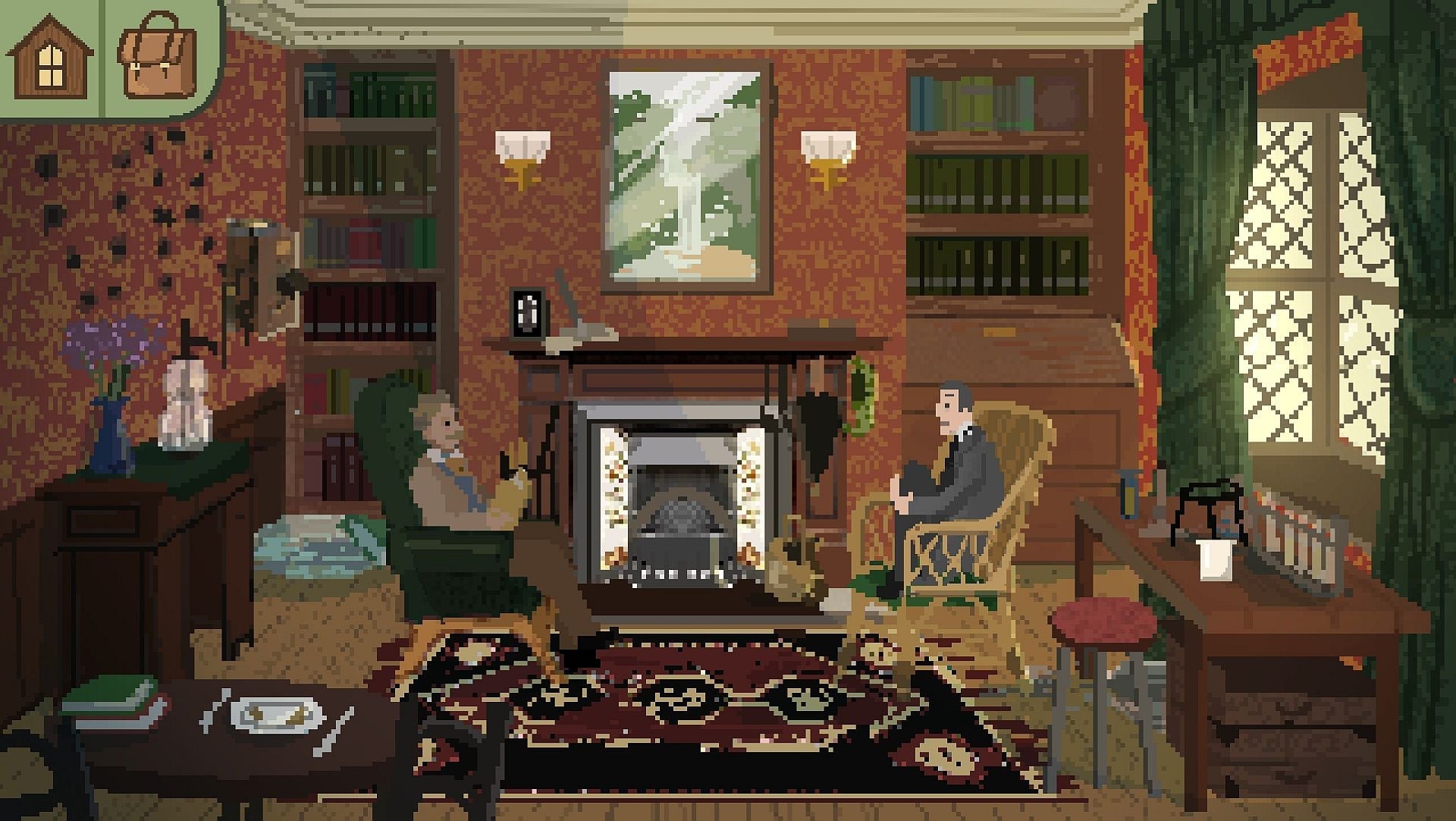
Beginning during the conclusion of The Adventure of the Three Garridebs, in which Watson is superficially wounded by a gunshot, we are soon in the famous rooms at 22B Baker Street, with Holmes trying to find the right words to tell Watson something important. In a densely packed room filled with objects to look at, use, pick up, and even talk to, the opening moments are all about procrastination, Holmes resorting to habit, deducing banalities as he delays informing Watson of his intention to retire.

Buried Treasure Indie Game Reviews
Buried Treasure is a site that hunts for excellent unknown games that aren’t getting noticed elsewhere. You can support the project via its Patreon
As Holmes fans will know, the detective intends to move to the Sussex countryside and keep bees. That’s something Doyle wrote about in The Adventure of the Lion’s Mane, one of only two stories narrated by Holmes himself, and not featuring Watson at all. This isn’t the last Holmes story however, with His Last Bow telling of Holmes and Watson’s spy-based adventures at the beginning of the First World War, but it suggests how Holmes intends to spend the remainder of his life. Enter The Beekeeper’s Picnic
It’s now 1918 and Watson has just returned from the war, where he was serving as a medic on the front lines. Holmes is implied to have continued his work for the British government throughout the Great War, but is now back in his retirement village of Fulworth. He lives with his new housekeeper, the rather fearsome Martha, in the tiny town filled with recognizable references to The Lion’s Mane, like local school The Gables and its headmaster, the affable Harold Stackhurst. Watson has come to stay, and Holmes is greatly relieved to see him. In the years that have passed, as Holmes has aged, he’s begun to regret more and more how he treated Watson throughout their lives, and he seems determined to make efforts to put this right. Primary among them on this day is to organize Watson a picnic, so the two can enjoy some quiet, comfortable time together.
To achieve this, Holmes needs to do all sorts of point-and-click adventure things, like win the best honey contest at the village fete, and find a missing cat in pursuit of some elderflower cordial. Holmes also has his “brain-attic,” where he can pair deductions together on an imagined blackboard, and muse on all the characters in his lives. And as he does, he inevitably stumbles upon a little case: the disappearance of some valuable taxidermized animals from a London museum seems to have some ties to events in the village. What’s so joyful here is that all these puzzles, no matter how contrived they may sound, are all entirely focused on relationships with people. This is a Holmes for whom the feelings of others have finally become relevant, and while he’s unquestionably the same incorrigible master detective, he would rather focus his efforts toward supporting the impetuous actions of children than catching nefarious criminals.
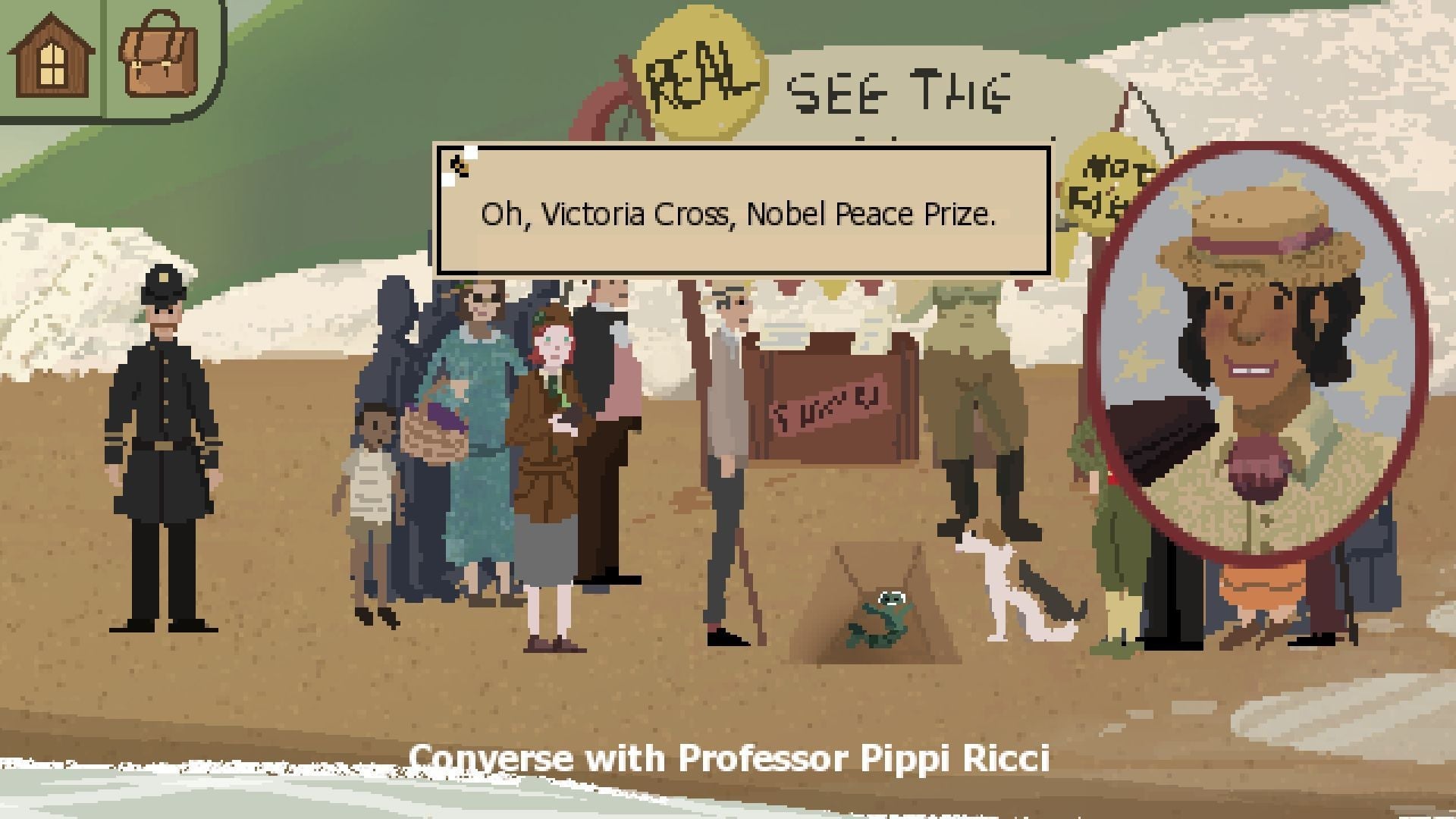
In fact, should you choose, you can invite Watson to the picnic at the very beginning of the main game, and ignore everything else. It won’t go well–the beach below will be unpleasantly noisy, with the crowds gathered to see the purported “mermaid” a shyster claims to have discovered, and there won’t be any food or drink, but the credits will still roll. You can also focus entirely on the picnic, ignoring the various other little stories there are to discover, and it will go to plan…it’s just that Watson won’t praise you for all the differences you made to people you encountered, some of which can be quite moving.
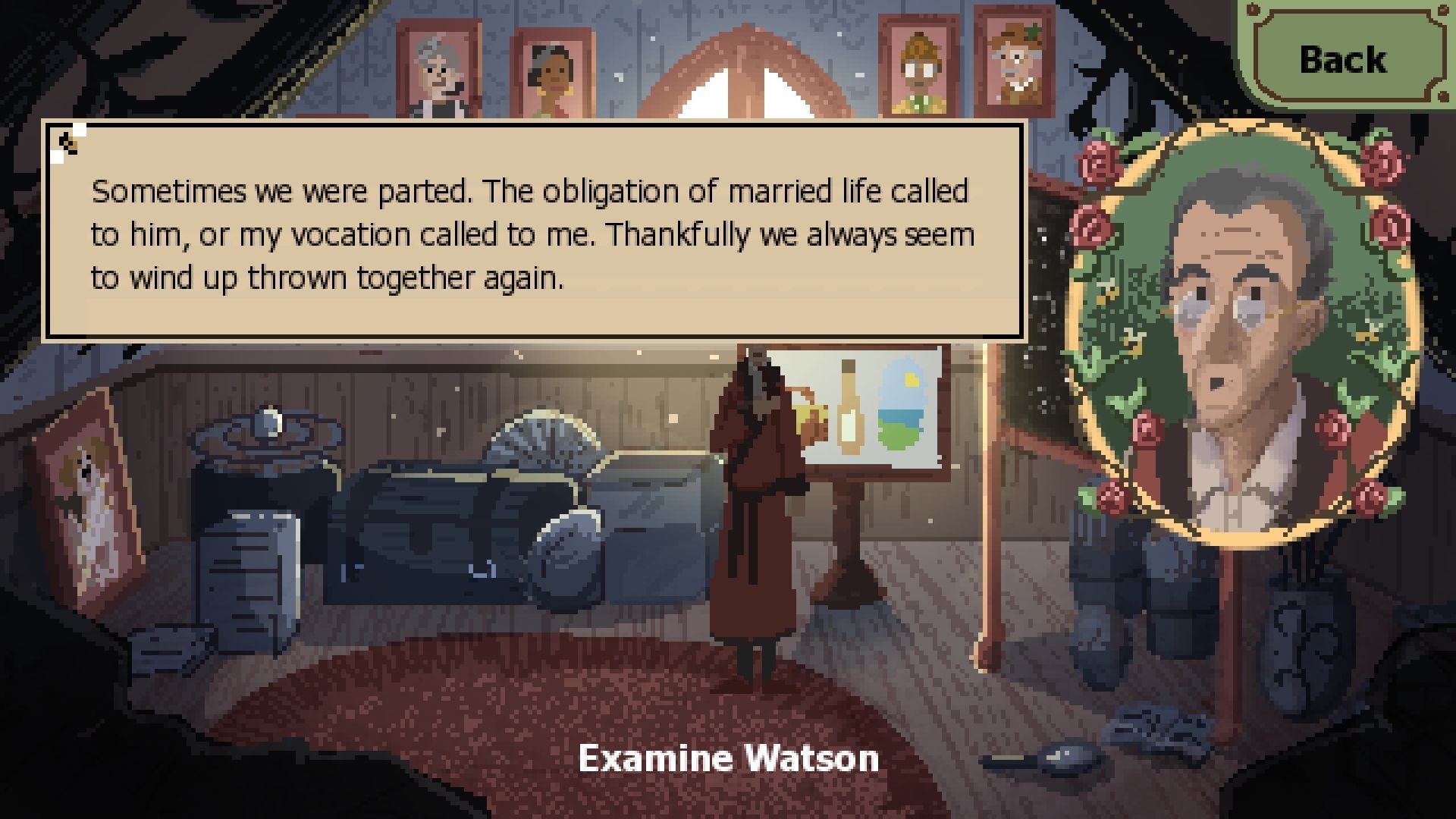
What I’m skirting around here, as does Holmes, is the nature of the relationship between the pair. While people have shipped Holmes and Watson forever, I’ve so often found this crude, and to miss so much of the point. More than anything else, it fails to recognize Holmes as a man entirely incapable of sustaining a meaningful relationship with anyone at all, such is the nature of his pathology and self-interest. The Beekeeper’s Picnic, however, earns the right to probe this territory and suggest that things may have changed, given the many years that have now passed, the effects of the war on both men, and the results of Holmes’ years spent in quiet reflection.
Choosing to start with the denouement of The Three Garridebs is incredibly smart, because it’s really the first time Doyle allowed Holmes to soften enough that Watson would be able to perceive some depth of feeling, before Holmes resets to form in the next story. Facing off against Killer Evans, Watson is shot, and Holmes immediately thumps Evans on the head with his pistol. Holmes checks Evans’ body for more weapons, then guides Watson to a chair while exclaiming,
“You’re not hurt, Watson? For God’s sake, say that you are not hurt!”
Watson’s narration then continues,
It was worth a wound—it was worth many wounds—to know the depth of loyalty and love which lay behind that cold mask. The clear, hard eyes were dimmed for a moment, and the firm lips were shaking. For the one and only time I caught a glimpse of a great heart as well as of a great brain. All my years of humble but single-minded service culminated in that moment of revelation.
It’s within this framing that the game is set, with Holmes’ love for Watson an unanswered question. Even at the start, when Holmes is trying to find the way to tell Watson he intends to retire, the scene burns with a deeper burden he wishes he could share. It’s made very clear once we’re in 1918 that Holmes deeply regrets not saying more, and sees the picnic as a chance to make that right. But, crucially, what that love and relationship looks like is not determined by this narrative–it is up to you, and how you see their connection, and in the game’s final moments there’s no forced imposition of romance. I’ll leave you to discover all the possibilities.
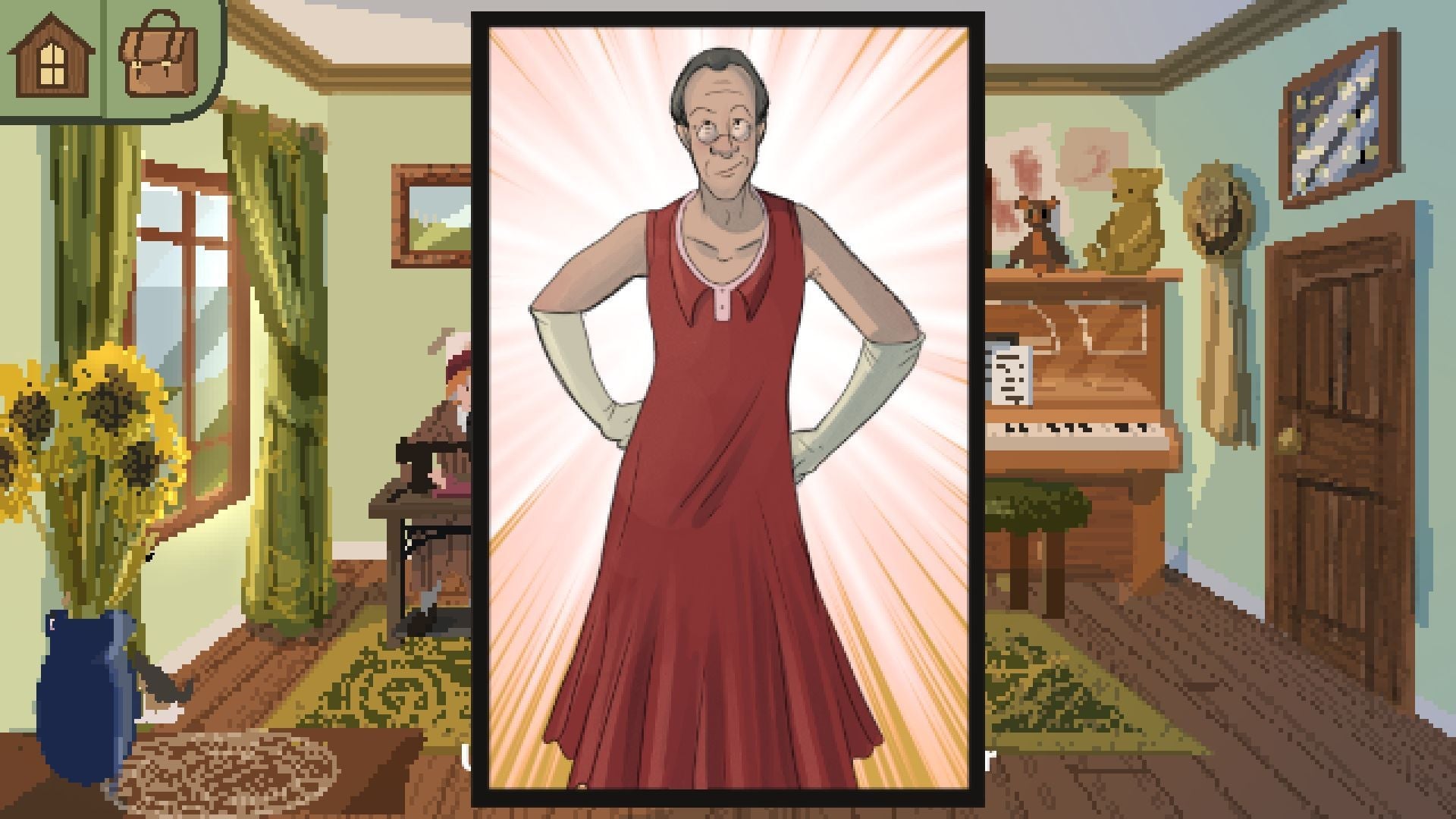
What results is a deeply humble love story, and the nature of that love, whether agape, eros or phllia, is your choice, and really not more important than the existence of that love in any form.
It certainly helps that the performances here are extraordinary. British actors James Quinn and Andrew James Spooner play Holmes and Watson respectively, both with an incredible calm and gentleness. Both characters have been rendered by popular culture as such caricatures that they’re often portrayed as gurning eccentrics, but not here at all. Both are restrained, their performances tinged with a melancholy, and helped greatly because for once a game has cast older actors to play older characters.
They’re not alone. I am astonished by the cast here, given this is an obscure indie adventure drawn in (beautiful, superbly animated) crude pixel graphics, that has not received a single review from the gaming press. Mycroft, who appears as the greatest in-game hint system in gaming history (you can telephone him at the Diogenes for a conversation, and ask for his thoughts on unfinished matters) is played by Game of Thrones’ Maester Wolkan, Richard Rycroft. One minor character, Mrs. Whitlock, is voiced by Alison Skillbeck, an actor with credits going back to 1976, most recently appearing in The Crown. Enormous credit must go to Wooden Overcoats‘ Felix Trench, who plays the game’s most poignant character in a side-story that can be completely missed, but which is heartbreaking and can end beautifully.
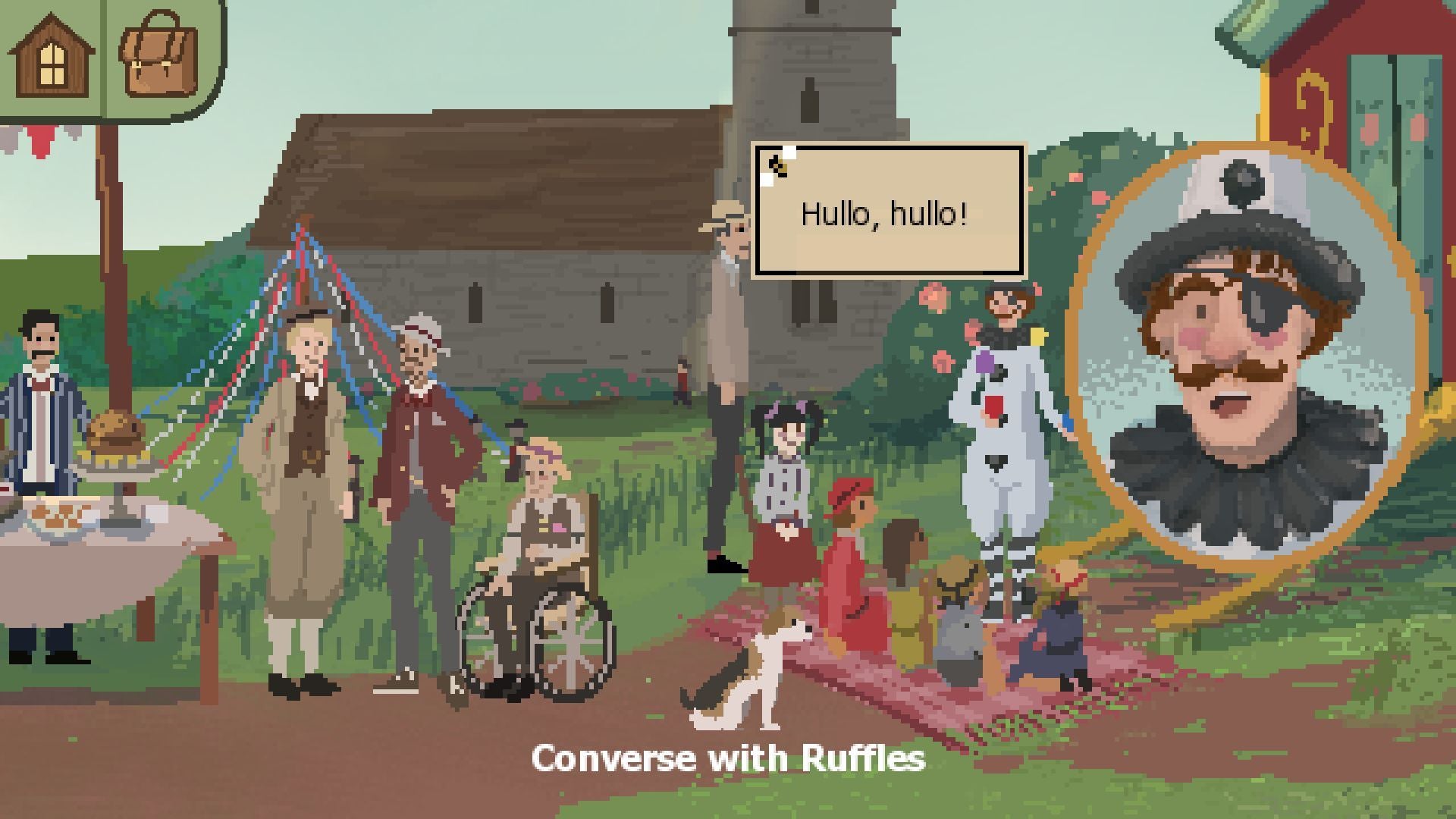
This game is such a total delight. It’s warm, meaningful, and packed with whimsy. (Toby III, Holmes’ new pet dog, can talk, although of course no humans can understand him. A stuffed bear in the background of one small scene can be talked to, too, for a lovely little extra.) Exploring the love between Holmes and Watson could have been so clumsy, but not a foot is put wrong, and the result is so heartwarming and truthful.
I don’t know how this game came to exist, nor how it has gone so completely under the radar. This is, improbably, primarily the work of one person–Helen Greetham. She has written, programmed, and drawn the entire game, and I think legitimately added to the Holmesian canon in a way so much of the post-copyright contributions fail to achieve. This is my perfect ending to the tales of Holmes and Watson, and I’m so delighted to have played it.
You can buy The Beekeeper’s Picnic from Itch or Steam for $14.