For the last week, one thing has been bugging me about the 3DS version of Smash: the controls.
I think, to some extent, this is a question that’s been on everyone’s mind. Does the 3DS version feel good to play? Should you try the game out on the 3DS, or should you just wait for the Wii U version, which will allow you to play with an actual gamepad? After playing the game for almost fifteen hours, I can concretely say one thing: I don’t like how the game handles on the 3DS.
One thing I’ve noted while playing is that the game requires the type of reflexes and input that the 3DS doesn’t seem to handle very well. Playing on the XL, I’ve found that my system will sometimes start creaking, as the frenetic pace of the game takes its toll on the plastic body. This is not something I’ve ever experienced on the 3DS before, and I don’t think it’s because I mishandle the system or anything. Walk into any room with a few people playing Smash on a console, and you’ll probably be able to hear the clack-clack-clack of the control sticks going wild before you even open the door. That’s just the type of game Smash is, and the 3DS doesn’t seem built for it.
The circlepad is an issue, in particular. I don’t feel like I can be as quick or as responsive using the circlepad as I know I can be with a stick on a console. The telling thing for me is that I’ll sometimes try to pick up characters that I’m familiar with, only to find that I can’t quite move at the same speed as I do while playing on, say, Brawl with a Gamecube controller. And the 3DS version of Smash is even faster than Brawl.
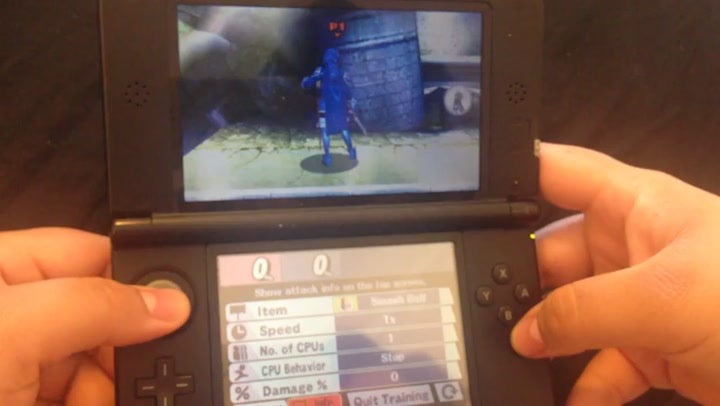
Part of the problem, I think, is that the system sometimes just plain doesn’t record the proper input sometimes: (Edit: I urge you to keep reading after you watch these videos, as the text will delve into why inputting commands faster/flicking isn’t a solution here):
Here’s Stephen trying out the same stuff, as a comparison:
I’ve had lots of issues with my trying to do something basic, like dash or recover, only to have the game fumble on what I’m doing. I’ve also had issues with being precise when it comes to dashing and trying to pick up an item on the map—I’ll often overshoot, or fall short of where I want to stop. Finally, I’ve found some issues when it comes to being consistent with tilt moves. The commonality between all these issues is that they all require precise input from the circlepad.
Now, after watching this video, you may be thinking to yourself—well, your problem is that you’re trying to input movement too slowly. And sure enough, the game’s manual does say you need to flick in order to jump and dash. Two problems with that, though. Constantly flicking on the game means you’re constantly experiencing the gumminess of the circlepad, especially if you’re holding the circlepad in one direction and then changing the direction quickly, which occurs often in this game. At times, I could even feel a very slight click on the circlepad if I was playing too ‘vigorously’ for the 3DS.(Again, this wouldn’t be an issue on a Gamecube controller.)
The second issue is with jumping. Traditionally in Smash, even slight ‘up’ inputs were recorded—no need to flick. Your character will always jump if you press up, regardless of how fast you press it. This is why so many people turned off tap jumping. The fact the 3DS version doesn’t do the same is strange, though it does mean that people who don’t like tap jumping won’t be prone to accidental jumps as much as they might have in previous games.
Part of why I’m experiencing these problems might be linked to the build of the XL itself. The way the circlepad feels on that system is different from what it feels like on the normal 3DS; there’s more resistance on the XL’s pad. In fact, it’s this resistance that could mess me up sometimes—I didn’t show it in the video, but sometimes I’ll flick the stick but not go far enough in any given direction, so the game won’t actually register the command. I’ll hit the dead zone radius of the stick, where nothing is recorded. But it’ll still feel like I’m inputting that direction, because I’m applying so much pressure.
The circlepad on the normal 3DS, meanwhile, is looser, doesn’t require as much pressure. I can see how playing Smash on the original 3DS might be a better experience because of this, but that system appears to come with its own set of problems. The non-XL handheld’s looseness makes it easy to see how someone might completely destroy their circlepad while playing Smash Bros. on the 3DS—you’ll note that most of the systems that have been reportedly destroyed by people playing are the original 3DS model. I don’t think that’s a coincidence. The smaller system feels flimsier, cheaper, not as well-made.
Given how many people I‘ve seen modding their 3DS to work with a GameCube controller to play Smash, I think others feel similarly. There’s a reason people make mods in the first place, and I don’t think it’s some feverish devotion to the Gamecube controller. The 3DS version just doesn’t feel as good to play. Almost everyone I’ve talked to says they’ll experience cramps after playing Smash 3DS for a few minutes, something which, again, does not happen if you play the console version of the game. You can alleviate some problems by making changes to the controls a bit—for example, I found that swapping dodge and shield to be on R and L, respectively, felt better than how the game originally maps those buttons. But on the whole, it’s not the best experience.
We’ll have more a more in-depth take on the game as a whole next week, when we run our full review. For now, though, I can’t help but wish the portable version of Smash Bros. felt better to play.