
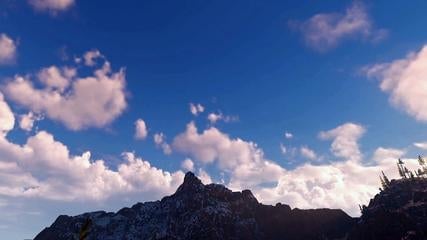
When Horizon: Zero Dawn was announced at E3 by the makers of Killzone, what most people focused on were the big robot dinosaurs. Which, you know…fair enough. But the landscape and skies are bringing something awesome to the table too. Let’s take a look.
Spotted by GearNuke, Guerrilla Games recently posted a huge presentationthat broke down the complicated process undertaken by the developers to create what may be some of the most realistic clouds in video games, period. Behold:
Clouds might seem like a strange thing to care about, especially considering that plenty of games have achieved beautiful skies already. But, it’s not quite that simple.
“[First person shooters] usually restrict the player to a predefined track, which means that we could hand place elements like clouds using billboards and highly detailed sky domes to create a heavily art directed sky [in Killzone],” Andrew Schneider, principal FX artist at Guerrilla Games, wrote on the presentation.
“These domes and cards were built in Photoshop by one artist using stock photography. As time of day was static in the Killzone series, we could pre-bake our lighting to one set of images, which kept ram usage low and processing low.
“By animating these dome shaders we could create some pretty detailed and epic skyscapes for our games.
“Horizon: Zero Dawn is a very different kind of game,” Schneider declared. For one thing, the sky is not static—nor is the world itself. Their goal is to create a living, breathing world, and the sky is a part of that.
“We simulate the spinning of the earth by having a time of day cycle,” Schneider wrote. He also points out that the skies are “a big part of the landscape” of the game, often making up “half” of the screen. So of course Guerrilla Games tried to go all out with its depiction of the, excuse the pun, horizon.
The presentation explains that they tried to make the clouds “realistic,” with “multiple cloud types,” all of which “integrate with weather” and are capable of evolving as you play.
At first, they tried building clouds with predetermined shapes. This sort of worked, but didn’t go far enough. So they sat down and researched clouds further to get a sense of how they actually form and work, as well as how light actually passes through them, which in turn allowed them to create clouds that looked more natural.
This was then meshed with the weather system, which necessitates certain types of clouds for certain types of weather—for example, rain clouds for rain. In this instance, the clouds will actually change depending on the amount of precipitation, which in practice means that you can see them getting darker and heavier as rainfall approaches. Additionally, they built the system so that the skies transition to different cloud types whenever the horizon becomes covered with too many clouds of any particular type. It’s not neccesarily realistic, but was done to maintain a sense of “epicness” in the game.
All of these are small details, to be sure, but it’s fascinating to read about the process involved with creating big upcoming games. Much of the explanation for how Guerrilla Games developed its cloud systems is highly technical, and you can read it in full here, but if you skim through it you’ll learn a bunch of fun factoids—like how they actually used powdered sugar to get a better sense of how to build the clouds.
I’m just hoping that, after putting all this effort into rendering fantastical skies, it will be implemented into the gameplay somehow. Imagine, for example, having to pay attention to the sky in order to hunt more effectively? That would be cool.
If nothing else, the entire thing looks damn incredible, and that’s an achievement onto itself.
Contact the author at [email protected]