Cyberpunk 2077 is out in the wild. After eight long years the whole world can now judge it for themselves, through whichever perspective or tint of glasses they so choose. And best of all, for 99.9% of those players, they won’t ever have to justify their feelings to the rest of the audience.
However, for the last couple of weeks a select and tiny number of people have had access to the game, on PC alone, and since Monday they were permitted to share their thoughts about it. The reaction has been… well, predictable and demoralizing.

The Authority Of Print
There was a time when game reviews appeared to be held in a very different esteem. Back in the ‘80s and ‘90s, paper magazines were released once a month, and keen readers would pore through them to learn all the news and opinions about their chosen medium of gaming. Each magazine would have a Reviews section, in which the team of writers shared their thoughts and feelings about the latest games, and then, inevitably, gave them a score. If they were lucky, something out of 100. If they were unlucky, something out of 10. If they were cursed, something out of 5. It was an inherently silly endeavor, writing detailed opinions, subjectively explaining the nature of the game and its flaws and successes, and then contradicting any notion of nuance with a fixed numerical score. Of course, it was the first thing anyone looked at, and then—in ideal circumstances—they read the words through the prism of that number. Most of the time, people would see a “67” and just turn the page. Despite this, perhaps simply because of the scarcity of alternative information—remember pre-home internet there were no other avenues for gaming information, no TV channels, no mainstream media coverage—the reviews held weight. They had authority
Come the widespread access to the internet and that authority became immediately diluted. Not only could people immediately access a range of alternative scores and opinions, but—more insidiously—they could gather information about the games directly from the creators and publishers. While print gaming magazines had their significant flaws and their (rare) scandals, they were at least a filter between the people who wanted money, and the people who had the money. The internet broke that barrier down, and now the optimistic spin and outright lies of the publishers could reach the players directly.
At the same time, the costs of running a gaming publication disappeared. Anyone could set up a site reviewing games, and all the checks and balances, all the process that ideally filtered out the deceitful, the inept, or the terrible, were mostly removed. No matter how problematic it might have been, when there were just a fixed number of established print outlets there were at least editors, publishers and lawyers between anyone who fancied it, and those who actually got the job. This of course had all sorts of deeply negative results, too. It’s why games magazines were predominantly staffed by white men who looked and sounded like each other. They hired someone else who “fit in,” and as such, it was a homogenous and mono-cultured voice, that while unquestionably represented the majority of the potential readers, simultaneously alienated absolutely everyone else. It also meant that if a bad apple ran an outlet, that outlet would tend toward hiring more bad apples. (Anyone in the industry can point you to a bad era for a particular print publication.) However, with all these flaws, that authority remained, but was soon to go.
The Evil Empire
It was absolutely right that the audience for gaming outlets started to question their integrity and authority, and the internet provided the means and space to do so. I’ve been writing for gaming publications for 21 years, and I have spent that time privately and publicly questioning that integrity and authority, too. I’ve regularly questioned my own. I’m hardly alone. And as a result, bad apples have been more regularly caught and plucked out, albeit and unfortunately in a far more public and cruel way. (I’ve been part of that cruel public, too.) All this was and is great. However, somewhere along the way this process tipped over from a healthy skepticism to conspiratorial lunacy.
While obviously 2014’s “GamerGate” clusterfuck was always at its core about obliterating the voices of women and minorities in games criticism/journalism, the lie of “ethics in games journalism” caught a large number in its wake. This notion that the entire process was institutionally corrupt, run by a cabal of venal shills, went from the silly whispering of the few to a broad outcry of so many. The disenfranchised, the lonely, the rejected and the naive were swept up by the cruel and the crazy, and coalesced around an identity that relied on there being this Evil Empire for them to oppose. Gaming wasn’t broadening its appeal to more people because more people were making games—it was because of the Evil Empire forcing their progressive politics down our throats. Never mind that vastly more of the types of games this audience demanded were being released than ever before, never mind that white dudes holding giant guns still appeared on the boxes of every other game, their culture was being stolen from them, and all the bad, sad feelings inside them were because of Them
It was far easier to believe that the world’s most popular gaming sites were all in it together, conspiring against them, pushing their agenda, than to accept the world’s scariest force: change. To anyone in the industry, this concept was so laughable. Let me tell you a secret. We all scrutinize each other. Honestly, if the angry mobs saw how one outlet talks privately about another, they’d abandon that conspiracy faster than a pool as a shit floats by. There was, apparently, a mailing list in which some writers chatted amongst themselves—no one ever invited me, so I’ve no idea what they said. How rude. I’ve seen stories of some bad ideas being proffered in there, but then shot down by wider consensus. But I’d bet my bum there was a lot less, “Let’s all give Shooter XVII 2/10 because it doesn’t feature enough people with dyslexia,” and a lot more, “Can you believe what Brian Gameshack wore on that video?!” And more sensibly, I’d imagine a lot of writers sharing information that enabled people to better report about the lies and nonsense being said by the publishers. Yet, despite this, trust me—and I know some won’t: no one is holding this industry more to account than itself.
The irony of this is, of course, that no one better knows and cares about the flaws in the games journalism industry than games journalists. (For the record, personally I avoid the term “games journalist”. There are many writers very worthy of the title, a lot of them on this site, but I call myself a “games critic.” Still, “games journalist,” it’s the understood generalization, so I’ll use it.) Where the furious crowds still to this day let me know that I’m in the pay of publishers, or only saying things so I can have sex with a developer, or whatever ludicrous nonsense they imagine, I’m one of the loudest voices within this industry, yelling at sites and writers to hold themselves to higher standards. And the most miserable thing is, it’s generally the sites that deserve the most vitriol that receive the most defense from these baying mobs of furious games players. It’s the well-managed, truthful, well-intentioned sites that receive the vast majority of the conspiratorial hate.
So 7/10?
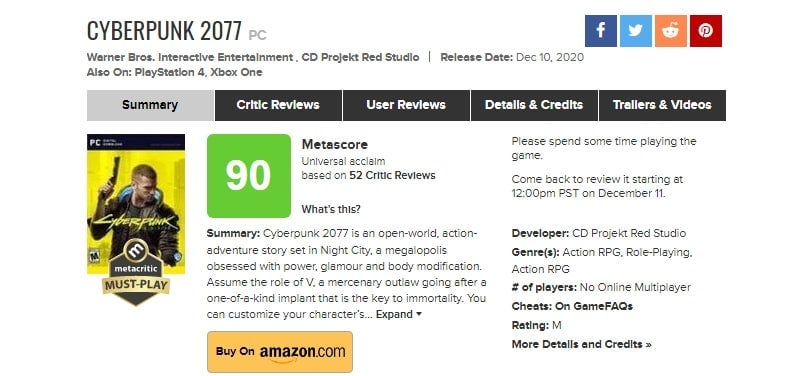
So what has all this to do with Cyberpunk’s scores? Well, everything. Because this breakdown of barriers to entry, plus the breakdown of trust, is what leads to the utterly ridiculous situation where a game so bug-ridden and flawed that many outlets just refused to review it yet, has been handed out 9s and 10s like confetti. And it’s also why any site that attempts to say anything other, score accordingly, is then subject to unbearable volumes of abuse. Then on top of both, you’ve got an audience that increasingly just doesn’t want reviews to exist in the first place.
Why sites hand out 9s and 10s for bug-ridden games is up for grabs. Some may just think bugs aren’t important to their valuation. Many have completely different priorities when assessing a game. I know from personal experience that when reviewing a huge game with a lot of expectations around it, it’s too easy to get caught up, to enthusiastically slap on that giant number, only to regret it later. I’ve done it, in the most embarrassing ways, right on the front cover of a magazine. As a result I’ve since become extremely hardened to such things, and got very used to seeing my score at or near the bottom of a Metacritic rundown. Scores that, once the initial period of hype was over, would far better stand the test of scrutiny.
Then you’ve got the few more-established large-scale sites. The ones with history, long-experienced writers and layers of editorial oversight, that—when everything works—provide the security and confidence to ignore the crowds and write in isolation. Clearly any newer site can eventually reach this place too—and clearly new sites often have a valuable, fresh take to add. It’s the insulation of the bigger sites, though, that helps you get a PC Gamer score of 78, and a Gamespot review that gives the game a very reasonable 7/10. Which is then responded to by a significant section of the audience as an affront of the game worthy of a public uprising. (To dignify the stupidity of the argument made by certain blowhards on YouTube with a point-by-point response would be too much, but when someone says, “I never felt any need to do X,” while they spend 50 hours playing a game, that’s a valid criticism of the game, not a failure of the reviewer. They are not play-testers, required to establish the efficacy of every system in the game; they’re people playing, responding, and writing about their own experience.)
Of course, another interesting phenomenon has occurred in the last few years: sites losing scores altogether. Major review sites have realized they’re not beholden to this demonstrably silly constraint, and the writing conveys the information in a far more useful way than a fixed number at the end. So we’ve recently seen sites from Eurogamer to Polygon dropping the practice altogether, alongside sites like Kotaku and Rock Paper Shotgun (that I co-created) that never assigned them in the first place. The result of this is a large number of the sites that would have given more reasonable, sensible scores to a game with as many issues as CP2077 just don’t give scores at all, and the Metacritic number just keeps climbing higher.
As a result, those lower scores (and remember, we’re talking about 7s here, not 4s) appear to stand out even more, appear to go against some perceived consensus. It’s more “proof” that there’s an “agenda,” look how those sites don’t align.
The Mirror Universe
Of course, the far bigger issue is that a loud proportion of Cyberpunk 2077 purchasers (and indeed any other big-name game) don’t want reviews at all. They want reassurance. They paid for this game nearly two years ago, for whatever illogical reason (“I’m supporting the massive multi-million dollar company!”), for no gain, no extra content, no early access, no bonus items, and they want to know they did the right thing. And, for some, paying for a years-away game is just the start of the sort of self-imposed brainwashing that causes someone to switch from being A Person Who Pre-Ordered A Game They Want To Play to being A Fan. They’ve not only irrationally invested money, but since then have been investing their emotion. They’ve read everything they can find to read about it, hooked up to the PR drip-feed of information that comes both direct from the publisher and the compliant sites that report it all to their readers. This emotional investment mutates into a form of loyalty, a belief that they are now on the game’s side, and a slight against the game is now a slight against themselves.
So what is a review other than a criticism of their own loyalty, and financial and emotional investment? If the review is suitably rhapsodic, then they too are vindicated and praised. If a review steps even slightly out of line, even vaguely critiques aspects of the product, then it’s a personal attack. It’s wounding.
That’s at its most extreme, and for the last week I’ve been the oh-so fortunate recipient of a deluge of hate and rage—called everything from “cunt” to “pedophile”—from fanatics of a game they’d not yet played for my perceived failure to be appropriately euphoric about a publisher. A publisher that has, over the years, threatened its own customers for alleged piracy, went back on promises to not crunch its staff, tweeted out awful jokes, and had staff learn of crunch-extending delays via Twitter. (Of course, the external observer might say it’s a good sign when a member of the gaming press holds publishers and developers to account. How naïve they are. In the mirror-world that we now live in, it is in fact a demonstration of “corruption” to do so.) But even farther from those extremes, there’s still a sense of dissatisfaction amongst so many of a game’s potential players when reviews contradict their hopes.
This leaves us in a place where the desired purpose for a review, as prescribed by those most likely to leave feedback in some form, is to reflect the wishes of the reader. Deviation from this is failure, and most likely evidence of some form of foul play.
Which is really quite some distance from the days of a print magazine’s review.

A Group Of Strangers
So are genuinely critical reviews therefore out of date? An old concept, an anachronism that a select few outlets still persist with against all sense? Absolutely not! There’s still a huge audience out there for them, just as there was in the ‘80s and ‘90s. The thing is, they don’t feel a need to respond. They are the vast, vast majority of the outlet’s readers, the people who know a game is coming, are waiting to see if their preferred critics think it’s worth their spending their money on. And no, they’re not representative of the majority of a game’s customers. Most people will wait to see what their friends think, or buy it because it looked cool in the ads on the side of the bus. Most game players are nothing like what “gamers” think they are like. Most people buy a game, play it, and never feel the need to tell a group of strangers anything about it.
But a large proportion, making up the millions of people who visit particular reputable websites, they still want reviews. They still read them. We, in this job, are told incessantly by nasty, vindictive people on Twitter that our sites are “dying”, that “no wonder no one reads your site any more”, that we have “turned on our readers,” that we “hate” them. It’s what they want to be true. It isn’t what’s true. When I sold RPS in 2017, and thus the last time I can report on its audience figures, it was more popular than it had ever been before, with more organic readers (this was before the site started all that SEO business we were too lazy to do before the sale) than ever, and made more money per year than at any point in its history. All its graphs were curves that continuously climbed, and the events of 2014 or any other time since made no impact whatsoever.
We were hated and blacklisted by some publishers, sort of tolerated by others, and so far removed from being in the pay of any of them. (And because someone will say it, we set up our own internal walls so we weren’t at all involved in who might advertise with us, and their ads appearing were as much of a surprise to the writers as anyone else. I once cost RPS £28,000 in ad money after a review I wrote caused a childish, petulant publisher to pull a campaign, so much was the flow in the opposite direction.)
Most people don’t give a shit about any of this! Most people just read about games they’re interested in, and play them without feeling a need to write the developer into their will. Most people aren’t aware the controversies exist, and wouldn’t care if someone tried to tell them. There is, however, a very, very large number that cares an unhealthy amount, and make our jobs much more exhausting, their parroted and always baseless accusations of corruption like tiresome gnats to endlessly waft away.
There’s a significant proportion of that number that go far further, and attempt to destroy the lives of anyone who they decide has crossed them—almost always women or minority writers. These mobs think they represent the audience, the masses, and it’s just yet another conspiratorial delusion amongst so many. And now, as they wrestle with the fact that CDPR deliberately kept any reviewing outlet from getting console code before release in order to hide what a dreadful state it’s in, as they try to rationalize this as either a good thing, or the fault of someone else, their anger will grow and their lashing out will continue to seek exactly the wrong targets. But as they do, the vast majority of games players will never hear a single thing about it. And most readers will be glad of the reviews that warn them of the potential issues.