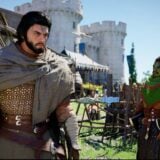
The sad tale of the closure of 38 Studios and Big Huge Games and the cancellation of the Kingdoms of Amalur becomes even more tragic with each new scrap of information on the massively-multiplayer game. That’s why author R.A. Salvatore explaining the story behind the game at DragonCon earlier this month made me so melancholy.
Joined by Kingdoms of Amalur: Reckoning lead designer Ian Frazier at the packed panel on Sunday morning of the convention, the bestselling author and creator of the popular Dungeons & Dragons dark elf popular character Drizzt Do’Urden explained how the single-player experience that we can play tied in with the MMO we probably won’t.
In Reckoning, the player begins the game by being killed and subsequently resurrected via the Well of Souls, a magical phenomenon capable of bringing the dead back to life. The player’s rebirth was a fluke — a one-time success in a long string of failures to conquer death.
Several thousand years the magic is perfected, and a Gnomish engineer activates the Well of Souls for everyone on the planet. Suddenly death is no longer a thing.
It’s both a practical MMO mechanic and a major hook in the story. “In an MMO the fact that you have to accept is that when you die you come back,” Salvatore explained to the packed room. “Because if you spend $100 million making an MMO and people die and they stay dead, then you’ve lost $99.9 million in a hurry,” he continued, adding a nod to the financial issues that caused the game to be shelved.
Salvatore saw the game mechanic as a chance for storytellers to take storytelling to the next level.
“You have to come back from the dead — that’s level one, every MMO has it, whether you spawn naked in Freeport and have to do a corpse run,” the author continued, referencing one of the original EverQuest‘s finest and most punishing features.
The second level is giving the name to the mechanic, in this case the Well of Souls. “Big deal, anyone can do that.”
The third level is exploring the why. “Why is there a Well of Souls? This didn’t just happen. It took the better part of 5,000 years to happen,” Salvatore said. “That was the thing that was going to start the MMO — the Well of Souls becoming active.”
And the final level?
“What does it mean to the societal structures of the world when all of the sudden you’ve got immortality?” the author asked. It’s one of those deep questions my generation would ponder back when it was in its late teens, the party dying down and the munchies running out. “The obvious answer was everybody’s going to be happy, we’re all going to live forever!”
But it’s not so simple. Population, for one thing, doesn’t stop growing. The world becomes more and more crowded.
Salvatore wanted to take it a level deeper still, exploring the ramifications on a more personal level. “What does it do to the leader of a church whose entire power base is predicated on promising you an afterlife?” Suddenly the churches are no longer needed. How does that effect the moral structure of a society?
“What about the old lady whose lost her husband and children.” Old and broken down, she’s looking forward to dying and seeing her family again. “Does she want to live forever? Does she want to go through the Well of Souls? What about the emotions of the last people that lost a spouse, mother, husband, child or best friend before the Wells became active?
“This was the philosophy of Amalur. When you did something that was going to have implications you had to explore those implications,” Salvatore explained. “Instead of giving me a quest series to go collect 11 rat ears… give me the quest about the woman that doesn’t want to go through the Well but her family wants her to. Give me the quest about the bitter person that’s trying to get back at the Gnome who she thinks created the Well of Souls in her town because her son died before. Give me those kind of quests. That’s what we were trying to do.”
It sounds like exactly the sort of game I would have loved playing. The IP is currently in the hands of the state of Rhode Island, and while it is for sale, the teams that worked on it have (hopefully) all moved on to greener pastures.
“We’ll see,” concluded Salvatore. “Without the engineers, without the designers… we’ll see.”