If you ever need a reference point for how ferocious – and some would argue unnecessarily so – Zelda fans can be about their beloved franchise, one need only look at a public showcase Nintendo held in the year 2000.
For a few years between the mid-1990s and early 2000s, Nintendo decided against revealing major new hardware and software launches at established trade shows. Instead, it held irregular events called “Space World”, where rather than jostling with other companies for the limelight Nintendo could have the media’s attention all to itself.
One such event was held in 1995, and would become famous for giving the world its first look at two upcoming Nintendo 64 classics: Super Mario 64 and The Legend of Zelda: Ocarina of Time. Another, held five years later, would become famous for something a little different.
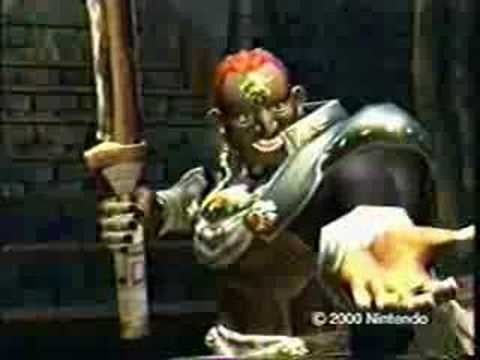
At the 2000 Space World, Nintendo was again showing off a range of upcoming games, this time for its yet-to-be-released GameCube console. Titles like Luigi’s Mansion and Metroid Prime were in attendance, but the star of the show was a short look at what was assumed to be the next major The Legend Of Zelda release.
Featuring the same character designs as Ocarina of Time, only with major graphical enhancements, the short demo was only ever intended as just that: a demo. As many companies do when showing off new hardware (and Nintendo did a lot of it when revealing the 3DS, for example), it was merely a technical demonstration. It never had a name, never had a release date and was never advertised as an actual product.
That didn’t stop people from going bananas. For its time, the demonstration looked amazing, the dark lighting, detailed character models and frantic action leading many Zelda fans – who were now a lot older than they had been when the series first began – to presume that the GameCube’s Zelda would be as “mature” as many of them felt they had become.
Gaming site IGN, in attendance at the event, wrote that despite knowing “the entire presentation was literally thrown together by Miyamoto and teams at the last minute”, the demo “can only be considered the unofficial sequel in the Legend of Zelda franchise”.
The thing is, it wasn’t. And a year later, the shit hit the fan.
At Space World 2001, Nintendo showed off an actual Zelda game. One that was actually going to be released. And it looked nothing like the 2000 demo.
That game would eventually be labelled The Legend Of Zelda: The Wind Waker, and for years, it would be the subject of scorn and derision from certain elements of a fanbase who felt they had somehow been betrayed
While the 2000 demo was dark, which many mistook as being “mature”, it had led to months of speculation entrenching itself as fact that the next Zelda game would be one for a more adult audience. The Wind Waker was, at first glance, definitely not that game.
Featuring the kind of bright, cheery visuals you’d expect from a Saturday morning kids cartoon, it was instantly and cruelly dubbed “Celda” by many fans, in reference to the fact it employed cel-shaded visuals. Dismissing the game without ever having played it, and assuming it would be a game for “kids” without ever having played it, showed that many of these “mature” Zelda fans were nothing of the sort.
This reaction got under the skin of Zelda creator Shigeru Miyamoto, who said at the time he was “startled by the response we got from the press when we showed it off the first time”.
“They all said, ‘Oh, so is Nintendo now taking Zelda and trying to aim it only at kids?’ Because, really the whole concept we had behind it was that we thought it was a very creative and new way to show off Link. All the sudden it had been interpreted as Nintendo’s new strategy, and that was a shock for us.”
“When it comes to Nintendo strategy, it’s not that we want to make games for kids. It’s that we want to make them creative while appealing to a wider audience. Obviously we see games as entertainment, and what we want to do is find the best way to make the gameplay experience entertaining for everyone.”
Upon the game’s release in 2003, critics were quick to move beyond this initial knee-jerk reaction, and the game received wide-ranging praise for its amazing graphics and unique, “open world” take on the Zelda universe. Yet many fans simply couldn’t move past the fact this game was not the one they believed they’d been promised three years earlier.
Despite a recent “renaissance” in public opinion for the game, brought on by the continued use of its visual style in handheld titles and a recognition that The Wind Waker was at the end of the day a pretty fantastic game, it’s never seemed to be able to truly shake the stigma of the great Space World switcheroo.
And that’s a damn shame, because when you get past the game’s visuals, Wind Waker is arguably the most adult Zelda of all. For one, it’s taking place in what is essentially a post-apocalyptic Hyrule, the ruins of everyone’s beloved fantasy kingdom sent beneath the waves in a cataclysmic event, the few survivors left scrabbling for an existence atop a rocky outcrops or on the ocean itself.
Also, not only does Wind Waker have the scariest enemy to ever feature in a Nintendo game (more on that tomorrow), but its ending features a scene of such graphic violence that it’s a genuine shock when its first encountered.
We’re well past the point of needing to call for a re-appraisal of Wind Waker. As I said above, most people managed that a number of years ago. What makes looking back on this sad affair interesting, then, is how it so clearly shows what’s both so great and so tragic about Zelda fans, who can love a game so much they guard its legacy with fury, yet at the same time love a game too much, and embarrass themselves in the process.
Stay tuned for more stories like this throughout the week, as we continue to celebrate the 25th anniversary of The Legend Of Zelda
https://lastchance.cc/happy-25th-birthday-the-legend-of-zelda-5765780%3C/a%3E%3C/p%3E
Total Recall is a look back at the history of video games through their characters, franchises, developers and trends.