The world is a confusing, messed-up place, but as I sit here at my laptop contending with my humanity, I’m absolutely sure of two things: My stomach hurts like hell, and I’m tired of Daniel Mullins’ shenanigans. The former, I assume, is the result of some bad carne asada, while the latter occurred to me several hours into my playthrough of Inscryption, the latest meta experiment from the guy behind Pony Island and The Hex
Since first making a name for himself, Mullins’ penchant for infusing his projects with M. Night Shyamalan-style twists and turns has made him into something of an indie darling. And while this is thanks in part to the video game industry’s largely unimaginative mainstream market helping anything slightly more ambitious than the latest Call of Duty look like a masterpiece in comparison, there’s no doubting Mullins’ unique ability to push the medium’s interactive storytelling into unknown territory.
I bring up Shyamalan because I see echoes of his professional trajectory in Mullins’ own career following his 2016 debut, Pony Island. Just like Shyamalan put himself on the map with 1999’s The Sixth Sense, a supernatural thriller whose climactic revelation that the protagonist actually died in the movie’s opening home invasion scene still hasn’t lost its luster after all these years, Pony Island’s more-sinister-by-the-minute story about a haunted video game enshrined Mullins as someone to watch in the indie dev scene.
And, for better or worse, these early successes still inform both artists’ work today. Shyamalan can’t seem to write a movie these days without some sort of left turn in the plot, while the two games Mullins produced after Pony Island have been full to bursting with the same meta-level revelations as their predecessor. That’s not to say both men aren’t compelling and talented artists in their own right (I will defend Lady in the Water to my dying breath), but for the most part, you know exactly what you’re getting into when you sit down with one of their creations.
 Thankfully, Inscryption—released last month on Steam and GOG—never wastes your time by pretending to be anything but another entry in Mullins’ Menagerie of Meta Mindfucks. My first time booting up the game, the main menu greeted me with several options: New Game, Continue, Settings, etc. Except, wait a minute, New Game is grayed out? And the only way to begin is to select Continue? Well, that must mean someone else played this copy of Inscryption before me! The mind reels.
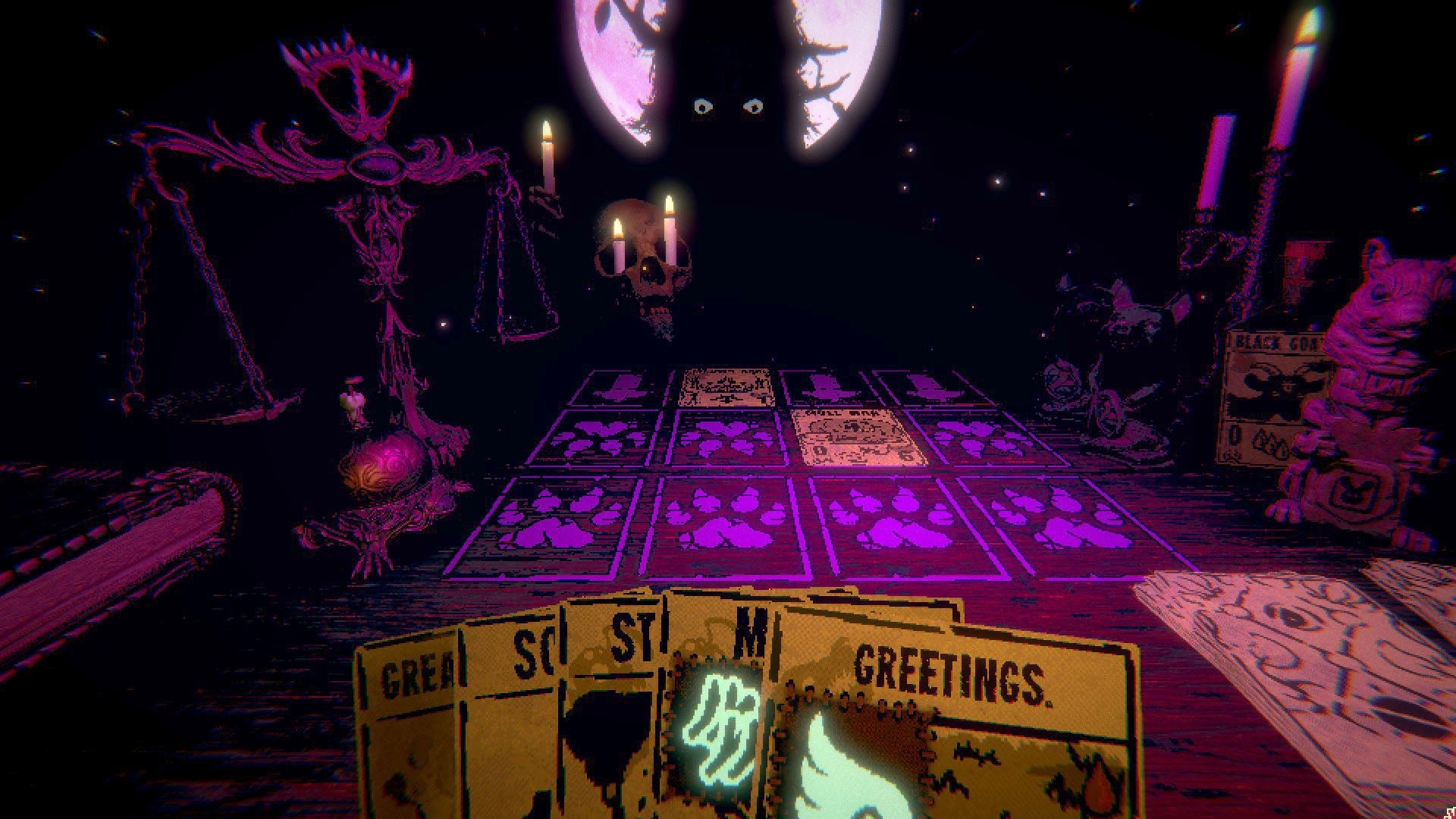
What follows is largely the same game seen in Inscryption’s pre-release marketing. You’re trapped in a cabin and forced to play a rudimentary, wildlife-based deck-building game against a shadowy figure. You traverse a branching map akin to 2017’s Slay the Spire and start over from the very beginning when you die. Every so often, you’re allowed to stand up from the table where the game plays out, explore the cabin, and solve puzzles that unlock new cards and items that carry over into subsequent playthroughs.
This is the Inscryption with which I initially fell in love. Sure, the card game is pretty simplistic and easy to break as you’re given better deck-building material, but alongside the roguelike genre’s ubiquitous “one more try” appeal, the claustrophobic atmosphere and foreboding narrative were enough to keep pulling me back to the table. But, as many folks correctly assumed before Inscryption launched, this cabin setting soon falls by the wayside as the game boldly marches into subsequent chapters.

After defeating your tormentor in an elaborate fashion that would make absolutely no sense without several more paragraphs explaining the first chapter’s dense yet ultimately unimportant lore, the “New Game” option on Inscryption’s main menu unlocks. It’s around this point you also learn that what you’ve been experiencing is actually gameplay footage recorded by someone who found coordinates to a buried floppy disk containing Inscryption while opening booster packs for a physical card game of the same name.
That’s right: Inscryption’s protagonist—and by extension you, as the person playing Inscryption—is a YouTuber. It is described as a horror game on its Steam page, after all.
Inscryption then shifts dramatically. Upon finally starting a New Game, you’re plopped into a 2D, pixel art world reminiscent of the 1998 video game adaptation of the Pokémon Trading Card Game. Your goal here is to defeat four Scrybes, each with their own unique mechanics. Where the game in the cabin focused on sacrificing cards and sometimes even using the bones they left behind to summon stronger monsters, Inscryption’s second chapter doubles the mechanics with an energy meter and gems, both of which also dictate when and where you can and should place cards on the playing field.
Sadly, this ruleset expansion comes at the same time Inscryption becomes far less compelling narratively. In establishing a story outside of the game itself, it cheapens the whole experience by turning it into the type of alternate reality game mystery we’ve seen so many times before. It’s funny that Inscryption leans so heavily on its content-creating main character in the second and third acts, because the whole game feels explicitly designed to cater to the cottage industry of “X Ending Explained” channels on YouTube, the result of that early 2010s flavor of internet storytelling that treated plot like something to be solved rather than a vehicle for a central thesis or emotion.
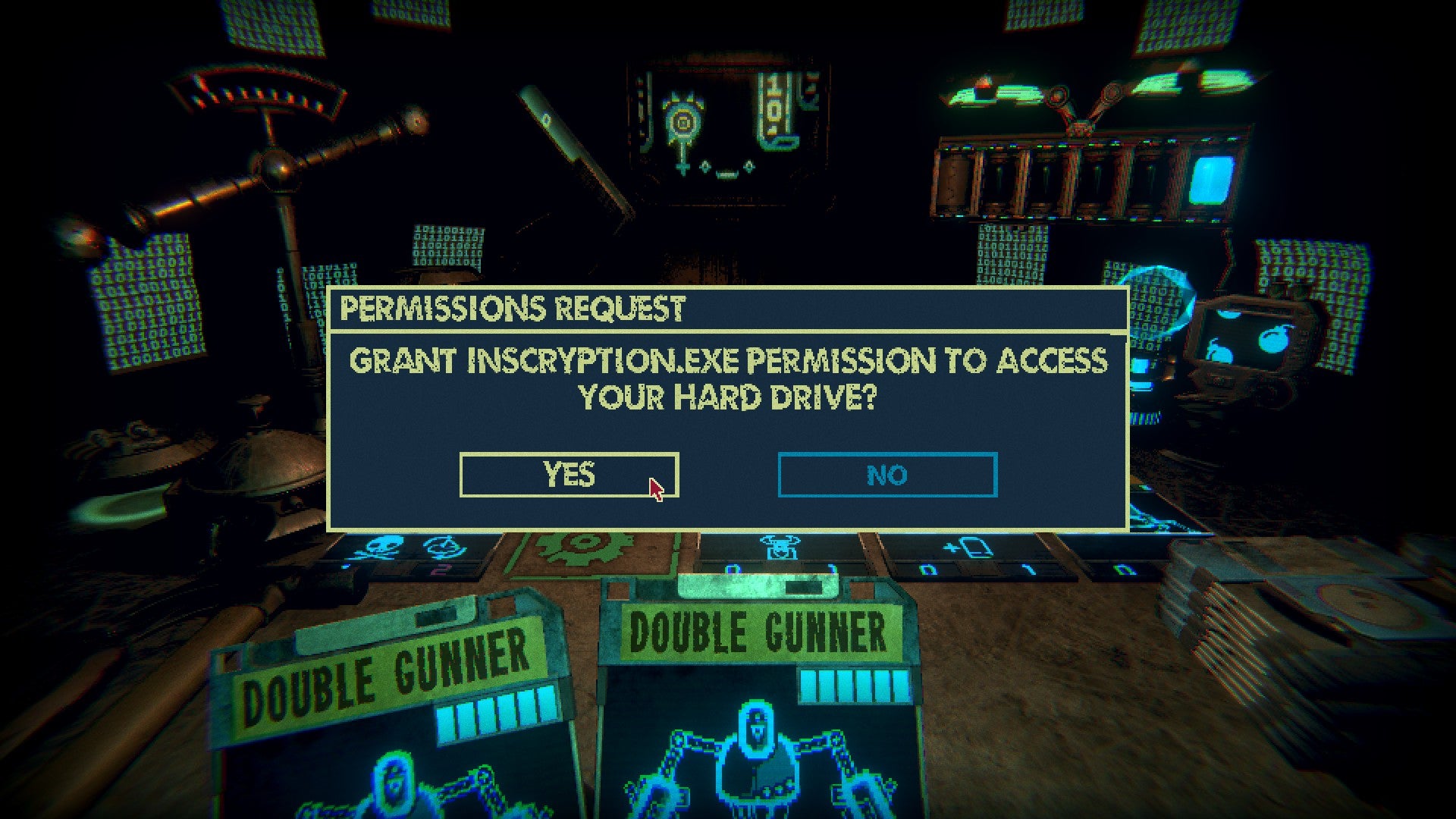
Inscryption eventually returns to the escape room escapades of its first chapter—this time with a robotic captor and a more grungy, sci-fi aesthetic—but at that point, the game had well and truly lost me.
Of course, that’s not to say it doesn’t keep doing Cool, Meta Things. One of my favorite moments in the whole game came when I was asked to use actual files on my hard drive as cards, and was threatened with their deletion should they be defeated. The underlying mechanics also remain super fun and engaging right up to the end, despite strategy becoming less and less important as the game lazily feeds you beefier cards. It just no longer felt like Inscryption cared as much about highlighting these bright spots as it did getting to the next part of the laborious story.
As a video game, Inscryption is constantly reinventing itself. I’ve generally grown weary of deck-building roguelikes, but the way in which its mechanics iterated across the three, distinct chapters was a genuine joy. That said, the card game at the heart of Inscryption eventually feels like an afterthought, packaging for a separate, wholly less charming alternate reality thriller. And reaching the end of the contrived “evil corporation puts out a scary game that’s grown sentient and wants to replicate itself via Steam” storyline required succumbing to a sunk cost fallacy that obviously didn’t pay off.
If Inscryption had only stayed in that dank, dreadful cabin and expanded on that experience, I probably would have walked away feeling like it was a decent use of my time. But as it stands, the game is merely a cliched experiment dredged from the same shallow pool as the internet’s most contrived, YouTube-baiting pseudo-mysteries.