For the sake of making their games more realistic, video game developers have done extensive research on all sorts of random or mundane things: parasitic fungi, game theory, gun sounds, paleobotany, and breast physics are just a few. Some of these subjects no doubt required expert commentary, academic research, and a genuine dedication of time and resources. Others might have simply required a cursory Google search. Here is another topic—arguably more important than all of the ones listed above—that could be improved by any level of research: how to respectfully include queer people and cultures in video games.
There’s no shortage of video game analysis either guided by or outright focused on queer theory. There are entire TV Tropes pages, sharp, intelligent opinion pieces, and heartfelt personal accounts by queer people. They shed light on better ways to show queer lives, ways that developers have messed up, ways that developers could do better, and ways that consumers are complicit. In short, there are resources for developers to do better—all a click or a phone call away.
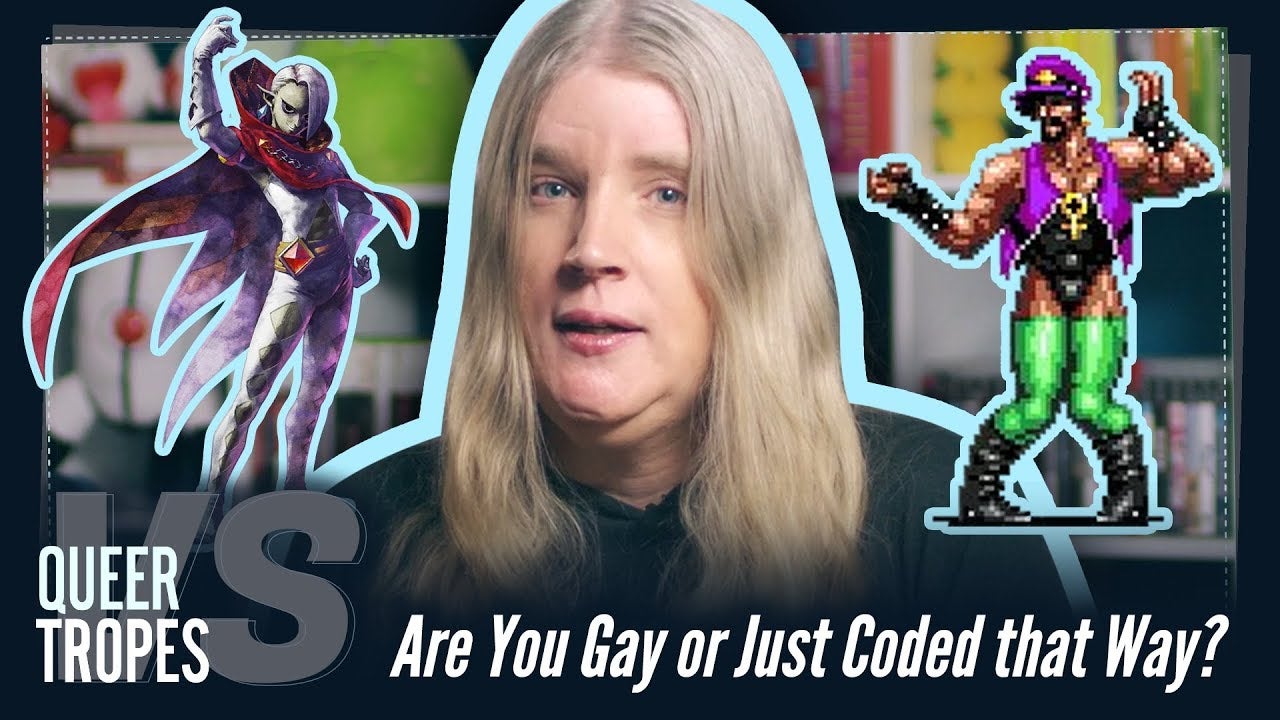
I’m loath to admit this, but I found myself feeling a very familiar exhaustion when I first heard about Feminist Frequency’s new Queer Tropes miniseries, released today, hosted by Carolyn Petit. It’s not because I disagree that there are glaring and continual issues of queer representation in video games—it’s clear that there are, and the miniseries points out myriad examples, old and new. As someone with skin in the game—nonbinary, bisexual, genderfluid, LMNOP—and someone who also critically studies media tropes, I don’t discount the importance of having these conversations. But there was one thought that prominently came to mind when I first heard there would be a new video series on the topic:
“Again?”
This isn’t, per se, an issue with Petit’s work, which is thorough and thoughtful. The videos use examples—many of them regularly cited, some more obscure—to highlight common themes, design choices, and character archetypes in video games. The first video is a dive into queer-coded villains and a critique of the way their queerness is often conflated with their villainy, with examples like Dead Rising’s Jo Slade and Skyward Sword’s Ghirahim. The second is a look at the relative lack of viable queer romance storylines in video games. The third is a broad look at games that encourage players to be complicit with homophobia, either via gameplay choices or general queerantagonistic humor—the sorts of things, essentially, that seem harmless but have a real impact on our lives
For their part, Petit’s videos are a solid enough survey of queer representation in games. I didn’t love her level of focus on Dream Daddy as the most prominent example of queer representation done right—as a femme, I’m a little skeptical of any cis-gay-men-first approach to queer representation, and Kotaku’s Riley MacLeod and Gita Jackson havediscussed some of the game’s issues previously. But then, that’s exactly Petit’s point: Queer gamers have been starved of quality queer content for so long that we have to resort to head canon and often feel the need to whip up a complimentary frenzy if something is even half done well.
Frankly, no one is ever asking for perfection—just, you know, an effort to stop portraying trans women as heartless murderers and rapists, for example, or to stop making violent sex criminal lesbians. Petit does successfully give attention to ways these tropes are abused, what can be done to fix them, and examples of representation being done right. Each of these things is important. Each of these things has also been covered, broadly and with mind-blowing specificity, ad nauseam.
This isn’t to imply that Petit’s survey isn’t useful on some level so much as it is a lament that we keep having to point at the same problems, gawk at the same glaring imperfections, and raise the same points, over and over again, hoping that more developers will catch on this time around—wondering if this will be another case of preaching to the choir rather than an actual arbiter of a cultural shift. I sometimes explain to friends of the culture of being “offended”: Seeing homophobia in video games, especially as you get older, isn’t necessarily a cause for outrage, because at a certain point, you don’t even have energy for it. It’s more like walking into the office and hearing Carol in accounts payable making the same workplace joke for the 18th time. I might have gotten seriously annoyed at one point, but in this case, it’s just giving me a case of the fucking Mondays.
So that’s why I find myself utterly exhausted by the broader conversation around queerness in video games—and more specifically, the fact that we still have to have it. I’m not naive—I didn’t really doubt we’d keep having to have these conversations, nor has any of the above-mentioned resources ever seemed like a magic bullet for this issue, however well-written. I have no doubt in my mind we’ll still have a ways to go, and hopefully, Petit’s series will bridge the gap for someone who, maybe, genuinely missed the conversation that’s been going on for years here. Cultural inertia is a bitch: It takes waves and waves of resistance to push back against the way things are.
In the meantime, I’ll continue to look forward to smart, thoughtful analyses of video games doing it right, video games doing it wrong, and video games just doing weird, transgressive, and overall queer shit. I will not look forward to having to continue to hold people’s hands about this stuff. So kudos to the people still doing this work and to the people paying attention. There are plenty of reasons things are the way they are now—I just can’t really see them as viable excuses, for my part.