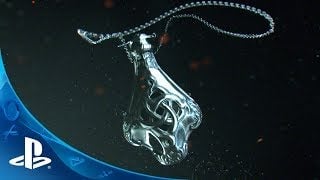
The Order: 1886 does what it wants. Zeppelins, elevated trains and automatic rifles? It might not fit the history it’s based on, but hey, why not? Toss them in. Developers Ready at Dawn are telling a story about men and women fighting half-bred monster people that never existed in their own vision of 19th century London.
The Order‘s presentation is as striking as the content. The entire game—cutscene and gameplay—is framed in a 2.40:1 animorphic aspect ratio (so it looks like a widescreen movie). It runs at 30 frames per second because that delivers a look they like. And they’re taking cues from what other developers have done in order to build the experience they want to give players.
The titular Order refers to a group dating to the Middle Ages who have carried on a millenium-long war with half-breeds who have some beast blood in them. It’s not a straight-up shooter but rather a third-person action adventure in the vein of Uncharted (with cover, of course), and the similarities between Naughty Dog’s franchise and Ready At Dawn’s potential series-starter extend beyond a shared genre.
Aside from the visual fidelity afforded by developing exclusively on the PlayStation 4, the most glaring characteristic of The Order I noticed in the brief hands-off gameplay demo we were shown at a press event in LA last week is its seamless presentation; it goes from cutscene to gameplay without a break, then from shooting to branching quick-time events back to cutscenes with nary a gap to be found. And once you start playing, studio co-founder and creative director Ru Weerasuriya promised me, you’re not going to face a loading screen until the next time you boot up the game.
“The point is immersiveness, making sure the player, once they’re involved, that emotionally they don’t get detached,” Weerasuriya emphasized. “Every single time you break it, regardless of whether it’s a visual break, that changes the way cinematics [change] from gameplay, or whether it’s a loading screen that changes the pacing, all of those are pace-breakers.”
Where you might say the seamless presentation is inspired by Naughty Dog, the QTEs I mentioned are akin to those we’ve seen before in Heavy Rain or The Wolf Among Us. They come in a sequence, and missing a button doesn’t doom you immediately but changes that sequence. Fail too many times and you’re dead, sure, but this is the new age, not the old one. Ready At Dawn wants these QTEs to customize the experience a bit for you, and to be one of many bits of curation the studio is using to deliver its vision.
“Every single element is really there as a tool to deliver an experience,” Weerasuriya told me. “There is no one thing.”
Another of those single elements is the framerate, a contentious point of debate in gaming these days. But bigger is not necessarily better, despite what some people will tell you, because while Peter Jackson may insist that 48 frames per second is the only way to watch a movie now, more folks tend to disagree with that than not. Also, frame-boosting tech on modern TVs—like TruMotion, MotionFlow, ClearScan, etc—are the butt of so many jokes (“I can’t even watch five seconds of it” was all Weerasuriya had to say about that) because the visual difference between high and film-stand framerates is extremely stark.
And while response time is a worthwhile concern—60 frames definitely feels faster than 30—Weerasuriya noted the way the game is constructed can eliminate the need for a quicker response.
“You build the game with that in mind, because everything you do is a compromise,” he said.
“Some things are done the way they are because of the experience they’re trying to portray to the player. I think for us 30 frames per second and the animorphic… is very calculated because it happened very early on.”
Ready At Dawn was from the beginning seeking a specific look and feel for the game. They liked the way 30fps looks versus 60, and they insisted on utilizing a 4x multisampling anti-aliasing (MSAA) process—which is quite technically demanding. Between that and any number of other graphical effects they wanted to implement. going with a higher framerate just wasn’t a priority.
“Higher framerate doesn’t equate to better,” Weerasuriya insisted. “The framerate has to satisfy the experience you want to have.”
Phil Owen is a freelance journo with work at VG247, GameFront, Gameranx and many, many other places over the years. You can follow him on Twitter at @philrowen. Send hate mail to [email protected]