
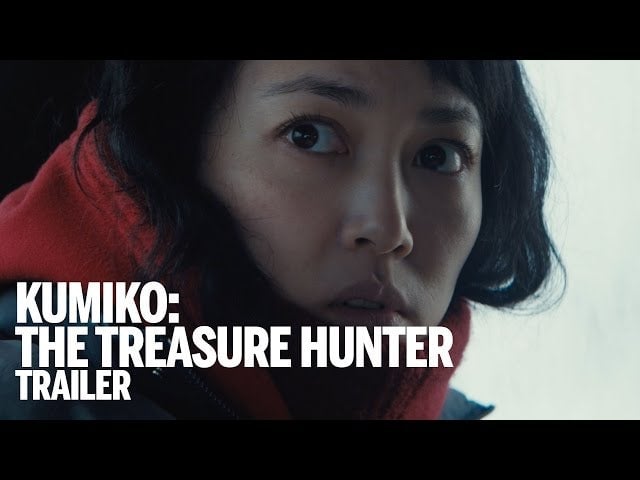
New release Kumiko: The Treasure Hunter is based on an urban legend that a Japanese woman thought Fargo was real and travelled to America to find the money Steve Buscemi’s character buried. The real story, however, is far more depressing.
The urban legend started in 2001 after a Japanese woman in her late 20s named Takako Konishi was found dead in Minnesota after travelling in North Dakota. According to the story, which was reported in the press at the time, Konishi believed that Fargo, which claims it’s a true story, was real and went looking for buried cash.
It’s somewhat understandable that such a misunderstanding would happen. It also happensamong native English speakers.
There is no buried cash, and tragically, the woman died of exposure to the brutal cold.
The story inspired filmmakers David and Nathan Zellner to make a fairy-tale style adventure, with actor Rinko Kikuchi of Pacific Rim fame as Kumiko, a woman who thinks
Fargo is real and goes searching for the suitcase of money.
But as sad as the newspaper reports that inspired the movie is, the real story is even sadder. Takako Konishi didn’t travel to the United States out of a mistaken belief. She wasn’t looking for treasure. She went there to kill herself.
In 2003, filmmaker Paul Berczeller made a documentary about Konishi titled
This Is a True Story. While reporters were happy to regurgitate a factually incorrect “weird” story, Berczeller talked to the officers who had met Konishi and traveled to Japan in hopes of understanding why she left Tokyo.
During the filming of the documentary, Berczeller discovered how the Fargo story got started. Konishi came to the police station with a map that showed a road and a tree, and needed help finding it. One of the police officers who talked to her recalled, “Well I don’t speak Japanese, she didn’t speak English, she just said ‘Fargo.’ She wanted to go where the money was buried.” Berczeller asked how she knew that if she didn’t speak any English.
“That was the moment the penny dropped,” Berczeller told
The Telegraph. “Oh my God! He’s made it up! The whole story that everyone’s interested in, that she’s this crazy Japanese woman searching for money, it was just a mistake.”
You can watch the documentary
here or read the article Berczeller wrote in The Guardian
[Photo: Kumiko Official Site]
But did the filmmakers behind Kumiko Treasure Hunter see it? “We didn’t watch it,” David Zellner told
The Telegraph. “We didn’t want to be influenced in a subconscious way. We wanted to keep our story pure,” his brother Nathan added. Both do know the facts of the case and that Konishi was not searching for Fargo’s money. According to David, this revelation was initially a disappointment. “We didn’t want to believe it initially.”
Kumiko: The Treasure Hunter seems to draw on a much larger spectrum of stories, whether that’s Spanish conquistadors or Grimm’s fairy tales. And whether the movie is factually correct is besides the point—the picture should be taken on its own terms, as a movie and as a work of fiction. So far, I’ve heard nothing but good things about this film and am excited to see it.
[Photo: Kumiko Official Site]
What makes the real story so sad, however, is that for a variety of reasons, Konishi didn’t get the help she needed during her final days, and when she passed, she faded into urban legend as “that Japanese fan who thought Fargo was real and died trying to find the money.” A incorrect recounting of what she was really doing in Minnesota—something that became tragically more clear in the suicide letter she sent her parents. Instead of a depressed woman in need of help and compassion, she’s simply some foolish fan. There’s no dignity.
Often, urban legends and bogus news stories circulate not because they are true, but because people want them to be true. Maybe it’s because they’re lurid. Or maybe it’s because these stories make people feel better about themselves.
What’s even more baffling is that the officer’s story was so widely believed. If you’ve seen Fargo, you know that Steve Buscemi’s character doesn’t hide the money next to a tree. There is no tree, but just rows and rows of fence posts.
[Photo:
And So It Begins Films]
Yet, details like this get in the way of a good newspaper story.
The night before Konishi died, she placed a 40-minute call to Singapore. “I called the number, and I found out there was a man involved, an American banker she’d met in Tokyo who’d moved to Singapore.” Berczeller told
The Telegraph. “He’d left her behind. He didn’t want anything to do with her.” That man was from Fargo.
To contact the author of this post, write to bashcraftATkotaku.com or find him on Twitter @Brian_Ashcraft