Toeing the line between camaraderie and fierce competition is near-impossible, especially in fighting games communities, but the Super Smash Sisters have mastered it, with bite.
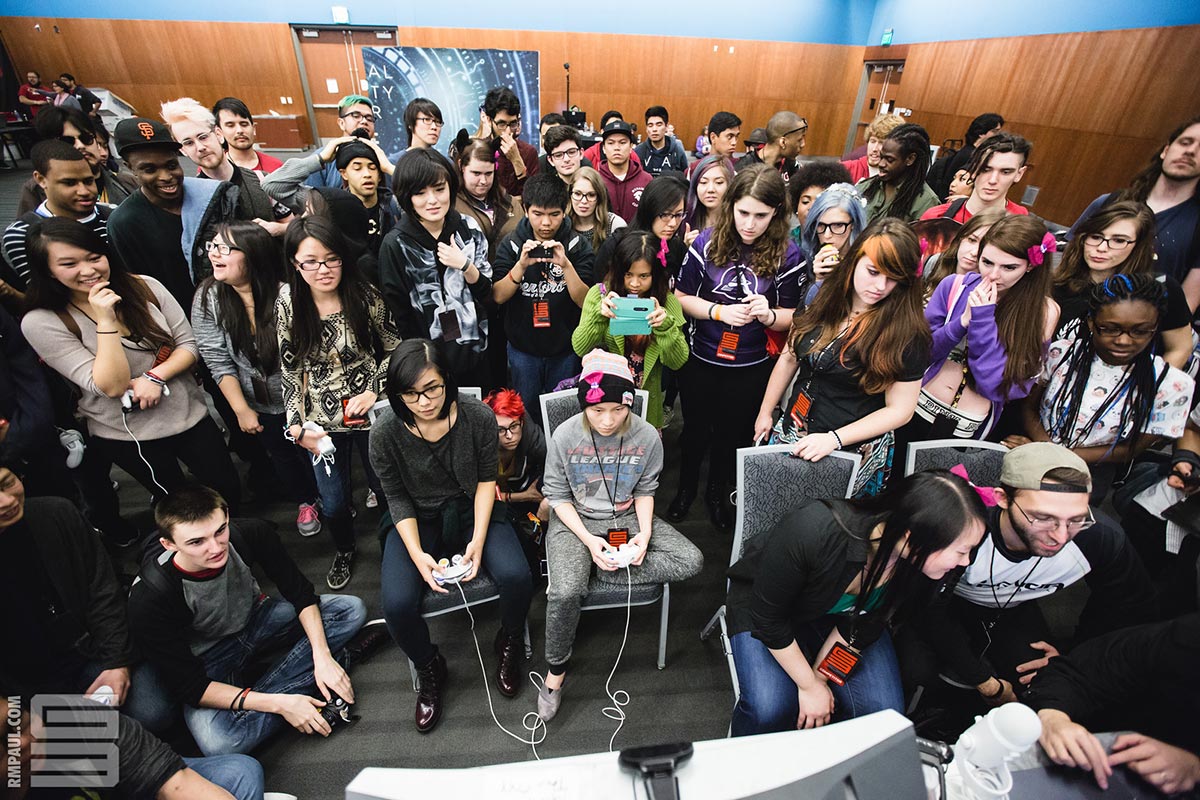
Smash Sisters isn’t a club as much as an ongoing event, a series of Super Smash Brothers Melee and Smash 4 crew battles across the country. The goal is to normalize women competing at Smash, a Sisyphean task considering the gender makeup of most tournaments. And yet, last weekend at Virginia’s Super Smash Con, the Smash Sisters drew around two dozen participants, all of whom seemed thrilled about the push for a competitive women’s-only brackets in which they could sharpen their wave-dashing.
Emily Sun and Lil Chen, both competitive Melee players, approach the game with rare admiration for how players creatively exploit its technical elements, from edge-guarding to double-jumps. That admiration for the game also extends into their admiration for the Smash community, where they’ve cultivated long-lasting friendships with Melee players around the world. Now, they’re carving out a space for more women to forge their own personal bonds through Smash
I’m embarrassed to admit that, later on in our interview last night, the Smash Sisters co-founders appeared frustrated with me. Likely, it’s because I was pressing them on gaming-while-female, a topic that co-founder Emily Sun isn’t as interested in as Super Smash Brothers itself. I don’t blame her. Read below for our conversation on Melee purism, the beauty of fighting games and how it feels to lose to girls.
Cecilia: Tell me what’s so compelling about the Smash community.
Emily: Last year, I randomly went to Denmark. I had no plans and didn’t know anyone. So, I posted in the Denmark Melee group, “Hey does anyone want to play?” I immediately got responses. I got housing that night. A person who, now, is a really good friend of mine showed me around the city and cooked me dinner.
The Smash community is amazing. Awesome. 100%. This shared passion is the glue that holds us together. We’re all connected, around the world, whether we know each other or have friends of friends.
Lil: When I think of Smash, I think of diversity. Because the game is the sole thing that connects us, you see people from different economic classes, social groups, people you wouldn’t have any reason to interact with otherwise outside of the video game. Now that I’ve moved to San Francisco which is full of privileged tech people, I’m constantly reminded how grateful I am to have Smash to ground me.
Cecilia: Why are you both Melee players? The Melee community is often regarded as less friendly than communities around new versions of Smash
Lil: Melee forces people to meet in person to compete adequately. If it was online, I wouldn’t know all the people I do now. When I was 17, I flew to Indiana and Florida for a video game. That’s how I made these friends [I have now].
Cecilia: What about Smash 4?
Lil: I haven’t really played it. I don’t have any interest in it, either. I’m not remotely as close to being the best I can be at Melee. As a competitive person, I see no reason to dabble in a new Smash game.
Emily: I’ve tried all versions of the game, from N64, Project M, Brawl and Smash 4, and really prefer Melee. I do dislike the elitism Melee players have. But I’m not gonna lie: I like my game better. I think it’s a better game. But I wont go out of my way to publicly tell everyone their game sucks. That mindset is disrespectful and unproductive.
As it relates to Smash Sisters, we both have a heavy Melee focus. When I run an event, I wanna do Melee. It’s like how I don’t want to run a Street Fighter event. It’s not the same game. We have women who run Smash 4 events.
Lil: I think a lot of the tension [between different Smash versions’ communities] would be removed if people just stopped acting like we’re all one happy, cohesive community. We’re not. I’m hesitant to say that, but it’s true. For several years, I didn’t even know the top players at Brawl. But I didn’t disregard their community out of malice. I’m just absorbed in mine.
People act like because it’s the same franchise, we all know each other. We’re smaller communities. I feel constantly like there’s this obligation to play other games simply because of a brand pitch. I don’t have that much time.
Cecilia: How did you start Smash Sisters?
Emily: At Genesis 3 back in January of this year. That was the first Smash Sisters event. Lil and I connected—she had been writing about women in gaming, and in Smash specifically, competitive gaming, for a while. At Genesis, I was like, “Hey, does anyone want to do a women’s crew battle?” I wanted to make more female friends because I didn’t have any. There was a lot of interest. Lil was able to create the hype and exposure it needed to get this going.
Lil: It turned out pretty exquisite considering all-female events of this nature tend to have a lot of blowback. We were really pleased to see a lot of new and veteran women joined. Usually, veteran women aren’t as interested in these events because they don’t need it as much [to make friends].
Cecilia: How’d you each first encounter Smash?
Lil: I grew up with a younger brother who gamed. I was basically the backseat driver of gaming. But when Melee came along, I couldn’t help but join in, which escalated to battling customers who came to eat at my family’s restaurant. Eventually, I attended an anime convention with a tournament, where I met competitive people. They dragged me into my first tournament and just put my name down to play. It radically altered the trajectory of my life.
Cecilia: You beat your brother a lot?
Lil: Yeah, definitely. It was a point of contention. He’d spend all his time unlocking characters and stages. I wouldn’t even care (*laughs*). And I’d come back into the room and beat him. He was so upset.
Cecilia: How about you, Emily?
Emily: In high school, I was on the debate team. I was your typical ambitious Chinese-American student. I went to debate camp and, one year, someone brought an N64 with Smash. And all we did was play Smash and do debate. I went home and played with my high school friends, got into Melee when I went to college and dragged my then-boyfriend to our first tournament after I saw a flyer. I wanted to meet more people. That’s when I got into the competitive scene.
Cecilia: Who did you main?
Emily: I think I played Ice Climbers and Marth. It was chill.
Cecilia: Ha. Ha.
Lil: For me, Smash was an escape from school life. I was bullied a lot, especially because the town I grew up in was not diverse. When I fell in with the Smash community, all the sudden, being an Asian woman was a cool thing to be, so I got a lot of attention around that. I was 15 or 16. I was like, “I guess it’s better than the crap I’m getting at school!”
https://twitter.com/embed/status/764631466760372224
Cecilia: Huh. When I play Smash at tournaments or larger events, I find that it’s often difficult to convince male players to hand me a controller. That happened last weekend at Otakon. Sometimes, they just shut me down or say inappropriate things. Has that happened to you?
Lil: At a tournament, a friend once said to my boyfriend, “I would never let her out of the house wearing that.” I was wearing short shorts. Obviously, I was going to stick out because, back then, there was a gender gap more severe than there is now.
Emily: Luckily, one of my first Smash groups was my dorm-mates: three other females. All we did was play 4-person free-for-all casual with items. Our gay best friend across the hall played Pikachu. That was my first Smash group. When I first went to tournaments and more competitive stuff, I did get a lot of comments like, “Oh, you’re really good for a girl.” Some people would be like, “Make sure you don’t lose to her. You can’t lose to a girl.”
Cecilia: Do you find that, when you play with other women, it’s hard not being the “only girl” anymore? Is there a culture of cattiness?
Lil: I wouldn’t use the word “catty” as much as “have probably internalized a lot of societal behaviors that can be sexist.” It’s the best way I can say it. It’s something I face too and am slowly growing out of. When you’re in a competitive gaming community that is predominantly male, you absorb the behavior you see around you, whether right or wrong. It’s your default environment. It took me a while to appreciate female camaraderie and it’s still something I’m learning. Its something we consider when we run Smash Sisters. Everything about our image is devised not to pitch women against each other because that’s what we dealt with growing up in the gaming scene.
Emily: I was never able to get “catty” with anyone because I rarely had female friends.
Lil: I was always compared to the next girl who joined a Smash game. It was this metaphorical mud-wrestling match. As a young girl, you’re just trying to better the other girl.
Cecilia: Considering that, do you identify as feminists?
Emily: I’m not a feminist because I don’t see myself as someone who actively tries to promote equality between men and women.
Lil: She says that and then she runs Smash Sisters!
Emily: It’s more selfish. Maybe, at this point, I’ve become a feminist, but I wouldn’t have said it before. I like that it’s about equality, but I don’t like the negative connotations of the word and don’t want to be associated with that.
Lil: I’m, like, the opposite. I’m known as the feminist of Smash and eSports.
Cecilia: I like that contrast. Its seems fruitful.
Emily: That’s why we’re great partners. If we disagree, its okay.
Cecilia: So, Smash is my favorite game. But I’ve hard a hard time explaining why to people. What’s so special about it to you?
Emily (*exasperated*): Thanks for asking about the game. I fucking love the game. What the game is is art. Its self-expression inside a well-defined medium. In Smash, you’re given these technical tools so you can express yourself. Its so beautiful. Its something you don’t see in any other game. Its a free-form, free-flow movement that, when you incorporate things like directional influence or a double jump and the ledge and aerial space, creates thousands of permutations of options to express yourself and is beautiful and is art.
Cecilia: Holy shit.
Lil: When I was a kid, I remember picking up Mortal Combat and Soulcalibur, but there’s a freedom in Smash that didn’t exist in 2d fighters—not that they’re not deep. They’re very deep. But in Smash, you can immediately tell there’s a fluidity that doesn’t exist in other games.
Cecilia: What’s the secret to getting more controllers in girls’ hands?
Emily: It’s the fucking holy grail. Haha.
Lil: This is my favorite question. Because I don’t know. I’m not hesitant to say that, because the issue of women in gaming is way too controversial. It’s sensitive and polarizing. We don’t know whats right. We’re gonna try things. There might be multiple solutions and multiple mistakes. I don’t wanna sit on a throne and say, “This is it. It’s gonna cure everything.” This is an experiment. Were seeing the result produced. We’ll change to reflect the results.
Emily: And… with that said, here’s a roadmap. Just some ideas that might work:
Increasing our “install base,” our user base. That’s our aim with Smash Sisters: Getting casual gamers to play.
Create a community, so there’s friendship, a reason or incentive to come back.
When you have a community, you have to create content for that community, like combo videos or tournament videos. Maybe friendly rivalries, even. Or having a partner to grow with.
Having the resources for you to get better. That means having the right mindset, deliberate practice, having someone better than you around.
And then, you have to go to tournaments. If you don’t go, you cant get better.
Lil: The higher-level aim is normalizing the notion of women competing. All of Emily’s proposals feed, basically, into retention.
Cecilia: Thanks so much for your time.
*This interview has been edited and condensed for clarity.