You’re crouched in the dark. You can hear two guards talking; they’re just around the corner. If they spot you, you’re as good as dead. Best to remain in the shadows, unseen.
You creep up to the corner, slowly. You’ll need to get a glimpse of your enemies to best plan a way around them. Pressed up against the wall, you reach the corner. What do you do?
That’s right. You lean
For anyone who grew up playing PC games, video-game leaning is a natural thing. Before the “E” key became the default for environmental interaction, it and the “Q” key let you lean left and right. In games like Deus Ex and Thief, mastering the lean was the key to mastering sneaking.
I’ve spent the last few days playing Thief: Gold, and that game is a lean-fest. (And the many Thief fans out there will be happy to hear that despite the dated graphics and tech, I’m loving it. Here’s to addressing our gaming blind spots, one by one.)
Thief is pure, hardcore stealth, and if you’re gonna make it through these levels unspotted and unscathed, you’re going to have to lean. It’s an oddly empowering move—something about peering around a corner feels really satisfying, and I find myself leaning more or less constantly.
Somewhere in the 90’s or early 2000’s, video game leaning went out of style. What happened? As far as I can see, two things did: Consoles rose to prominence and as they did, a lot of stealth games went third-person.
Both Metal Gear Solid and Splinter Cell involved a lot of sneaking, but you were doing so while looking over your character’s shoulder. That opened up your field of vision a lot compared to a first-person game. It was possible to stick Sam Fisher up against the wall, slide up to a corner, and shoulder the camera over to get a look around it without actually needing a specific button to do so.
More recent games like Rainbow Six: Vegas and Deus Ex: Human Revolution took on a hybrid first/third person camera to make stealth more manageable. I really like this feature—it feels slick and organic, and it makes stealth sections much more intuitive and empowering.
An Xbox controller doesn’t really have the extra buttons necessary for a lean, and so console games tended to eschew the move altogether. (At one point I was hoping that a squeeze-based controller might allow for something like leaning. No seriously, I was hoping for that.)
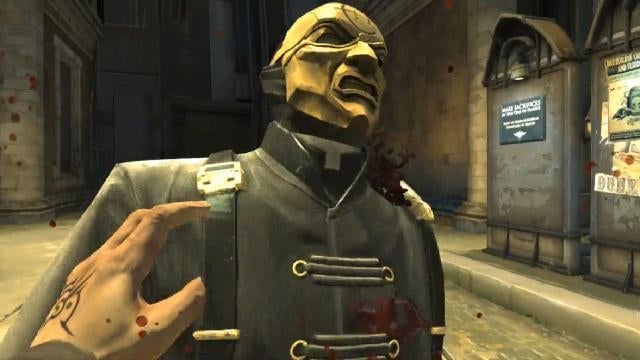
But there’s a new game coming out that looks to bring the lean back to consoles—Arkane’s Dishonored. As I mentioned earlier this week when Jason and I talked about stealth games, I’m kind of doing a media blackout on that game; at the very least, I don’t watch any of the new gameplay footage. But of course, I’ve seen a few videos of it in action. And in each one, the protagonist is leaning like a madman—leaning left, leaning right, leaning all over the place.
But wait, Dishonored is coming out on consoles as well as PC… that means it needs to work on a controller. How does the leaning work? I played the game at PAX a couple of weeks ago, and kind of couldn’t believe how smart Arkane’s approach was:
You hold the Y button, and then lean using the thumbstick. Simple. Brilliant.
As I played Dishonored, I found myself leaning every which way, back in the groove of the PC games I grew up with. It works so well I can’t believe no one’s thought of it before. (Though maybe someone has?) And of course, it makes sense that Dishonored would feature a lot of leaning—several of the people from Arkane worked on Thief and Deus Ex
It’s not just a stealth thing, either. I’d love to be able to lean in Battlefield 4, or Far Cry 3. It’s such a natural move in reality, and yet such a perplexingly difficult one to pull off in so many games.
In the grand scheme of gaming, leaning will never be as glamorous as, say, jumping. It’s not bullet-time. But it’s a move from which first-person games, stealth and non-stealth alike, could benefit. Here’s hoping that other developers will copy Arkane’s approach. It’s time to lean once more.