The first time I heard “I’m getting my shit pushed in!” during a multiplayer match of Battlefield 3 was from the mouth of an acquaintance in Party chat. I assumed he and his friends were laughing at how ridiculous it sounded, because robbed of context it did sound pretty funny. I’ve since come to realize he was parroting and mocking scripted dialogue from within Battlefield 3‘s multiplayer, and somehow this homophobic content has escaped the notice of the video game press for nearly three months.
I try to be very sensitive about homosexual prejudice in culture but even I didn’t realize the implications of this dialogue until I started paying concerted attention to it.
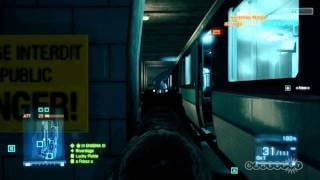
The Operation Metro map in Battlefield 3 is a close-quarters environment, which means players spend a lot of time in close proximity to their teammates. Once I started paying attention I realized that when I was playing as the Americans on the Operation Metro map I was being pummeled with a torrent of “I’m getting fucked up the ass over here!” and “Fuck, I’m getting my shit pushed in here!” from all directions while my team waded through the meat grinder. That’s because the problematic dialogue seems tied to the suppression mechanic that blurs visuals and reduces accuracy when enemy bullets are coming close to but not hitting a player.
The connection to the suppression mechanic is the key to unpacking these statements. A soldier is taking close fire from the enemy, which means he’s in trouble. He wants to convey that to his squadmates, so he uses the metaphor of anal sex to indicate he’s being attacked and needs help. It’s assumed that his male squadmate will interpret a reference to anal sex as a negative statement because the squadmate would find anal sex repulsive by default. The homophobia is implied. I don’t think it’s intentional. I think DICE wants this dialogue to sound gritty and lend to the illusion that players are actually fighting in a war.
Battlefield: Bad Company was playful. It introduced a squad of goofy protagonists to star in the franchise’s first campaign. Battlefield: Bad Company 2 toned down on the antics, dulled the characters and gave us a campaign that took itself more seriously. Battlefield 3 is downright humorless, and we need look no further than the rivalry between the Battlefield and Call of Duty series for an explanation as to why. Electronic Arts wants their piece of the military shooter pie, and COD has set a gritty tone for the genre. 2010’s Medal of Honor reboot didn’t give EA the market share it wanted, so Battlefield 3 had to get serious for EA’s second try.
“I’m getting fucked up the ass over here,” as heard in Battlefield 3 multiplayer.
You can see the same evolution in the multiplayer components of the last three Battlefield games. Bad Company 1’s multiplayer had goofy, rockabilly guitar licks and Midwestern voices that harkened back to the character of Private Haggard, the dim-witted pyromaniac who provided comic relief in the campaign. Bad Company 2’s multiplayer was a much more intense audio experience, with foul-mouthed soldiers yelling “Payback’s a bitch, motherfucker!” and other manly-man shouts during combat. DICE ostensibly chose to insert this homophobic dialogue into Battlefield 3 multiplayer in an attempt to increase the realism even further.
Homophobia in the United States military is definitively a real-life problem, so it’s entirely probable that one could hear this kind of speech during combat in the American Army. One has to look no further than the debate over “Don’t Ask, Don’t Tell,” the policy of the American military that gay servicemen and servicewomen who outed themselves were to be discharged on account of morale issues. That policy has since been rescinded, and one has to wonder whether homophobic rhetoric on the battlefield from now on is a potential morale problem in frontline infantry units.
The military also has a tragic problem with rape in general, including male-on-male rape which often goes unreported due to the rampant homophobia in our armed forces and requisite shame in reporting the crime. Rape operates in the military along the same lines that it operates in prisons. Raping another man anally is an act of forced submission meted out if someone isn’t being “manly” enough, or has offended someone in authority. Newsweek tackled the issue in April of last year.
Greg Jeloudov was 35 and new to America when he decided to join the Army. Like most soldiers, he was driven by both patriotism for his adopted homeland and the pragmatic notion that the military could be a first step in a career that would enable him to provide for his new family. Instead, Jeloudov arrived at Fort Benning, Ga., for basic training in May 2009, in the middle of the economic crisis and rising xenophobia. The soldiers in his unit, responding to his Russian accent and New York City address, called him a “champagne socialist” and a “commie faggot.” He was, he told NEWSWEEK, “in the middle of the viper’s pit.” Less than two weeks after arriving on base, he was gang-raped in the barracks by men who said they were showing him who was in charge of the United States. When he reported the attack to unit commanders, he says they told him, “It must have been your fault. You must have provoked them.”
When we talk about “realism” in military first person shooters, we’re not talking about true depiction of reality. Shows like Generation Kill and movies like Full Metal Jacket are depictions of hyper-reality. They’re media real. The Hurt Locker, which was celebrated as a realistic, gritty depiction of the horrors of our War on Terror came under criticism by real-life Iraq War veterans for its numerous inaccuracies. There is no such thing as reality in media depictions of war unless they’re documentaries.
Battlefield 3 would be no less hyper-real with these lines of homophobic dialogue removed. Even if homophobia isn’t intentional, it’s still harmful because it contributes to a culture of shame around homosexuality. We asked DICE for comment but Electronic Arts PR told us the developers couldn’t make our publish date for this feature and added “[Battlefield 3] is an M rated game.” I would have liked to have asked DICE what their motivations were for inserting this specific dialogue in the game. I also would have liked to know whether it occurred to them that doing so might be problematic. I presume not, because it’s unlikely either EA or DICE expected anyone to be looking at Battlefield 3 this closely.
The most common criticism of games like Battlefield 3 and Call of Duty is that they make light of the realities of war. Activision’s tag line “There’s a soldier in all of us” is catching flak precisely for this reason. Doesn’t this homophobic dialogue in Battlefield 3 make light of the reality of homophobia in the American military and the 50,000 male veterans who screened positive for “military sexual trauma” in 2010? Yet this dialogue has flown under our collective radar so far.
“I’m getting my shit pushed in here,” another of Battlefield 3’s more colorful quips.
If we talk about the influence of media on culture, the media which is digested the most is the media with the greatest influence on culture. Military first person shooter games taken collectively are one of the most popular genres in the entire video game industry. Games like Call of Duty: Modern Warfare 3 and Battlefield 3 are, from this point of view, two of the most culturally-significant video games currently in circulation
It’s easy to gloss over close analysis of these games and wave them away as stupid shooters designed for dudebros in no small part on account of the famously horrific online behavior of their players, but the cultural significance of these games demands the full scrutiny of our critical attentions rather than bored dismissal or oblivious immersion in pure mechanics. If we don’t ask whether inserting homophobic dialogue which doesn’t arguably make the game better is justifiable, we can’t tell developers that they ought to think twice about making decisions which arguably make the real world worse.
Dennis Scimeca is a freelance journalist from Boston, MA. His weekly video game opinion column, First Person, runs Thursdays on The Escapist. You can reach him through his blog, Punching Snakes, or follow his random excitations on Twitter: @DennisScimeca