For some, the soothing dulcet tones of Bob Ross is a great way to unwind after a bad dose of Hearthstone RNG. For others, a stiff drink. But one YouTuber has another idea: poetry.
The project, called “Life on Hearthstone”, started out year ago. It starts out as a vignette about playing Hearthstone: picking a deck you just created, enjoying a drink while you wait for a match, sitting on top of the skill curve, being perfectly average, overthinking decisions.
James Ward, who animated and narrated the video, based it off his own experiences. But underneath the soft, almost hushed tones of Ward’s voice, is a deeper meaning. It’s not actually about Hearthstone, at least not if you listen closely.
“It’s like Mel Blanc dodging studio censors,” Ward explains, saying that the key is to be relatable as possible. By outlining experiences and tales that everyone has had while playing Hearthstone at some stage, viewers have something to connect to – which opens the door for connecting them to deeper issues, like anger, depression, and misery. “If I get too arty, people will run,” he said, “but it can’t be inane or there’s no teeth to it. So like, I’ve gotta hide the arty shit, like hiding dirty jokes, get the audience comfortable first.”
“It’s a literary device … if I go round throwing like, ‘Hey this is depression look at what I’m portraying’, [the audience] will be like, ‘So what? fuck off.’ But if I portray their own behaviour in a relatable way, you get those laughs, and [people] identify themselves in the work, and everyone’s on the same page. And that’s when you sneak in the little tidbits of like, this is sad behaviour, this is fucked, why are we behaving like this, we’re medicating ourselves with screens and video games and inane, repetitive media, what’s going on here. But without picking out the little shit that makes people go, ‘Oh fuck, that’s me alright’, it just comes off as didactic.”
Put another way: the YouTube audience is incredibly savvy when it comes to bullshit. Not savvy enough, however, to realise that they’re being introduced to one of the oldest forms of literature. That’s the plan, anyway.
But why go to all the trouble in the first place?
According to the 25-year-old Melbournian, his love for poetry wasn’t an overt pleasure. It came from a much more common connection: music.
“I’ve always written little poems and tidbits since I was a kid – as I’ve gotten older they’ve gotten sillier,” Ward told me over Discord. “I’ve always liked poetry, but in sneaky ways. I grew up listening to the Beastie Boys and like, Rage Against the Machine and Green Day and stuff- and being the kid I was if I I’d known that MCA, Zach De La Rocha and Billy Joe Armstrong were thoughtful lyricists and aspiring poets in their own way I would’ve chucked all my tapes out.”
It’s a bit cliche. Like many kids, Ward was attracted to the music of rebellion. But it wasn’t until later in life, when circumstances took a turn and Ward ended up homeless, moving from place to place. Life was unstable and as many do in similar circumstances, he returned to the music he grew up with.
“I think that’s when the heart of all the music I was listening to as a kid really started to matter,” he explained, “because I really needed something solid to grab onto or make where my life was something fun and exciting rather than just like, scary and uncertain. And yeah, fortunately when shit really hits the fan, silly videos are a great cure for the blues.”
Some of the silly videos that ended up being the strongest inspirations were from Brad Neely, an American artist and producer. Neely worked on the 11th season of South Park as a consultant and, a couple of years later he created the webseries I Am Baby Cakes
Inspired by the blend of comedy, simplistic graphics and darker themes from videos like Neely’s, Ward gained the confidence to create something of his own. He made a pilot for a show called This Week in Hearthstone, which was picked up by the US esports organisation Tempo Storm. One thing lead to another, and after a few episodes he ended up creating a script for a parody of a show Tempo Storm was creating called The Inn Crowd.
His script was well received, and he ended up producing a script and recording the voiceovers for what would be The Inn Crowd’s final episode. But the end product, which Ward says he wasn’t allowed to edit, completely bombed. It was an empty process, he explained, and without the creative control over the end product or brand, it wasn’t worth the trouble. So Ward released the Life in Hearthstone pilot and spent the next year focusing on a music band and improv.
But what happens if nobody gets it?
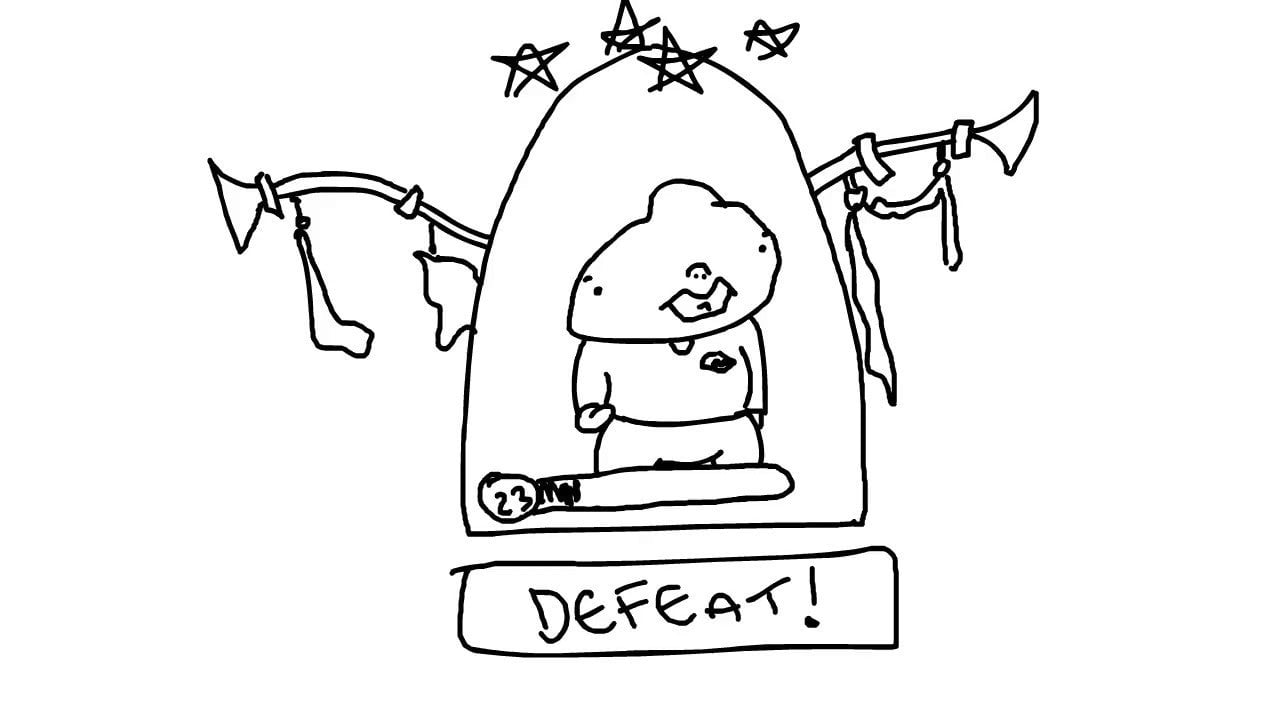
Life on Hearthstone is a five part series, and the reception to the first few episodes has been warm. That’s encouraging given how dark the videos can get. The first episode draws a metaphor from the widgets on the Hearthstone board, equating them to objects placed in a bottle designed to keep an insect from being bored, from trying to escape. “Grind” touches on the emptiness of Hearthstone’s rewards, and how it mirrors the emptiness of grind in the real world.
The humour is pretty grim too. One comic device used is a construction worker, who suffers from vertigo and has no hands. Ward doesn’t use the worker purely as a visual gag – although given the simplicity of the animation and drawings, having a character fall down is one of the most effective devices – but more as a blunt tool for highlighting the futility of chasing virtual rewards, of things people complain about but never do, of life. Another episode quips that video games have eroded people’s attention spans so far that people can’t even get upset or depressed by their own thoughts, because messaging apps fill the void of loneliness before the thought is even completed.
Not all of it comes off, and Ward explains that the script has to walk a fine line. “For every handful of lines that are up front and funny or easy to digest, it affords me a certain amount of weirdness,” he said. I asked if in-jokes and Hearthstone references were almost like a currency with his audience, tools used to buy the attention of viewers so they would be more receptive to other themes, and Ward agreed.
For a content creator, there’s more leniency in parodying and referencing material viewers already know and understand. It works, but there’s also a limit to how far you can take that shtick. “Original content with original characters is almost comprehensively rejected unless you’ve got crazy resources at your disposal to make it very pretty and palatable, but there’s no ceiling in that kind of work,” Ward reasoned.
It’s a maxim of Hollywood and comedy: one for them, one for me. And because of that careful balancing act, the weirdness works.
The responses to some of Ward’s videos are telling. “This was me about a year ago, but I’m turning things around.” “That was legitimately depressing.” “I hate you for making me see myself. Thank you.“ People admitting they don’t play for fun, but out of pure compulsion. People talking about their own depression, emptiness in their lives.
It’s far from happy. But Hearthstone fans love it.
Ward has been talking for several hours. He’s talked about how his videos wouldn’t work if it wasn’t for the music in the background. He’s chatted about games being a gateway to something deeper. He’s talked about his inner demons (and I talked about mine).
I asked why his videos have an ASMR-esque quality. It’s forced, he said, as the only way to get clean audio was by turning his pre-amp down and getting close to the microphone.
So the question had to be asked: what if people don’t get it? What if the only response is “this is great content”, and the deeper message never sinks in? “It’s the most likely outcome,” Ward admits. “People say haha, fun … and forget about it. But that’s still something; my friends will know I tried.”
But if not opening up to poetry, one consolation is that it’s encouraged a conversation about depression. It’s hard to go past the email that inspired the series, a viewer who uninstalled Hearthstone and thanked Ward for it. Responses like those are rare, Ward says, and he reads every comment he can. And that’s a toxic loop: you might see thousands of shares, enormous amounts of views, but none of it sticks in the mind like a negative comment.
Ward isn’t thinking about that too much, though. The last episode in the series isn’t out until next week, and a week is a long time on the internet. But he’s hopeful that the goodwill continues. “Fingers crossed it gives me a platform to speak out and tackle [depression] more in future, it’s something I can see myself like, attacking for a long time.”
I’m reminded of other comics that mirror a simplistic drawing style with heavy topics, like Hyperbole and a Half. The internet has plenty of introspective comics, and we’re not far removed from the successful Kickstarter campaign for CheckPoint
It’s late, almost midnight, and I have to be awake in six hours. But it’s OK, and I’m going to bed happy. Happy because through it all, I’m convinced Ward will be fine – and the Hearthstone community will be the better for it.
This story originally appeared on Kotaku Australia