I never wanted to have sex with Lara Croft. And I didn’t want to protect her either. In the early Tomb Raider games that I played and loved, the relationship was simple. The lethal, archly snippy adventurer was me and I was her. I wanted what she wanted: to unearth the relics of antiquity. To go where human footsteps had never tread. To forge ahead into mystery. God, I remember swimming to Atlantis in Tomb Raider 1 so vividly. Any game that could create that much awe in me deserved its accolades, no matter what shape the character’s polygons were sculpted into.
But, then, Lara got lost. Too many games with too little to recommend them made it so that people only focused on her body and what she wore. (Yes, 2006’s Legend recaptured some of the good ol’ days, but its spark wasn’t enough to keep the series’ fires burning.) So it’s meaningful, then, that this Tomb Raider reboot starts Lara off at a new beginning. Also significant is the notion that the character who became one of video games’ biggest stars gains—and loses—some vigor on her new journey.
In the game, allusions are made to Lara’s lineage—as before, she’s the daughter of a renowned explorer—and they’re heavy with symbolism. “I don’t think I’m that kind of Croft,” she says to her mentor at one point. “Sure you are,” he replies. “You just don’t know it yet.” This game’s all about making Lara into a survivor, both inside the game and out on real-world store shelves. In many ways, this Tomb Raider is a game of catch-up, something to establish parity with the other bankable personas and franchises of the modern gaming landscape.
WHY: Tomb Raider is a taut re-imagining of the iconic Lara Croft as a more vulnerable but increasingly empowered heroine.
Tomb Raider
Developer: Crystal Dynamics
Platforms: PS3, Xbox 360 (version played), PC
Released: March 5th
Type of game: Action/stealth origin story with survival horror overtones and online play.
What I played: Played through all of the single-player campaign in about 15 hours. Raided a few tombs.
Two Things I Loved
Yamatai is a palimpsest of despair, a richly designed environment that echoes throughout history. Axis German troops, U.S. Marines from the early 1900s, 17th Century Japanese military forces… everyone was on this island! Finding remnants of previous lost souls makes you want to avoid sharing their fate.
The primal feeling of wielding the bow and arrow as a means of survival is tough to beat in Tomb Raider.
My Two Things I Hated
Tomb Raider 2013 can feel unrelentingly gloomy. Don’t go in expecting to feel like a wisecracking badass.
Every time I felt forced to resort to modern firearms, I felt dirty.
Made-to-Order-Back-of-Box-Quotes
“Best zip-lines ever!” —Evan Narcisse, Kotaku.com
“Attention, DC Comics and Warner Bros Interactive Entertainment: Steal everything applicable from Tomb Raider if you want to make a kick-ass Green Arrow game.”
—Evan Narcisse, Kotaku.com
You can feel the ambitions of the Crystal Dynamics creative team in the design of the game’s component parts. The presentational elements—plot, dialogue, voice acting and art design—all shine. Some characters lean too heavily on type but not so much as to be really annoying. This is a beautiful game to look at, too, with great animations and modeling/texture work that’s bursting with vivid, horrid detail in the characters and environments.
That last bit is key, as Tomb Raider quickly establishes it’s going to be far more horror-inflected than its predecessors. We meet Lara as part of an archaeological reality television show, heading out in search of a mysterious lost civilization called Yamatai on a ship called the Endurance. Crew members’ personalities run the gamut from gruff to kindly and—in the case of the show’s star Dr. Whitman—desperately egotistical. The Endurance wrecks on the coast of Yamatai and, from there, Lara must stumble through tableaus of human sacrifice, cult religion and agonizing despair to learn the skills necessary to save her friends.
I kept wondering how passionately this game would embrace awe and astonishment while mired in grit. Yamatai itself—and the men prowling it—provides the answer. The game’s locale is a cursed place, an island-of-no-return in the Pacific where ships and planes have been crashing for centuries. Players will find journal entries from the people who had been trapped here long ago and you learn that no one ever left. The latter-day stranded are pirates and mercenaries belonging to a cult called the Solarii. Their charismatic leader believes the freak storms that keep them trapped there are powered by the ancient Japanese legend of the Sun Goddess.
https://lastchance.cc/the-tomb-raider-reboot-could-use-a-t-rex-5932948%3C/a%3E%3C/p%3E
Much of Tomb Raider re-contextualizes elements that will be recognizable to anyone who’s played a third-person action game in the last five years: specially timed finishers in melee combat, shooting sequences that rely heavily on cover mechanics and a segmented open-world design that opens up as you gain more tools and weapon modifications. Likewise, Tomb Raider uses an experience system that aggregates points as you play and offers up scads of unlockable collectible challenges. Lara’s Survival Instinct—a special sight that highlights enemies and collectibles in the environment—will also be familiar. There’s stealth, too, and thankfully it feels meaningful rather than tacked on. Brawling or blasting away out in the open is never a path to victory for Lara.
As Lara explores the massive Island, you can set up camps, which act as save hubs and fast-travel stations for when you want to return to certain areas. Those camps are also where you upgrade weapons, skills and gear with salvage that you collect.
Are there tombs in Tomb Raider 2013? Yes. They’re entirely optional, though, and are mostly hidden, combat-free zones concerned with environmental puzzle-solving. Exploring tombs gives you secrets and rewards—like skill points for upgrades and maps that show where relics and other collectibles are—so it’s worth the investment of playing through them. They’re also a quiet remove from all the human/animal aggression on the game’s main path.
The Metroidvania elements to Tomb Raider‘s game design feel well thought-out, too. When you get the Rope Arrow ability, for example, it comes across as the result of Lara’s increasing ingenuity, not just an expected design feature. The skill unlocking makes getting around Yamatai feel like the most fun part of a grim enterprise. As you launch climbable ropes across previously uncrossable chasms or destroy barriers with grenades or shotgun blasts, Lara feels less and less like she’s at the mercy of the environment.
The key difference from, say, Batman: Arkham City or any Uncharted game is how effectively Tomb Raider drives home the physically grueling experience of being an adventure hero. After all, you never see Batman sweat and, despite his grumbling, Nathan Drake tends to be very well-adjusted to what he has to endure. Not the 2013 edition of Lara Croft. She yelps, groans and screams in combat and traversal. You know she’s going to make that jump. But it’s going to sound really unpleasant when she does. And when she dies? The game unleashes truly gruesome death scenes—which, yes, call back to previous TR games—that turned my stomach no matter how often I saw them.
Ominous dread replaces intrepid sauciness in this reboot, and there’s little of the breathless wonder that distinguished the first Tomb Raider games. You will see beautiful vistas, yes, but not much joy accompanies those moments. A tight claustrophobic camera zooms in on Lara when she squeezes through tight crevices and, even in the game’s more open environments, a tense anxiety is never too far off. But that dread makes the play of the game feel deeply satisfying.
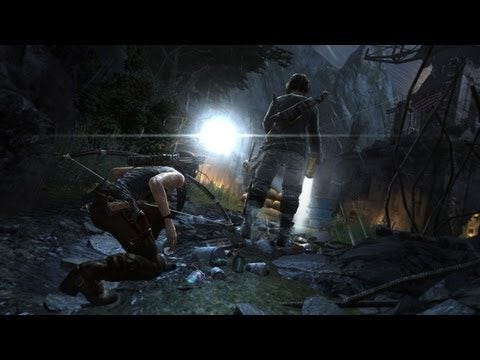
I grew to love the bow and arrow intensely in Tomb Raider, so much so that it was still my go-to weapon even after I’d gotten a shotgun and a grenade launcher add-on for my rifle. Lara spends so much of the game with wracked nerves and hiding from bigger, more vicious male aggressors. The bow gives you a way to weaponize all that angst. I always tried for headshots, to make sure the awful bastards shooting at me went down as egregiously as possible. Kotaku video editor Chris Person did the same, only he aimed for the crotch. Either way, pulling the string taut and letting fly feels like dishing out comeuppance.
Take the oppressive mood, the women-centric plot and the intimate nature of Tomb Raider‘s violence and this feels more desperate than any Uncharted game. There isn’t as much dissonance between the narrrative and the play. You’ll believe in what’s at stake and in the need to come out on top.
Initially, players will have to weather too many incredulous and affirmation-style statements—”Oh, God, what am I doing?,” “I can do this,” etc.—but eventually, Lara starts growling back at her antagonists. Despite that, Lara winds up feeling like a sacrificial lamb on the altar of commercial video games. This is a video game icon becoming who she needs to be to stay alive and you’re privy to an exhausting rebirth. Even when you come to the end of the game, you desperately hope that you and Lara will never, ever have to go through anything like that again. I liked what I played but I really want Square Enix and Crystal Dynamics to get Lara on her way to being cockily self-assured again.
Even if you know nothing about the earlier controversies that swirled around this game last year, it’s impossible to play 2013 Tomb Raider and not breathe in all the subtext in its atmosphere. It’s irresistibly ripe for interpretation: a cult of violent, trapped men forming around the myth of a vengeful Sun Goddess and a young, outmatched woman who gets bruised ad infinitum on her Hero’s Journey. On its face, Tomb Raider doesn’t appear to be about the portrayals of female characters in popular entertainment. But it’s certainly ready to be read that way.
https://lastchance.cc/youll-want-to-protect-the-new-less-curvy-lara-croft-5917400%3C/a%3E%3C/p%3E
That layering—like the overall shift in tone—serves to gin up the experience in a counter-intuitive way. It’s the kind of feel-bad that feels good. If you miss the old Lara, you’re compelled to finish this title to get her closer to the snarky, actualized persona of the PS1 era. In the game, Lara has been a doubter of the tales her father brought back home with him. “The lines between our myths and the truth is blurry,” she realizes at the game’s end. The truth here is that this game is a finely crafted reboot, one that ensures that Lara Croft herself won’t become a relic of the past. It’s gloomier, yes, and laden with a thick sheen of meta-awareness. This new origin story throws more trouble at its heroine than ever before. But the changes folded into this Tomb Raider add a turbulent urgency that the old adventures lacked. We’re left with a Lara Croft that we know better. She can handle what’s coming, especially when it looks like she can’t.
Note: Tomb Raider offers online multiplayer but I hadn’t yet sampled the experience at press time. Once I get the chance to evaluate the game’s online modes, I will update this review.
Update:
Tomb Raider‘s multiplayer offering is a lot like its single-player campaign. It’s filled with variations of match types and progression systems that you’ll see in Call of Duty, Battlefield 3 and other shooter-centric playgrounds. Just like in loads of other games, you earn XP for nearly everything you do and memorizing the maps is key to success in Tomb Raider multiplayer.
But, while both halves of Tomb Raider are built on familiar foundations, the multiplayer lacks the set-up and urgency that makes single-player play so satisfying. None of the desperation you feel on the part of Lara or the Solarii true believers comes through in the middle of a Team Deathmatch.
There’s a slight bit of reward for exploration in multiplayer, in the form of salvage that you find. You need salvage to purchase new weapons and skills. You can have an Offensive Skill and an Survival Skill active while you play, letting you suffer less damage from certain weapons or earn more XP for finding salvage.
You’re playing to level up a character and earn unlocks. That’s about it. (If you want to play as Lara or other important storyline characters in multiplayer, you’ll need to farm enough XP to unlock them.) The experience was stable enough and I had no trouble finding matches. Is it fun when you’re playing a group that’s found its groove? Absolutely. But it never felt special.
It would’ve been great if the design of the multiplayer organically encouraged more co-operation but instead I experienced the same kind of chaos found in all too many competitive shooters. The design of the levels is wonderful, though, with ziplines, twisting, branching footpaths and oodles of foreboding energy throughout.
Two modes have slightly interesting imbalances built into them. Cry for Help has the survivors gathering batteries for three radio transmitters that they then need to activate and defend. All the Solarii need to do in this mode is steal 20 batteries. Rescue makes the survivors hunt down medical supplies and return them to a base while Solarii are only able to kille the opposition with melee strikes. Team Deathmatch and Free For All are what you’d expect.
There’s noting like playing through a campaign full of well-crafted emotional trials to make multiplayer feel like a fumbly add-on. Loads of other narratively ambitious games have impaled themselves on the supposed necessity of online competitive modes. Sadly, it’s a trap that Lara Croft can’t avoid either.