Ten years ago Total War developers Creative Assembly announced a licensing deal that would see the historical strategy game developers take on, for the first time ever, a fictional setting: the fantasy Warhammer universe. Across three full games and multiple expansions, and all the work and acclaim that has come with them, that deal has been slowly building towards a single moment. This moment.
From the earliest days of the agreement Creative Assembly had promised that, when the planned trilogy of standalone games had been completed, players would be able to take part in a campaign that encompassed the entire world of Total War: Warhammer. All three games, with their already-huge maps, smooshed together into the one experience. Every faction, every continent, every city and every special character combined into something called Immortal Empires
It has taken a lot of work, as Creative Assembly explained a few months back:
In order to create the game mode, the development team had to collect and combine the content, features, mechanics, systems, and code from three different codebases into a single mega-campaign. Now, taking big chunks of content, data, and code from one game and porting them into another is always a challenge—speaking from experience in this regard—and takes a significant amount of time and tailoring to get all the pieces to play nice with each other and work properly. Even after the technical implementations are done, there are still bugs to find and fix, as well as a significant amount of playtesting to ensure that (as an example) one race isn’t ridiculously under- or over-powered or that each race’s unique features and mechanics are working as intended.
It’s no exaggeration to say that long-time Total War fans have been looking forward to this release almost as much—if not more—than the actual Warhammer games, because the sheer scale and number of options available to players would (sorry) dwarf that of previous campaigns. And if there’s one thing Total War fans like, it’s big campaigns.
The fanbase got a small taste for this after the release of Warhammer II, when Creative Assembly dropped the intermediary Mortal Empires expansion (which combined the campaigns of just the first two games) but this is one everyone has been waiting for.
Across its vast lands Immortal Empires lets you conquer over 550 settlements, and take on over 270 other factions, with 86 of them being led by the universe’s “Legendary Lords”. The first time you start a campaign and hit the “End Turn” button, to see the AI start crunching through over 200 factions, is both one of the funniest and most terrifying things I have ever seen in a Total War campaign.
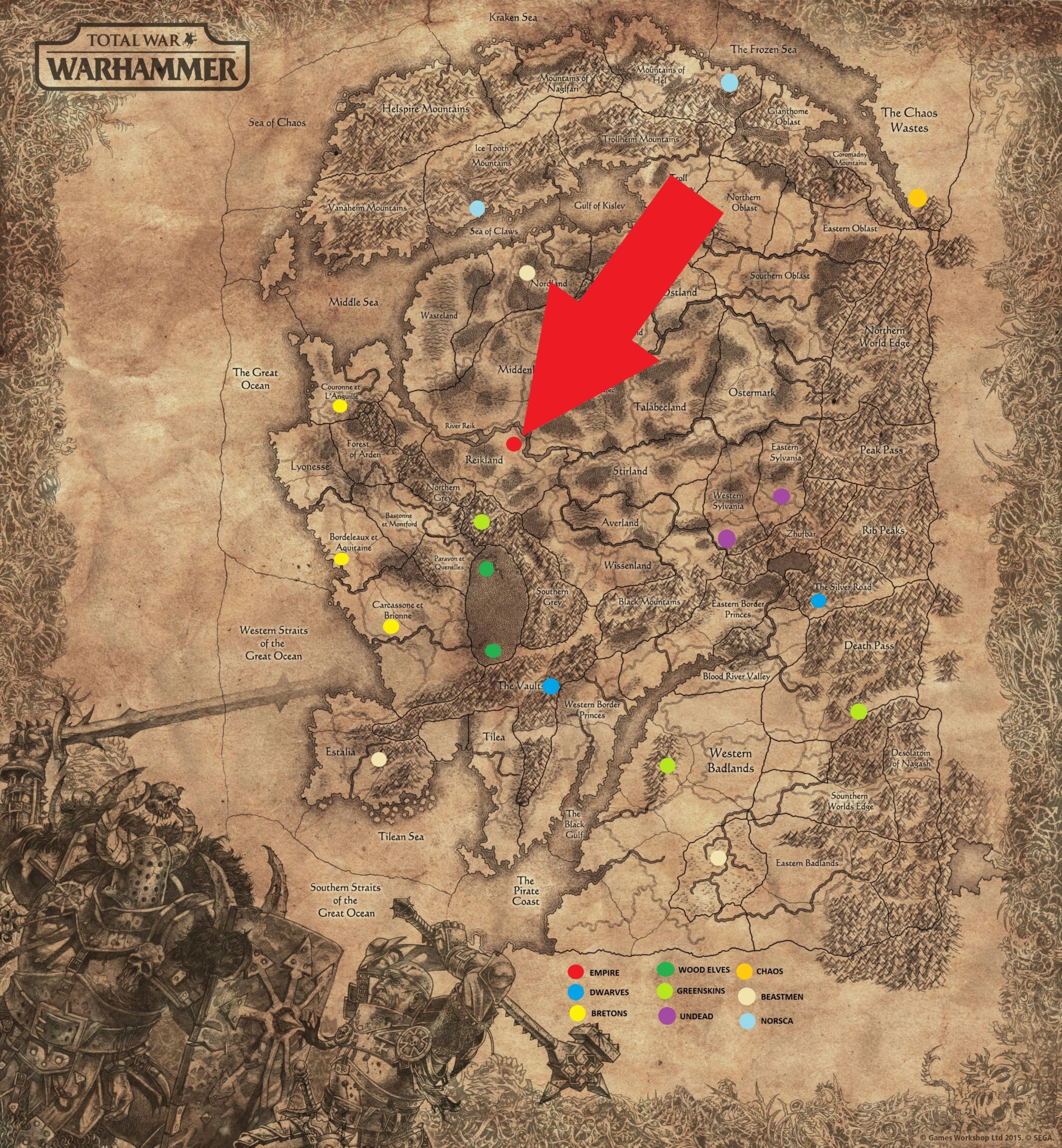
To give you an idea of the kind of scale I’m talking about, here’s a map of the first Total War: Warhammer game. The red dot is where you start if you’re playing as The Empire. Note the surrounding terrain:
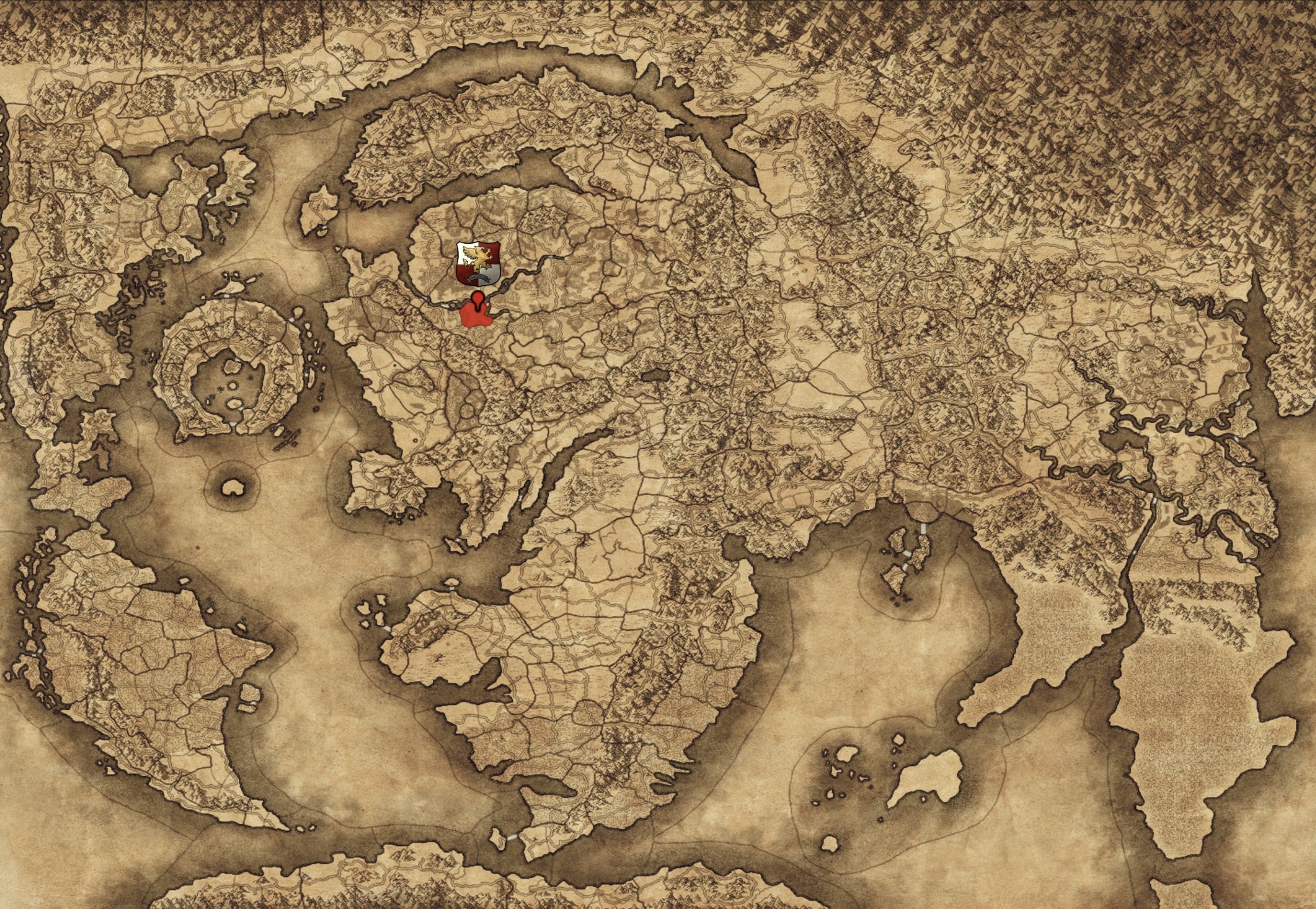
And here is the map for Immortal Empires. You start in the same region (the red), but holy shit:
I’ve been talking about size a lot so far and little else, but that’s really the whole point here. The game itself is still Total War: Warhammer III, which I’ve reviewed already, so if you want to know how battles work and economies and how pretty everything is, you can head there because nothing has changed.
Size is (ahem) important, though. Empire: Total War is still one of my favourites in the series, as broken as it is, because it felt truly world-spanning, as did Warhammer II with its cross-continental ocean voyages. That scale has gameplay implications as well. The more settlements there are to capture, the more factions there are to deal with and the more of the map there is to explore all give the player a lot more options during the campaign, leading to some truly intercontinental strategies that can span entire lands and races.
So how does this work, exactly?
While Immortal Empires is a free download, to be able to play it you’ll need to own all three Total War: Warhammer games. You’ll also need to own them on the same store for the game to recognise them. Multiplayer games, however, will only require the host to own all three (though which games other players own will determine which factions they can choose).
The sheer size of this map also presents some fresh challenges for a Total War campaign, while also serving as a bit of a throwback. The last decade has seen this series slide towards increasingly elaborate, scripted conditions for singleplayer campaigns, all in an attempt to try and alleviate a long-running issue where draw-out efforts to simply conquer the whole map got boring. But that’s basically what the point is here. To start small and paint the map, like the olden days, so if you were missing vintage Total War’s campaign simplicity, you’ll dig this, because older game’s endgame limitations have simply been addressed here by throwing more regions and possible enemies at you.
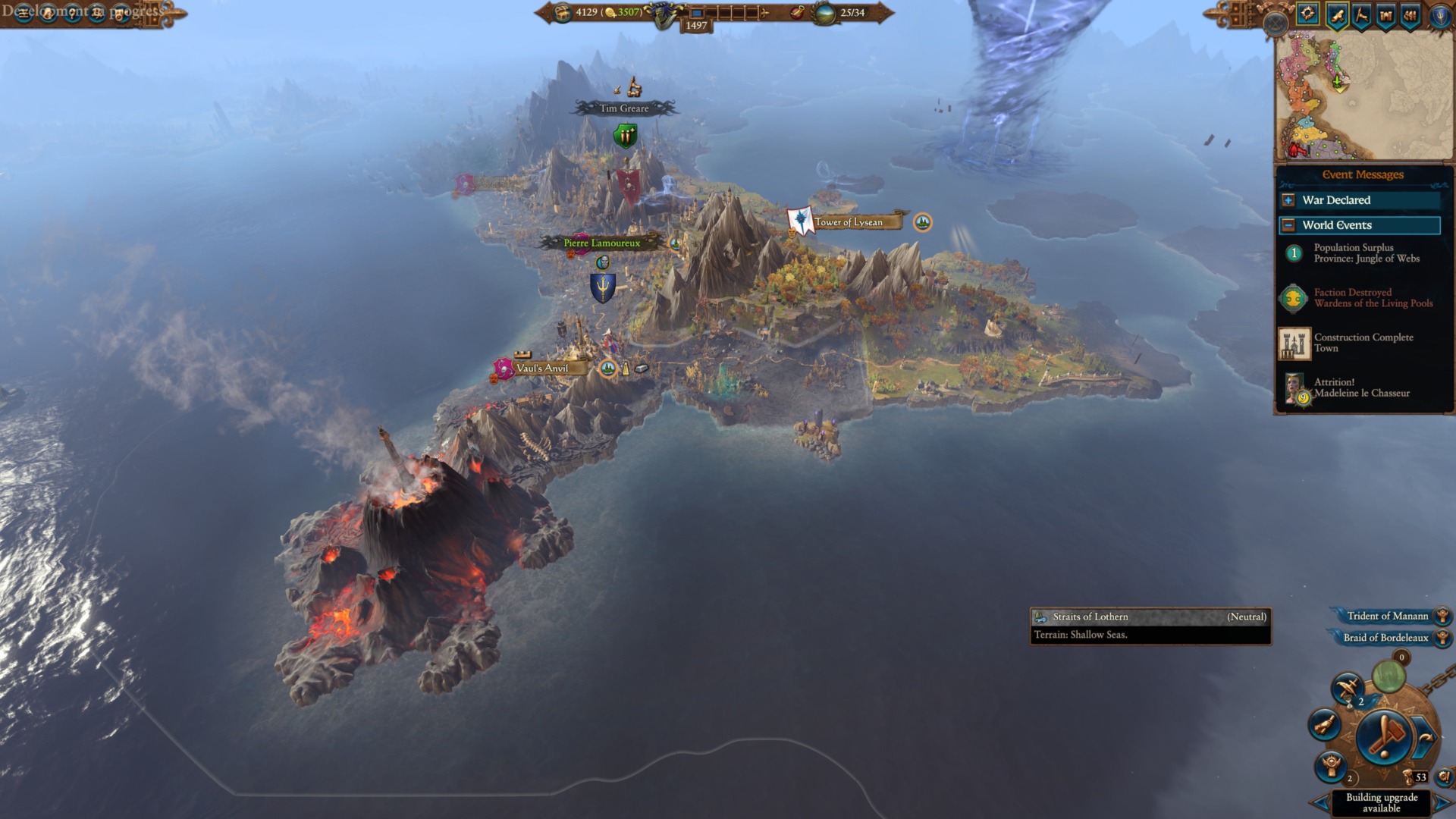
The design and aesthetic of the map are important as well, maybe more than you’d think for a strategy game. Total War campaigns are often defined not just by their map’s size, but their design and appearance as well. A dull one can sour the experience (Three Kingdoms, Napoleon), while a vibrant and interesting one can be a blast (Shogun II, Warhammer II). Immortal Empires, helped by the fact it’s simply combining three of the best maps in the series already, is definitely a case of the latter. Just look at everything going on here!
Immortal Empires is best thought of as a buffet, or a season box set. You already know what you’re getting, but now you just get more of it, all at once. You can boot it up, look at the map and start anywhere, being anyone. Want to be a human Lord? Sure. A vampire pirate? Why not. An Aztec lizardman? Knock yourself out. Or you can be a dwarf, a beastman or a member of the undead, and practically every time you start as one of the game’s seemingly endless number of playable factions you’ll be in starting in a new area of the map with new enemies and a fresh set of challenges.
The game’s size doesn’t always work to the campaign’s benefit, though. It can get exhausting. I didn’t finish my first two attempts because Total War’s classic rubber-banding AI—which will always try and check your advances just enough—starts to grind you down once you start threatening entire continents. If you’re looking at completing Immortal Empire’s larger victory conditions, then, you are in for a slog.
Mercifully the game knows this, and so has included a bunch of shorter objectives. Playing as the The Empire you can take over the world if you want, sure, or you can achieve a smaller victory by just uniting the forces of humanity, which is a much more manageable task. The endgame has been tweaked slightly as well; while it doesn’t have a single big arc like the main games, it does introduce some randomised events that can threaten even the strongest empires.
But wait, there’s more
Immortal Empires has released alongside the Champions of Chaos DLC, which bring four new Legendary Lords that are playable in both Immortal Empires and Realm of Chaos campaigns. While the big campaign is free, though, Champions of Chaos is a paid download .
You should know that while Immortal Empires has been deemed fit for public release, it’s still technically in beta, hence this being more of an impressions piece than a formal review. Creative Assembly have a lot more detail on thathere, but essentially it means that while the factions and the map all work, extra stuff is going to be added in the months and years to come. Surprisingly given all the disclaimers provided, and the dreaded prospect of playing on such a big map with so many AI factions, I found performance on my semi-decent PC to be just fine. Noticeably better than Warhammer III had been, even, which was a relief.
I’m sorry there wasn’t much more to add here other than “the map got bigger”, but hopefully I’ve got across the point that yes, the map got bigger but that also means something for a Total War campaign, and that the end result, something fans have been waiting years for, is everything you would have expected (except for the fact it actually runs pretty well, which might be the biggest shock).