The U.S. Army’s gamer to soldier pipeline is hardly a secret at this point, but new documents show its recent, detailed plans to spend millions to recruit Gen Z through gaming-related sponsorships and ad campaigns. The partnerships ranged from Call of Duty Twitch streamers to sponsoring content at IGN and G4, with the aim of familiarizing audiences with “Army values” and bolstering its reputation among young people.
The plans were detailed in internal Army documents obtained and published by Vice’s Motherboard on Thursday through the Freedom of Information Act (FOIA), and they include a breakdown of projected marketing spends throughout 2022. $675,000 was suggested for the WWE during June, $750,000 earmarked for the Call of Duty League and Paramount’s Halo TV show, and $300,000 listed for Call of Duty esports team, OpTic Chicago.
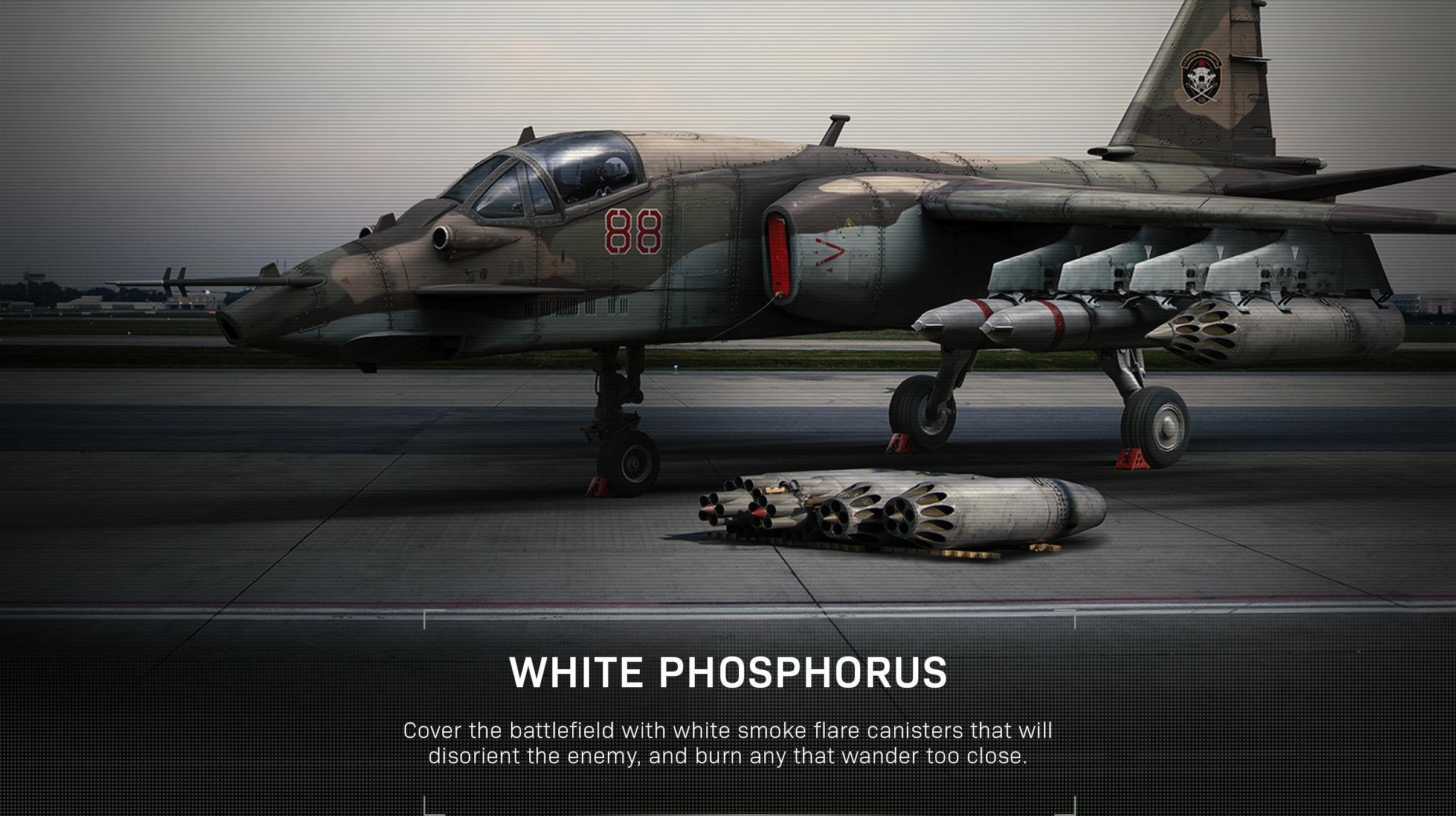
The idea was seemingly to use the popularity of Call of Duty, the perennial best-selling shooter that’s previously turned war crimes into killstreaks and violent geopolitics into bombastic playgrounds, to spread awareness of “Army values and opportunities.” One of the metrics for success when it came to partnering with Twitch streamers and media outlets was also to boost its favorability among survey respondents, especially among women and Black and Hispanic people.
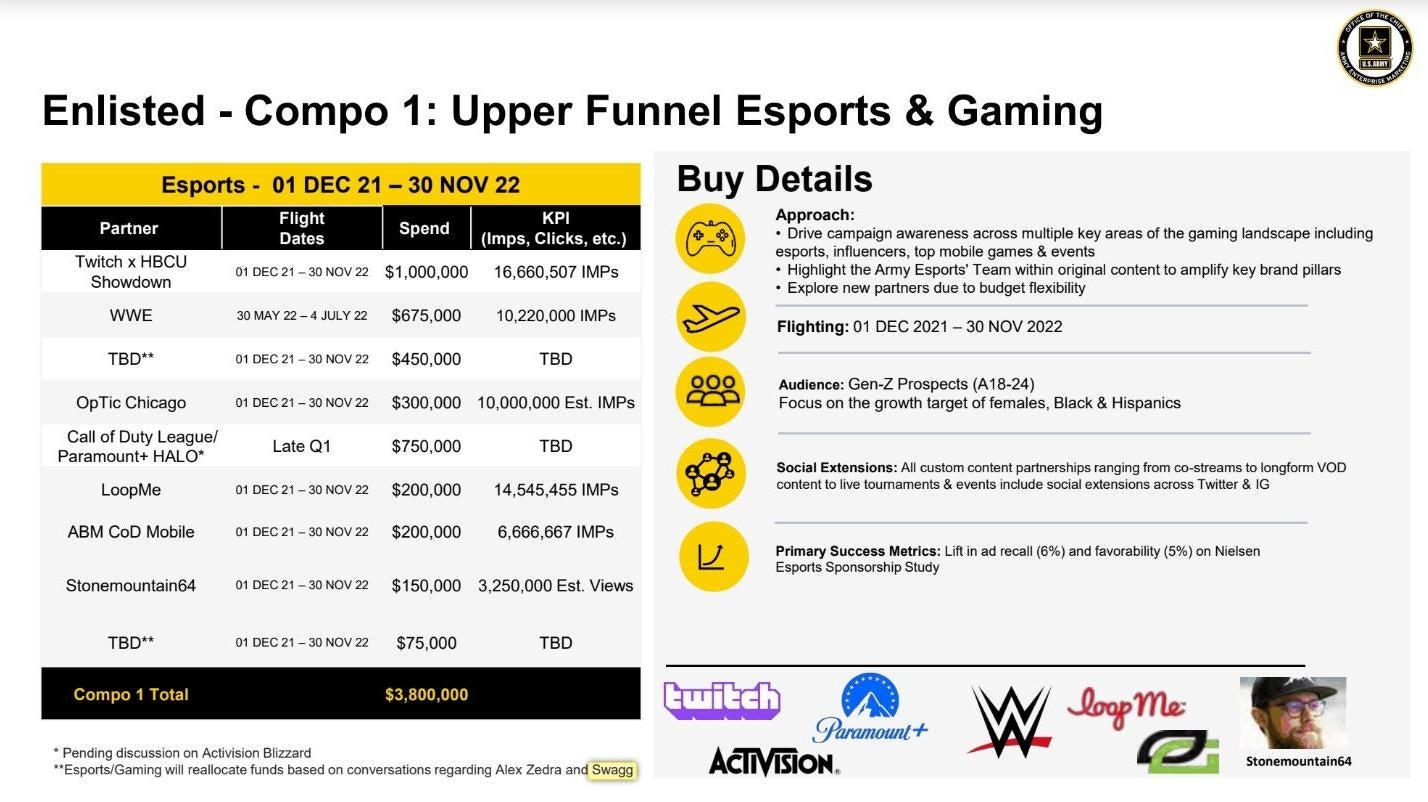
Notably, some previous sponsorship money for the Call of Duty League was rescinded back in 2021, shortly after Activision Blizzard was sued by California regulators over allegations of widespread sexual harassment and discrimination. A month after the lawsuit was filed and media reports began pouring in about workplace issues at the publisher, the Army’s Deputy Chief Marketing officer, Ignatios Mavridis, announced internal plans to “pause all activities immediately with Activision’’ due to the “serious allegations,” according to an email included with the marketing documents.
A copy of a stop-work order to DDB Chicago, Inc, which was subcontracted to do the marketing, detailed a Call of Duty League sponsorship that cost $1.1 million and an Activision YouTube media buy that cost $170,000. Mavridis also suggested the Army not send its esports team to participate in an upcoming Call of Duty tournament.
The U.S. Army’s Twitch Debacle
This isn’t the first time the U.S. Army has tried to make inroads with younger Americans on Amazon’s streaming platform. The Army’s Esports team used to have its own Twitch channel, but eventually abandoned the platform after being heckled by viewers over alleged war crimes and engaging in fake giveaways.
Read More: Amid Backlash, U.S. Army Retreats From Twitch
But the Army’s marketing plans extended to Twitch and some gaming media companies. $1 million was suggested to be spent on the streaming platform’s HBCU (Historically Black Colleges and Universities) Showdown esports league, though a Twitch spokesperson confirmed to Kotaku that it never ended up working with the Army on any sponsorships. The documents also point to discussions with big Call of Duty streamers David “Stonemountain64” Steinberg, Kris “FaZe Swagg” Lamberson, and Alex Zedra.
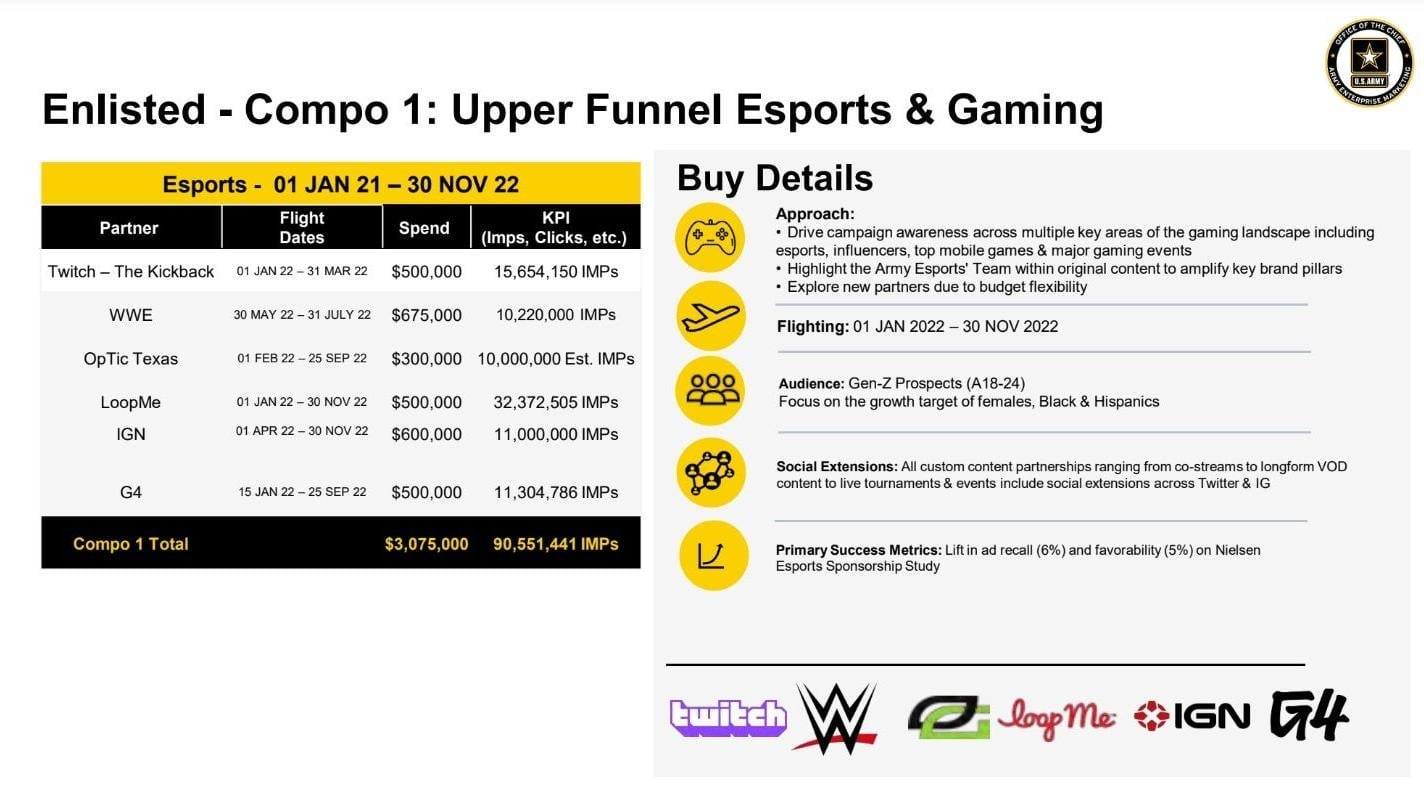
If you watched IGN’sSummer Game Fest coverage or Summer of Gaming showcase back in June, you may have noticed frequent ads for the Army. While we don’t know how much the Army actually ended up spending, the new documents suggest $600,000 for the world’s biggest English-language gaming site, and $500,000 for G4, the recently resurrected and then shuttered gaming network.
While some IGN viewers were critical of the website’s Army partnership, two former G4 employees previously told Kotaku that its own sponsorship was a source of much frustration internally. “Their response to pushback was that they understood that the G4 employees were largely liberal, but they didn’t want to alienate the right-wing audience members in any way,” one former staffer said.
Another described a tense meeting over the summer with G4 leadership where the issue was raised. Joe Marsh, G4’s last boss before everyone was unceremoniously fired via a press release in October, apparently responded by saying that the network wasn’t in a position to turn down any sponsorships. “The audience was audibly grumbling and, like, disgusted,” the person said. Some might consider it a testament to the ways G4 was mismanaged that a historically irreverent voice in the world of gaming had become so reliant on money from the U.S. military in the first place.
“Army Marketing’s goal for sponsorship is similar to all our advertising purchases which is to reach a specific market in support of Army recruiting,” a spokesperson for the Army told Motherboard in a statement. “Ad recall and favorability are important as they are both industry-accepted measures of effectiveness of the advertising and sponsorships we purchase. In Army marketing, we must meet the youth where they are and that is online.”
Update 12/2/22 11:21 a.m. ET: Added more context from Twitch.