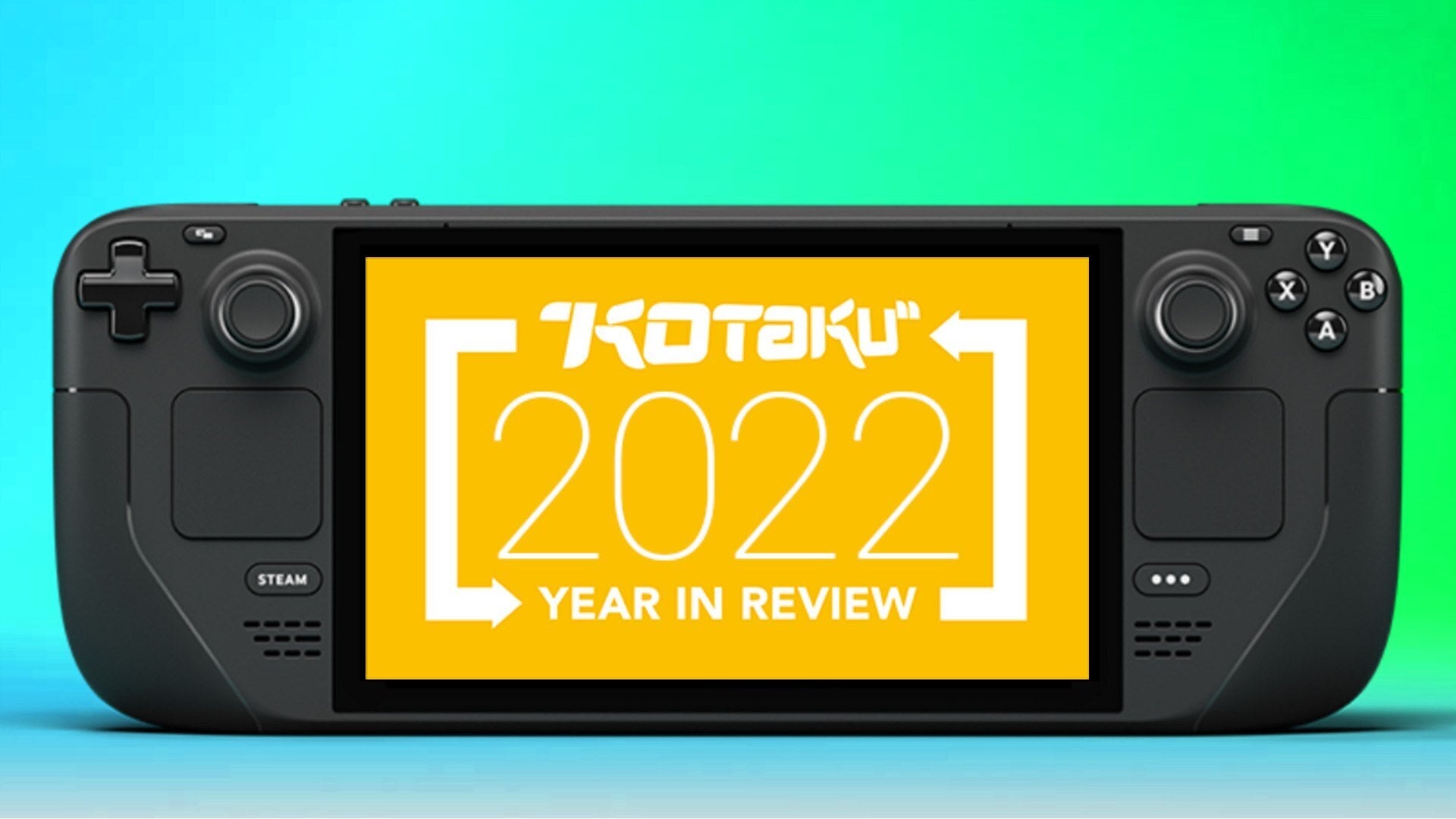
Though it’s hard to say whether or not “Steam Deck” has become a household name yet, it certainly deserves such a status after an impressive introduction. Valve’s mini-PC has had a one-of-a-kind first year, one that might make other platforms envious. After various attempts at getting into the hardware game, from the complicated Steam Machines and Steam Controller to the more successful Steam Link, Valve’s hardware ambitions finally landed with a remarkable, perhaps even industry-shaking, hit. In a JNCO-pocket form factor, the Steam Deck is a little terror of PC-computing power. And its connection to the Steam marketplace provides a library that no console could ever dream of upon launch.
Initially available via reservation, Steam Decks started shipping in February. Though this delivery window was itself a delay (Valve had been targeting December originally), that Decks began appearing at the doorsteps of eager fans so swiftly and regularly is kind of a miracle itself. The impact of the pandemic, and various related global supply chain and shipping issues have complicated a number of industries; consumer electronics has been notably hit. While the demand for, say, a PS5 is very different than that of a Steam Deck, we’re two years into the PS5’s life and it’s still a bit of a challenge to get one of those. Steam Decks though? Nowyou can buy one without a reservation. Shipping is typically the only waiting period.
Not only was the Steam Deck arriving more swiftly and reliably than a lot of other gaming hardware, it also arrived with a remarkable amount of games ready to play. True, this comparison might be a little unfair when you consider the fact that the Steam Deck is basically a gaming PC you can hold in your hands and not as much of a generational “platform” as, say, PS5 or Xbox Series, but look at a title like Aperture Desk Job. Released by Valve clearly as a way to demo the various features and graphical power of the Steam Deck, you are forgiven if you have never heard of it. Unlike, say, Astro’s Playroom, a similar kind of “game” to show off the PS5’s capabilities, there was no need to bide one’s time playing (with all due respect to Astro) demoware until “the good games” came out. Right out of the gate, the Steam Deck was delivering experiences like Control in a way we’d never experienced before; PC-gaming level graphics quality was yours to play on the couch, public transit, a park, or anywhere you damn please. Battery life might be a little tight, but when you consider the level of performance you’re getting, it feels understandable as opposed to limiting.
And as a portable console, the Steam Deck gives the Nintendo Switch some serious competition. Sure, unless you’re running an emulator (which even Valve admits to doing) the Switch will still have certain exclusives that aren’t as easy to obtain on the Deck. But the Switch has been out for a while, using an aging mobile processor—meanwhile, the Deck which is running actual PC-level silicon under the hood. Nintendo’s portable may have better battery life on average and the newer OLED model has a wildly prettier screen, but it’s starting to show its age. Meanwhile the Steam Deck is out here crushing it with Cyberpunk 2077 running in your hands. As Kotaku’s Zack Zwiezen noted in his piece, recent big titles like Bayonetta 3 and Alan Wake’s remaster struggle on the Switch. While the Switch might be the most mainstream out of the big three consoles, its sales are also starting to slow down, and more importantly, its ability to keep up with modern games is waning. Sure Bayonetta is exclusive to Switch, but the Deck is more than happy to provide thousands of modern, last gen, or classic games, sometimes with a flawless 60-frames per second.
Just over 10 percent of Steam’s entire library is “Verified” on Deck as of the close of this year, and countless others are playable with some patience, workarounds, and compromises. My Steam Deck arrived around halfway through the year and I can’t recall the last gaming device I bought—in its first year, no less—that had so many playable titles right away. And it’s not just great games, the Deck immediately impressed with its malleability as a piece of gaming hardware.
The Steam Deck runs a Linux-based operating system, much like the Steam Machines that came before it. But unlike the Steam Machines, Valve included an accessible “desktop mode” that, with some limitations, provides a recognizable desktop experience that’s fun to mess around with and surprisingly usable. This has allowed users to gain access to alternative storefronts like GOG or Epic with simple utilities like the Heroic Games Launcher. To be clear, this requires a little bit more computer know-how and even some hacking-lite skills, though all of which are easier than modding a console. But those learning curves have been flattened by the Steam Deck community and its willingness to craft and document clever innovations. Getting Epic Games Store games up and running is as simple, if not more so, than installing a mod for a PC game. Hit up Reddit or YouTube with a simple “how to install…” search and there are tons of tutorials for how to set up different storefronts, customize the boot screen, and more.
With great product availability, the ability to deliver your Steam library to you on the go, as well as other PC-based gaming storefronts, the Steam Deck has not had to justify itself unless portability just isn’t something you’re interested in. Sure, it has room for improvement, such as a desperately-needed better screen and better battery life, but few pieces of gaming hardware have shipped with such a powerful library of games with unique ways to play them. And that it’s all packaged in this open source software environment that’s incredibly customizable and moddable is the cherry on top. 2022 was a powerful year for the Steam Deck, and it’s only just getting started.