Big game gets hype. Big game comes out. No one seems to care. Big game flops. Life moves on. Except, these days, when all that happens, the big game still usually has a few months’ worth of DLC to drop. If that DLC is good, it’s a shame that so few people will play it.
Watch Dogs 2, a game with great open-world gameplay, a weird hipster-hacker tone, and a whole lot of undertow from people bitter about its inferior predecessor, had some good DLC that you probably missed.
It has the kind of DLC that doesn’t necessarily make headlines, because it’s not some sort of classic expansion that’s so good it should be its own game, à la the anti-slavery “Freedom Cry” adventure originally appended to Assassin’s Creed IV. It’s instead the kind of DLC that riffs—the kind that uses the gap in time between when the main game comes out and the add-on arrives to assume that the player has become really familiar with the game’s formula and is ready for some tweaks.
You can see the DLC-as-riff approach in the post-release offerings for 2015’s Rise of the Tomb Raider. The roll-out offered more of the same Rise of the Tomb Raider via the Baba Yaga DLC. But it also offered a different Rise of the Tomb Raider in the form of a survival mode, a non-violent side-story called Blood Ties, and even a weird challenge mode with random puzzles called Cold Darkness.
Watch Dogs 2 had two expansions, one called Human Conditions, the other No Compromise. Both added several more missions to the open-world game, which was already stuffed with things to do.
Human Conditions came out three months after the base game was released. It was marketed as featuring the return of Jordi Chin, a character from the original game. More interesting was a questline involving a self-driving car from Nudle, the game’s version of Google. In the fiction of the game, the self-driving car reads the rider’s biometrics, relates that to their “life score” and then secretly decides, in the event of a possible crash, whether to save the rider or the other people outside of the car who might’ve been killed in the crash. The car endeavors to keep the people with the best life scores alive. It’s a clever conceit that of course our heroic hackers expose, but not before they have to steal the car themselves.
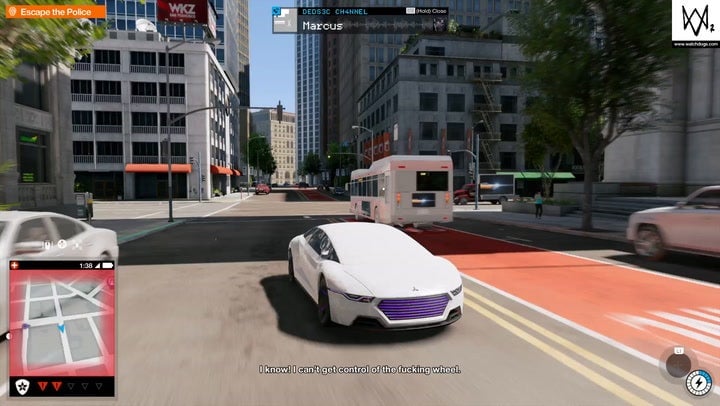
Human Conditions’ best riff on the game’s formula occurs during the climactic theft of the car. Watch Dogs 2, which is built on the open-world Grand Theft Auto formula, features plenty of driving missions. It also features a lot of hacking challenges, which usually involve node-connecting puzzles that are laid out in a wide variety of ways: across virtual computer screens or across the sides of buildings, across bridge trusses or maybe spread out on a floor. To steal the car, you first sneak into a TV studio, where the car is being featured. You get the car, turn it on, and, because it is self-driving, it launches you out into the city streets. The cops pursue.
Initially, you are given the liberty to use the many road-hacking skills you’ve earned while playing the game to foil the cops without having to worry about driving the car. This is a fun and empowering twist as you swivel the camera around, heedless about where the car is going, so you can force a pursuing cop car to drive off the road. Much better than that, however, is when your character, Marcus, decides to take the wheel. To get control, he has to hack the car while it is driving. Suddenly, Watch Dogs is presenting a hacking challenge on a moving vehicle, though at least you’re inside that moving vehicle. It’s a clever twist, and while it’s not that hard, it’s a smart combination of the game’s systems.
Watch Dogs 2 is amusing when it mocks real Silicon Valley companies and respectable when it pushes to portray a diverse cast of characters, but it very often just tries too hard with how outrageous its world is supposed to be. The prospect of playing a string of missions in its second expansion, No Compromise, set in the porn industry had me bracing for a lot of cringing. Eventually, you are indeed hacking through the security and camera systems in an expansive building where multiple porn movies are being shot. Sure enough there’s a lot of eye-rolling humor about how wild all of this is. You eventually take command of a robot that looks like a vacuum cleaner with tentacle arms and Marcus and his friends are all laughing about it.
Mechanically, however, what happens on the porn set mission is among Watch Dogs 2’s most interesting moments. The base games in the series establish the principle that you can hack into a camera and control where that camera points. If you can get it to point at another camera, you can warp over to that one and control it, too.
In various missions in both Watch Dogs games, you are thrown some twists. Cameras might be locked by a computer that needs to be hacked first. Cameras might actually be body cameras that move as the people who wear them move. All of that is explored most interestingly in the porn mission where you’re in an environment filled with cameras. There are security cameras, moving cameras, cameras shooting one scene here and one scene there. Hopscotching through them is an interesting challenge and one that shows how well this gameplay system could be used in a mission set in any movie studio’s lot, pornographic or otherwise. Watch Dogs could be a lot of fun, it seems, if it went Hollywood.
Watch Dogs 2’s DLC is made for people whose expectations were developed by the main game and were primed for something a bit different or a little more advanced. The missions feel iterative. They’re not shockingly better than what was in the main game, but they feel built with them in mind. They are a slightly more advanced course, slightly more mechanically involved, slightly more mature in their designs. They don’t transform the game, but amplify its existing strengths. They’re good, but likely missed. Watch Dogs 2, after all, wasn’t that big a game. It was supposed to be, but several months after the main game came out, most players moved on. That’s the gamble of designing games with a season pass. No doubt, though, they’ll try it again.