My first question for Watch Dogs was, “Well, what if I don’t want to shoot Maurice?”
“Sorry,” the game replied. “You are going to shoot Maurice and that’s all there is for it.”
It was the very first interactive moment of the game, and I had two things: A gun, and a prompt to shoot a cowering man.
I pulled the trigger and heard a click. Maurice screamed. Turns out, the gun was empty.
Okay, Watch Dogs, I decided. You and I are not off to a great start.
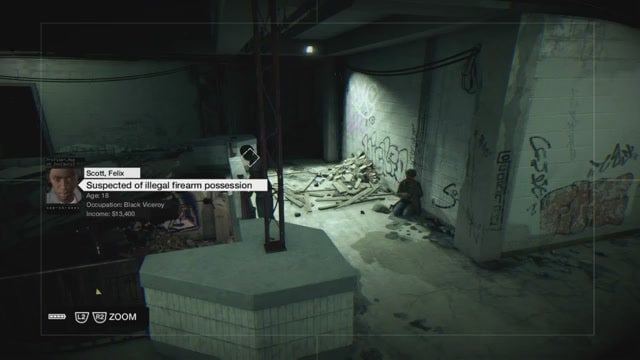
If you asked a Ubisoft marketing rep to summarize Watch Dogs in a single word, they would probably say “Hacking.” The game’s near-future Chicago is monitored by a new all-seeing security system called ctOS. The main character quickly gains access to ctOS, making it possible for him to use a smartphone to spy through mounted cameras, control basic city infrastructure, and peer into the private lives of the city’s citizens.
When Watch Dogs made its show-stealing debut at Ubisoft’s E3 press conference two years ago, the publisher seemed to be promising something smarter, something more dynamic, something more interesting than “Shoot Maurice.” As my boss Stephen Totilo watched that demo, he thought the same thing a lot of us thought: What is this game, where a guy takes down a city with his phone? Can it be possible that it’s about hacking more than it is about shooting people? Could this really be something different?
https://lastchance.cc/the-disappointment-of-video-game-guns-1538151848%3C/a%3E%3C/p%3E
Looking back on that moment almost two years later, he wrote:
For four minutes I thought I was seeing a wonderful, gun-free expansion of ways to interact with people and things in a video game city. There were four minutes of so many possibilities. Maybe, just maybe, no guns were needed for this new game to seem appealing and for the game to be fun.
Needless to say, the finished game involves shooting.
Lots of shooting.
The “Shoot Maurice” moment captures much of what makes Watch Dogs so frustrating. It is both a game that makes you shoot Maurice, and a game that attempts to subvert that impulse by surprising you (and Maurice) with an empty gun. It is both fresh and rote, both interesting and profoundly boring.
I’ve spent more than 30 hours exploring Watch Dogs’ city of Chicago. I’ve pursued protagonist Aiden Pearce’s quest for justice to its conclusion, and in the process I’ve crashed countless stolen cars, killed countless men, wasted hundreds of dollars gambling, and taken digital drugs that let me alter reality. Despite being in the middle of a real-life move from one state to another, I tried to relax and lose myself in the marginalia of big-budget video-game sprawl.
In the week since I installed Watch Dogs on my PS4 I have been alternately wowed by this game’s potential, annoyed by its many shortcomings, maddened by its worst missions, intrigued by its many hidden diversions, and ultimately unsure just where the game itself is located, like a body with ten arms and no heart, or a shattered ceramic sculpture, strewn about the floor.
With the whole Maurice situation over and done with, Watch Dogs makes a much stronger second impression. You stroll down a rainy Chicago street, one hand in your trenchcoat pocket, the other holding a mobile phone. With the press of a button, you can suddenly see personal facts about any of the citizens around you. This lady over here directs a high school choir. That guy over there makes cosplay. This lady makes only $17k a year. This guy is an avid video game player. You hack into someone’s phone and overhear a conversation. That guy’s cheating on his wife!
For a time, it feels as though anything is possible. You’ve got an entire city infrastructure at your fingertips! But of course, this is a modern big-budget video game, and it’s constrained by all the limitations that go along with that. Anything is not, in fact, possible.
You realize that the names and the information you’re seeing are randomly generated and serve no real function. You’ll see a person’s dark secret repeat, and then repeat again, and you’ll start to wonder how many Chicagoans are sex addicts. You’ll read the same text message exchange twice—omg I slept with a hot guy and then he robbed me!—and the illusion will weaken further
Hacking is Watch Dogs‘ best idea. It’s the notion that feels the freshest and, when it works, the most exhilarating. Watch Dogs shows us a game world with another world humming beneath it, a network of interconnected digital switches and currents. Change something in the virtual world and a door opens in the real one. Climb to a new vantage point in the real world, and you can access a new part of the virtual one.
Early in the game, I found my character infiltrating a Chicago prison, looking to have a word with a particular inmate. After sneaking past a half a dozen guards, I learned that my target was making use of the exercise yard up on the roof. I expected to have to make my way up a flight of stairs, and was surprised to see an objective marker telling me to head down to the basement. I made my way down, down… down to a bank of servers, where I hacked into the prison’s surveillance system and gained a bird’s eye view of the entire exercise yard. When Watch Dogs is at its best, physical space is reshaped into virtual space, and down is literally up.
Watch Dogs tells the story of Aiden Pearce, an overcoated tech lord with the personality of a loaf of bread. Aiden is a master hacker who at the start of the game has been spending his time pulling grey hat hacking jobs in Chicago and generally getting one over on the man. A job goes wrong, and someone sends a guy (Hi Maurice!) to rough Aiden up and scare him, that mission goes awry, and Aiden’s six-year-old niece winds up dead in the crossfire. Aiden blames himself for her death, assumes the mantle of “The Vigilante,” and sets off on a glum quest for sad revenge.
“The Vigilante” is just about the most uninspired superhero moniker I can think of, which makes sense, since Aiden Pearce is a supremely dull hero. He’s a 39-year-old man in a dopey baseball cap and an overly involved sweater, more or less what a suburban dad would come up with if asked to imagine a “cool hacker guy.”
I mean, look at this jerk:
The most unintentionally funny parts of Watch Dogs occur when Aiden sits in a car with his nephew and talks in his Batman voice. He’s telling his nephew that he cares about him, and wants to keep him safe, and the whole time he sounds like some guy doing a Dark Knight impression.
(For a good laugh, whenever Aiden ends a sentence or a conversation in the game, imagine him saying “I’m Batman.”)
Aiden’s story loses focus after a handful of missions, and in short order he’s gone from interrogating the man who killed his niece to murdering a millionaire pervert so that he can assume the man’s identity and attend an underground sex-slave auction, through which he can obtain information from the guy running security, who is a projects crime-lord named “Iraq” who has a secure server in his projects base housing a bunch of incriminating data that can only be accessed directly and… uh… did I mention the sex slave auction?
By the time Aiden was ramping a dirt bike through the countryside while helping a zany country guy fight off militia maniacs, I’d mostly lost interest in why I was doing what I was doing. That’s a shame, since it does appear as though the people who made Watch Dogs would have liked nothing more than to have made some sort of point about family, loss, and/or the perils of the modern surveillance state. Instead, the game succeeds only at saying that guns are cool and police helicopters are annoying.
Watch Dogs has spent five years soaking in the brine of the thirtysomething white guy, and those juices leak from every pore. This game feels aimed squarely at the predominantly male video game demographic and cares nothing for women or minorities, let alone any substantive investigation of real-life issues like the cultural fallout of sex trafficking or Chicago’s long history of racial violence.
One of primary groups you’ll be fighting is a gang called “The Black Viceroys,” a group of tech-savvy project hoods who embody blackness in the most uninteresting and trope-y ways imaginable. These guys talk ceaselessly about bitches and hos; they call each other “B” and say “sheeeit!” with regularity. “You there B?” they ask one another. Upon seeing a comrade get shot: “Yo, B’s been hit!” When engaging Aiden in combat: “Ain’t nothin’ can save you now, cracker!”
This video sequence, encountered partway through a story mission, pretty much sums up how Watch Dogs views black people:
Only one black character gets anything resembling character development; the rest exist simply to kill or be killed, or occasionally to engage in sexual assault while on camera. Toward the end of the game, I pondered just how many of Chicago’s young black men I’d helped Aiden Pearce murder. A hundred? Five hundred? A thousand? It was enough to make me feel like I was playing as some sort of weird techno white supremacist.
Meanwhile, female characters in Watch Dogs exist to be killed, kidnapped, or threatened in service of the plot, and the lone exception eventually proves not to be an exception at all.
“Most women die without purpose,” muses a villain at one point in the story, “but [this particular lady] had enough sense to die in front of the camera.” But in the world of Watch Dogs, the women do die with a purpose: To grease the narrative gears with their blood, moving things forward so the men can have a new reason to fight.
It’s not just that it’s lousy, it’s that it’s lazy, and that laziness permeates almost every aspect of Watch Dogs‘ story. The game never embraces a new idea when a cliché will do, and if you’ve seen techno-thrillers like Sneakers, The Net, Swordfish, Live Free or Die Hard or Hackers you’ve seen every narrative idea Watch Dogs has.
Guns work well in Watch Dogs—they’re easy to use, they aim straight, they carry lots of bullets. That’s a good thing, since you’ll spend a lot of time in this game shooting people. Like a lot of good modern action games, Watch Dogs allows for stealth at every turn, meaning that a nighttime creeping mission can quickly transition to an all-out gunfight and back to sneaking in a matter of seconds. The game does well when Aiden is on foot, creeping through an enemy compound, using his phone to hack into camera systems and reconnoiter enemy locations before surgically striking and vanishing into the shadows.
Other missions vary dramatically in quality. It wouldn’t be a Ubisoft Montreal game without a handful of unwelcome “Follow the guy who periodically stops and turns around” missions, though one of those is made humorously easy by your ability to simply hop from surveillance camera to surveillance camera, keeping tabs on your target without actually getting near him.
To my surprise, some of my favorite levels were the elaborate, combat-free environmental puzzles, which require players to hack open doors by finding hard-to-see circuit breakers. For a while I thought that I simply hadn’t arrived at a point in the story when these puzzles were accessible, but it turned out I simply wasn’t thinking laterally enough.
Things get far less enjoyable the moment Aiden gets behind the wheel of a car, and Watch Dogs spends an unfortunate amount of time on the road. We’ve built this great huge city, the game seems to say, and we’re gonna use it! Cars handle sluggishly and lack a certain drift that I’ve grown accustomed to, and every car chase eventually involves a huge group of enemy cars—either police or the anonymous “fixers” that fill in as the game’s faceless goons—attempting to drive you off the road.
Vehicles lope around corners in wide swings, the brakes and hand-brake rarely allowing for all that much finesse. Sometimes I’d collide with other vehicles and come away without a scratch, or hit someone headfirst on a motorcycle and simply grunt and remain seated. Other times I’d get rear-ended and my entire trunk would fall off. It’s all fairly crusty and never all that exciting or satisfying.
If Aiden attracts too much unwanted attention, the police will give chase. According to Watch Dogs, the Chicago Police Department is staffed entirely by ridiculous assholes, and escaping them is rarely less than a frustrating churn. Cop cars stick to Aiden’s vehicle like buzzing bees, ramming and piling into him with a level of gusto that’s one Yakety Sax lick away from pure parody. (Given the Chicago setting, it occurred to me that the goofy police chases could be read as a subtle Blues Brothers reference, but the game’s soundtrack isn’t nearly good enough to sell that.)
Several of the final missions were such a pain in the ass that I repeatedly found myself dropping my controller in my lap and exclaiming to the ceiling, “Why? Why? Who on earth thought this would be fun?”
For all its surface sheen, many aspects of Watch Dogs feel rushed and unpolished. Missions begin to repeat as the story draws to a close, as if the designers were simply falling back on tricks they knew they could make work. Okay, this one will have a car chase with a helicopter. This one will have some sneaking and shooting. This one will have a car chase with a helicopter. This one will have some sneaking and shooting.
Oddly, there doesn’t appear to be a way to go down ladders; you can only climb up them. The map doesn’t automatically trace a line to your next destination during a mission, meaning you have to go into the map to do it yourself. The soundtrack is a drab mess, alternating between a thrown-together playlist of licensed songs and a dispiritingly phoned-in score from the usually superb Brian Reitzell, who has earned so many accolades for his work on NBC’s Hannibal
There are no menu options to adjust the heads-up display or reduce the amount of visual clutter on screen. Enemy AI can be sharp one minute and ridiculously bone-headed the next. You’ll be able to access a far-away camera one moment, then unable to get it the next, accidentally triggering something else in the environment. In-mission checkpointing is generally horrible, with failure often starting players back at the very beginning. Worse than that, death will often mean that you have to watch an unskippable cinematic sequence before you get to play again, which just feels inexcusable.
The more I played, the more Watch Dogs began to pull apart into a collection of loosely affiliated design objects, a mess of shards of varying quality strewn all over the floor. There’s just so much stuff here, so many little things to do, so many ways to spend time outside of pursuing the main story missions.
Why does this stuff exist? Why can I play chess in this game, and what does the act of playing chess have to do with hacking, or the hazards of an Orwellian surveillance state? Did some game developer in some boardroom at some point simply proclaim that open-world games are supposed to have chess?
By the time I finished all the story missions, I was able to undertake the following activities:
• AR challenges that had me running and climbing through the city collecting golden coins.
• A game where I’d drive a flaming car through a red-skied hellscape, running over as many civilians as possible.
• A custom AR-game editor that let me make and upload my own coin collecting challenges.
• A psychedelic shooting game that had me defending against waves of enemies.
• A shell-game on the street, following a ball hidden under cups.
• An ordinary slot machine.
• QR codes hidden in perspective puzzles throughout the city.
• A game where I’d pilot a rampaging spider tank through the city and attempt to meet a series of ever-escalating goals.
• Time-challenge based hidden audio signals.
• Texas hold ‘em poker.
• A reflex-test drinking game where I’d do shots of liquor and then match button presses to keep from passing out.
• Not one but two different versions of chess.
• A game where alien robots have invaded Chicago and I have to evade them and return power to the city, cautiously avoiding their death-rays and using powerful EMP blasts to return light to the city. (No, seriously.)
• Dozens of Chicago “hotspots” that open up encyclopedia pages with information on the city’s history.
• Online missions that would task me with hacking and hiding from other players, “invading” their worlds and attempting to remain unseen.
• A “trippy” game where Aiden would bounce through a series of giant trampoline-like flowers, hollering with glee as goofy jazz honks away in the background.
• Missing persons investigations that focus on tracking down a serial killer.
• Hidden briefcases that eventually let players shut down a sex trafficking ring.
• Peeping tom side activities where you snoop into the private lives of the people of Chicago.
• Tech towers that function as elaborate environmental puzzles, unlocking safehouses and additional collectables on the map.
• Dozens of various “fixer contracts” that have players ambushing convoys, raiding gang hideouts, stealing cars and the like.
• Hidden weapon crates that can be tracked down in an effort to take down a group of smugglers.
Some of these tasks are dull. Others, notably the spider tank missions, the alien robots and the clever environmental puzzles, were good enough that I wished they were featured in the main campaign. And the seamless multiplayer events, in which players can invade your game and force you to spend several panicked minutes playing a deadly game of hide-and-go-seek, are genuinely fantastic.
Each of those things is a separate shard of some theoretically unified whole, and as I crawled around inspecting them all, I couldn’t help but feel farther and farther from whatever essential core Watch Dogs might have once had. That’s okay, to a point: If the essence of a game is lazy writing, boring characters and annoying car chases, it’s probably better to leave that all behind and go crush things in a giant robo-tank.
Version Check: I played through Watch Dogs on the PS4, though it’s also available on the PS3, Xbox One, Xbox 360 and PC, with a Wii U version coming at some unspecified point later this year. The game looked nice enough on Sony’s new console; not as lovely as last year’s Assassin’s Creed IV, but still sharper than a last-gen game, particularly when it came to smoke, sunlight and explosion effects. That said, the colors and lighting look washed out, and the game doesn’t have anything close to the glossy sheen of new-gen-only games like Infamous: Second Son or Ryse: Son of Rome, nor does it match the visuals on display in its own impressive E3 debut.
As for the PC version, it theoretically looks good on ultra settings but runs incredibly poorly. My mid-tier gaming PC was unable to maintain 60fps even on low settings; performance would oscillate wildly between a solid 60 and the 30-40 range. Furthermore, the mouse and keyboard controls are questionable at best, with commands mapped all over the place with little regard for intuitive flow. And of course, the PC version requires Uplay, an increasingly unnecessary-feeling game client.
Toward the bottom of my review notes is a single line: “Watch Dogs is not Gunpoint.”
I can’t remember the specific thing that made me write that, but it remains one of the truest things I can say about Ubisoft’s game. It would of course be unfair to expect one game to be another, different game, but the contrasts between the two games serve to illuminate how Watch Dogs loses the thread.
Gunpoint is a simple, focused game created by a single person. Much like Watch Dogs, it casts you as a dude in a trenchcoat and a spiffy hat and tasks you with hacking your way into buildings, sneaking around guards, and absconding with data while navigating an ever-more-elaborate web of intrigue and betrayal.
https://lastchance.cc/gunpoint-the-kotaku-review-511051656%3C/a%3E%3C/p%3E
The upside of this approach is that even if the main dish is less than appealing, the side dishes might make up for it. The downside is that the essence of the game will almost surely be diluted, and all that time and effort spent embellishing optional extra junk could theoretically have been spent making the core game better, more complex and more interesting.
Instead of focusing on its one best idea, Watch Dogs tries to do a hundred different things. It does some of those things well. It does other things poorly. But while both Watch Dogs and Gunpoint offer their share of pleasing challenges, only Watch Dogs makes you get down on your hands and knees and spend hours sifting through the rubbish to find the best bits.
Watch Dogs was created by so many people that at times it feels like it wasn’t created by anyone at all. It’s almost as though it sprang forth, fully formed, when someone entered the words “Gritty Dude Chicago Hacking” into a computer.
The machine barked to life and spit out a mountain of idea-junk, burying the room in the ramblings of its robot brain.
“Play my game,” the robot implored us. “Go ahead. Go to Chicago. Shoot Maurice, open your phone, and see what you see. I promise that eventually, you’ll find something you like.”
Sorry, Mr. Robot, but no sale.
To contact the author of this post, write to [email protected] or find him on Twitter @kirkhamilton
For a second opinion, check out the TAY Review over at our reader-run blog, Talk Amongst Yourselves.