“Nintendo, man,” my friend Jeremy said to me. “You’ll fall in love with them. But then they’ll break your heart.”
I had just shown up at his apartment to lend him my Wii U for the week or so I was going to be in California last month. Watching as I opened my bag and placed a pile of games and gadgets on his couch-side table, his eyes lit up with a hunger I’d never seen before.
“Are you trying to kill me?” he asked, looking down at the feast I’d just placed before him. This was an eagerness I was only just beginning to understand.
See, I wasn’t a Nintendo kid growing up. As much as I begged and pleaded with my mother, she never caved in to buy me an N64. She didn’t let me or my brother have any consoles, but not having the N64 hurt the most. It was the gold standard among my friends, and there was no game more inescapable than Mario Kart
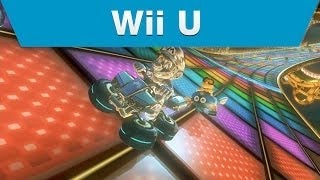
Ok, maybe Super Smash Bros. But Mario Kart had a unique charm that even Smash couldn’t approximate. It was like watching the Super Bowl—whether or not you actually enjoyed it was irrelevant. Everybody had to get in on the action in some way. Turning down an invitation to take a spin on Rainbow Road was like breaking some unspoken, sacred vow.
What other video game has achieved that level of cultural ubiquity? It’s all the more impressive given that Mario Kart did so in a place so far from its point of origin.
Flash forward 18 years, and gamers the world over are waiting on the next great Mario Kart (8, to be specific) with bated breath. But many others like Jeremy have given up on Nintendo. His tangible excitement shifted to talk of heartbreak after I boasted that I wasn’t only going to play the new Mario Kart in less than a week, but I was actually going to get to talk to some of the great minds behind the legendary series.
He was surprisingly unimpressed. When I asked why, his answer was simple: he’d grown tired of waiting for several years every time he wanted a new one.
Part of my job as a journalist is to serve as a sort of conduit between these two bodies—the teeming masses of anxious fans and the developers who want to do right by them. This is always a delicate balancing act. But it’s one that’s become particularly fraught any time I sit down in front of someone from a core Nintendo franchise. As Leigh Alexander recently remarked in a thoughtful piece for Gamasutra, the company’s current financial vulnerability has inflected all of these conversations with a special kind of emotional urgency—one I don’t remember feeling whenever I’ve sat down with someone from Sony or Microsoft to talk about their next-gen console plans.
The stakes only get higher every time a new Wii U game comes out and doesn’t immediately translate into a significant boost in sales for the flagging console. And that’s despite titles like Super Mario 3D World, Pikmin 3, and Donkey Kong Country: Tropical Freeze all receiving high marks from critics and fans alike.
The people at Nintendo clearly understand the tenuous position they’re in right now. Barely two months ago, CEO Satoru Iwata took it upon himself to personally apologize for the Wii U’s less-than-auspicious debut. Concerns about the console’s ambiguous future sit there stubbornly in the subtext of every casual conversation and formal interview I have about the company. It was something I was planning to ask about in my one-on-one phone interview with Kosuke Yabuki and Hideki Kono, the game’s director and producer respectively. I didn’t end up bringing it up, but that was because my interview was rearranged to be fit into a roundtable with a handful of other journalists.
Nintendo interviews have always been hard for me. There are logistical hurdles—the reliance on a translator, the time difference between a place like New York or San Francisco and the company’s Japanese headquarters. But there’s a profound cultural difference there as well.
I still can’t tell which of these factors is more persuasive. But by the time I walked into a small room in San Francisco’s Intercontinental Hotel last month, I could tell that the circle of journalists I joined weren’t happy. We had all gathered around a speaker placed on a small coffee table to hear from Mr. Yabuki and Konno. Two Nintendo representatives sat behind us. They’d closed the windows to shut out any commotion emanating from the street below us, so the room felt uncomfortably warm. Stagnant even. Everybody shifted back and forth in their seats quietly.
I suppose this is the point where I’m supposed to start digging into the minutiae of what we discussed. The reason the two of them offered for why they chose to include all seven of the koopalings. The improvements they felt they’d made from previous iterations of the series. The sheer HD-ness of the visual splendor thanks to its new home on an HD system.
But doing that would feel dishonest. Not because anything they said was untrue—you don’t have to look any further than our preview of the game to see that Mario Kart 8 is breathtaking. There’s a certain kind of joy I’ve only really felt playing these core Nintendo games. But trying to capture that same sense of elation when I was given this rare opportunity to hear from the people who actually made me feel this way proved much more difficult.
I don’t have any easy answer for why that’s the case. But I know I wasn’t the only one who left that room feeling frustrated. At one point during the roundtable, one of the other writers stood up, silently motioning to the Nintendo reps that he had to leave.
That put me in a tight spot. I had rushed to the interview from an already more-than-full day of racing back and forth in a massive convention center and chugging coffee between meetings, so the moment I sat down for the roundtable I realized I was going to spend most of the hour I had with them fighting the urge to run to the bathroom.
A few minutes later I gave in and excused myself. Opening the door, I ran into the other writer, who was returning to pick up something he’d left behind.
“You’re leaving too?” he asked. I said no. There was something I’d always wanted to ask the Mario Kart team, and I didn’t know if I would get another chance.
“I just couldn’t take it anymore,” he said, sighing. “All the PR bullshit.”
I could see what he meant. Before he left, he’d asked them about the game’s TV features that could let players capture gameplay footage and potentially share it with one another.
There was a pause as the question was translated. A few minutes of chatter on the other end of the line. Then the translator responded, speaking for Yabuki.
“We’re not going to focus too much on some of the stuff you asked about, but I’ll tell you what I can.”
Yes, he continued: players will have a degree of flexibility when it comes to recording their races. They can choose what character to focus on. They’ll be able to choose how long they want the videos to be. And they can adjust the sound levels for the clips.
“We haven’t implemented features that allow the user to go in scene by scene and do really finite adjustments to the camera,” Yabuki explained. “But we set up the overall system to focus on what we think the players will enjoy seeing. And I think what we’ve come up with will, again—with adjustments by the player to the character, the sound, the length of the video and whatnot—create a highlight reel that they’re happy with.”
Then Konno jumped in. Of course they could have made the system more intricate, he said. But they wanted to make “nice and simple, to get as many people to use it as we possibly can.”
That final point—opting for the simplest user experience possible in order to optimize the accessibility of the game—came up a lot at the end of their answers. I’ve only interviewed Nintendo developers a handful of times, but I’ve heard that same refrain every single time. Regardless of who was speaking or what game we were discussing, they made many of their design decisions because they wanted everyone to be able to play the game and enjoy it. If not literally everyone, then at least as many people as humanly possible. The only exception was with Tropical Freeze, a game that’s so brutally difficult I have trouble imagining how parents and children would play the game together. But even then, the developers told me that they made it that way to keep with the series tradition and not disappoint longtime fans.
There’s something touching to this logic—both in Nintendo’s universal aspirations and in the concise, technocratic way everyone from Shigeru Miyamoto to a third party PR person explains it. But it’s hard to keep having the same warm fuzzy feeling after hearing the same response over and over again. By the time it came to my second turn to ask a question in the roundtable, Konno and Yabuki must have felt pressed for time to keep hammering that point home. Or something else had come up on their end of the line. I can’t really say for sure what was going on halfway across the world. In any case, they stopped short in the middle of answering my question.
I knew we were getting close to the end our allotted time, so I wasn’t even trying to ask anything particularly pressing. Really, I’d just always been curious why they’d never revisited the buddy system from Double Dash, the GameCube’s Mario Kart installment and one of my personal favorites.
I was speaking more as a curious fan at that point than a writer with a job to do. But Konno’s answer still came across as one of the most surprisingly unscripted parts of the interview.
“It wasn’t just a simple case of: ‘Hey, we’re not gonna do that again,'” Konna replied. They were happy with Double Dash, and thought it worked really well in that game.
“So we’ve got that in our pocket,” he continued. “If we come up with any cool new ideas that involve two players racing together, we’d definitely grab that and bring it back out.”
I leaned forward.
Having multiple characters on a single vehicle did come at “a pretty high cost in terms of processing power,” Konno explained. But they were also working with a more powerful piece of machinery than they ever had before. So if they could figure out “some ways to get around that cost,” they’d certainly consider revisiting having two characters. Heck, they’d even consider three.
Then, all of a sudden, he stopped. A moment later, I heard him talking to the translator again.
“Mr. Konno believes that that answers your question, Yannick,” the translator said. “But he also has a question for all of you: During your time with Mario Kart, were you able to hear the background music pretty well?”
I looked around at the other writers, who all shrugged and shook their heads.
That’s too bad, the translator said, because this was the first time they had recorded live music for the game. The team had challenged themselves to get real instruments and time in the studio this time around. It wasn’t in every single course, but “definitely more than half.” The team knew that it’s been “highly documented” in the media that other franchises like Super Mario and The Legend of Zelda used live orchestration, so now they thought it could be Mario Kart’s turn.
“So that’s my brief advertisement for the music,” he concluded. “And that’s everything from Mr. Konno!”
I wanted to hear more (a lot more) about playing with three different characters at the same time. But time was up. Konno and Yabuki said their goodbyes, and we all shuffled out of the room. That was that.
I don’t want to read too much into this moment. That wouldn’t be fair to Mario Kart 8 or to all the people who made it. And really, I enjoyed playing the game enough that I’m not really sure it even matters. But it did tell me something about just how hard it is to genuinely communicate with someone when you’re trying to speak to them from halfway across the globe and in another language.
Yannick is Kotaku’s resident Shy Guy. Reach out to him on email at [email protected] or find him on Twitter: @YannickLeJacq