Many people who went to film school will tell you that film school made them hate watching films. In a similar fashion, as someone who has worked on triple-A video games in the past, the only thing that impresses me about triple-A video games is the amount of work that goes into constructing them. Project managers and producers are the miracle workers of triple-A game development.
I’m hardly being facetious when I say that the most impressive thing about Assassin’s Creed III is probably that they got 300 people to work together on one thing without that thing falling apart at the seams. And when they’re done, triple-A games are virtual tourism at best—and what an amazing place Assassin’s Creed III has made for us to virtually visit.
The Problem, as it were, for me, is that once I’m in the beautifully-realized virtual tourist destination, my brain snags on all the little things I can’t do. Before you comment about me being a hateful, snippy jerk who simply gets off on tearing things down, realize that “details” is actually my job description. If no one ever complained about not being able to talk to his mom from 500 miles away, would anyone have ever invented a telephone?
Having said that: Assassin’s Creed III as virtual tourism is, to me, like the police clamping a security collar on my neck the second I get off the plane a Honolulu International Airport: “This will explode if you remove a single article of your clothing; enjoy your stay, [asshole].” For the sake of argument, let’s say I was wearing a pair of jeans, hiking boots, and a heavy leather jacket as I got off the plane: this is not an enjoyable surfing outfit.
My ideal video games are muscle-memory buffets, silver platters piled high with the finger-food of 20-millisecond-long psychic screen / finger coordination contests.
Prolonged exposure to the inner clockworkings of triple-A games has only heightened my sensitivity to my reason for engaging professionally with games in the first place: I enjoy games for their great “physical” moments. My imagination thrives during momentary sparks no longer than a small multiple of 11 milliseconds, during which a turnabout occurs, and “nothing is happening” becomes “something is happening”. Parrying in Street Fighter III, aiming in Under Defeat, skidding and turning around in Super Mario Bros., and countless other similar actions inspired me to someday get involved with making games.
In other words, my ideal video games are muscle-memory buffets, silver platters piled high with the finger-food of 20-millisecond-long psychic screen / finger coordination contests.
You’d think this makes me the perfect candidate for a guy who’s going to call Halo 4 “The Game Of The Year”.
I hate to let you down: I am an antisocial jerk; I can’t get my head around the task of loving the modern first-person shooter’s faceless online multiplayer contest component. Every FPS these days feels like it’s trying to be chess, and forgetting how good Quake III was at being checkers. Quake III! Man, that game had such a viscerality about it. It was like soccer on a field the size of a hockey rink. It was like baseball played to speed metal. It was like basketball with guns. It was like Connect Four played to a metronome. It was like checkers, where you’re shooting the checkers. FPSes these days are like chess with chimpanzees, where the meta-goal of not getting feces crammed in your ear canal becomes more important than checkmating the other guy. (I mean that critically, metaphorically, and politically.)
So, in devoting my time to developing, designing, and consulting on mobile games, by playing tens of hours a month of mobile games, I have developed an appreciation for mobile games.
Gasketball
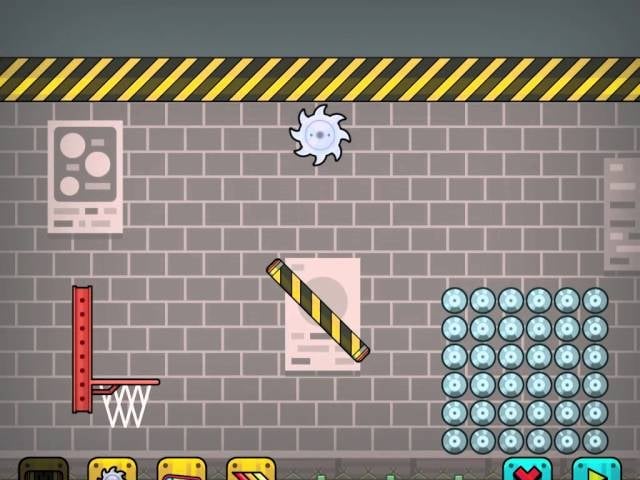
Gasketball (developed by Mikengreg for the iPad) is my favorite game of 2012. It is the “silver platter piled high with the finger-food of twenty-millisecond-long screen / finger coordination contests” that I yearned for just three paragraphs up.
Gasketball is a touch-controls physics puzzle game—you know, like Angry Birds
Oh no—maybe I scared you away. Come back!
First of all, now that you’re back: get over yourself. Angry Birds is not that horrible. Just because somewhere out there a die-hard Angry Birds fan rolls their eyes just as fiercely at the notion of a first-person shooter as you roll your eyes at the notion of Angry Birds doesn’t mean you should write the game off. Just because Angry Birds isn’t great art doesn’t mean it’s trash. Well—actually, yes, Angry Birds is trash, though it’s not, like, a half-eaten slice of pizza: it’s more like a perfectly clean chair that someone threw away.
What Gasketball Does is pull Angry Birds’ lasting appeal kicking and screaming into constant urgency. It does this with Incredible Controls and Superlative Level Design.
Angry Birds is a game about “selection”: you select an angle and power level at which to launch a projectile toward a pile of objects. The goal is to knock the objects over, crushing targets. The projectile is a “bird”, and the “targets” are pigs.
I say Angry Birds is a game about “selection”, and I put “selection” into quotation marks lest you mistake this for my saying the game is about “choices”. It’s not about choices: you have no choice. This isn’t Bioshock, where you choose to kill the innocent little girl or not. The “choice” in Angry Birds is already made for you: kill the pigs.
In Angry Birds, you don’t even face the choice of how to kill the pigs: you kill the pigs by shooting a bird at them.
Angry Birds‘ levels are puzzles during which you must select which objects to aim your bird at: either the pigs themselves, or numerous breakable or bumpable blocks or walls which can fall over to either damage the pigs or cause them to fall to their death.
Angry Birds gets inside people’s brains because it turns a tiny, seemingly frivolous selection process into an adventure. You “wind it up and watch it go”: you pull the bird back and release. The bird then journeys quickly rightward, and for a few breathless seconds you either doubt or believe in your aim. Sometimes the bird begins to deviate from your grand plan, and you groan—and then become hopeful: maybe some weird miracle will happen? Your brain is never exactly able to figure out the game’s physics; its unpredictability will keep you guessing for tens upon tens of hours.
Here’s the thing, though: Angry Birds is by no means a “mobile” or “touch” game: you could play it with a keyboard. You could be pressing up and down to angle the bird, and left and right to pull the slingshot back or push it forward a degree at a time. You could press the spacebar to fire: this is how we played Scorched Earth and Gorillas on our PCs way back in the days before Doom
What Gasketball Does is pull Angry Birds’ lasting appeal kicking and screaming into constant urgency. It does this with Incredible Controls and Superlative Level Design
Let’s start with the level design. Angry Birds‘ levels are structured questionably:
The player can zoom the game in and out as they see fit
The level can be any number of screens in width
The level can allow the player any number of birds
The level can allow the player any number of different types of birds
The level can allow the player any quantity of each different type of bird
From start to completion on a successful play, an Angry Birds level can take up to a minute
Gasketball‘s levels, on the meanwhile, leave no questions:
Levels are one iPad screen in size
The screen never zooms in our out
The player can finish every level in one shot
Finishing a level in one shot is, in fact, the game’s foremost goal: the goal is always, always to shoot the basketball through the hoop
Players have one type of ball: it is a basketball which behaves like a basketball
From start to completion on a successful play, a Gasketball level can take up to five seconds
The Gasketball User Experience for the single-player mode is not unlike many other physics puzzle games: the game gives the player five levels to complete, and five balls to complete said levels in. If the player completes the five levels in less than five balls, the game gives the player a ranking (bronze, silver, gold) and unlocks the next five stages.
Important: the game allows the player infinite balls to complete the five levels. This is important because it means that any player, regardless of skill level, is allowed to, at least, see all five levels in the current deck. The trick to unlocking the next deck, of course, is obtaining enough skill to complete the five levels with no more than five balls.
Once you’ve unlocked all the level decks in a set, the game lets you undertake a speed trial: with unlimited balls, try to finish all 20 levels in less than 90 seconds. Though at first 90 seconds feels like not enough time, after 50 hours with Gasketball, the time limit basically doesn’t exist anymore: that’s how good you are.
Clear all of the level sets in a world, and you open the next world. As you progress through worlds, the game adds new obstacles into and subtracts old obstacles from the level design rotation. Advance further, and old obstacles come back with higher prominence. The game becomes a chunky soup of brain activity. Polishing your skills—at shooting specific angles, at shooting versus particular objects, at shooting versus specific combinations of particular objects, at shooting in general—becomes a soul-engulfing endeavor. It is all training for Something Much Bigger.
Of course, it wouldn’t work if the game’s only player action weren’t so spectacularly perfect.
Shooting in Gasketball
The reason Gasketball is better than any other physics puzzle game is in its milliseconds: shooting the ball is a perfectly realized, ocean-deeply nuanced action.
Unlike Angry Birds‘ slingshot, it is not possible to map Gasketball‘s shooting mechanic to a keyboard. Moreover, you couldn’t even map Gasketball‘s shooting to an analog stick, or a combination of analog sticks, or even to two analog trigger buttons. Trust me: I’ve sat around trying to figure it out. It can’t be figured out: Gasketball is a touch-screen game for touch-screen devices (or for two analog sticks and two analog trigger buttons simultaneously, though let’s not get into that particular 20,000-word description).
Here’s how you shoot in Gasketball: you touch the ball, push it, and then release it.
The ball in Gasketball sits inside what I call a “control area”. Different stages’ control areas have different shapes and sizes, though let’s not get into that.
Slide and release the ball within the control area to shoot. Smaller control areas give you less range of motion in which to apply nuance to your shots.
Shots, however, are never just about their direction. Between touch and release, you can affect the shot by pulling, twisting, swishing; the ball controller logs the acceleration and speed of your finger over such-and-such number of pixels of distance—so that every time you let go, the ball flies in a snowflake-unique trajectory, at a snowflake-unique velocity.
It takes you no more than 18 thousandths of a second, most of the time, to touch the ball, apply a nuanced swishing English, and release.
Shooting the ball into a hoop a quarter of a screen width away from the starting point will at first feel like grocery shopping in figure skates.
Here’s where you say, hey, that sounds like something you could control with a mouse click, a quick wrist flick, and then a release. And I’ll tell you: yes, you could. Though it just wouldn’t work the way it works with a finger. There’s that part in Steve Jobs’ biography where someone insists on packaging a stylus with the iPad, and Jobs says no, that humans have 10 styluses right there on their hands. Gasketball is like that.
At first the game might feel mosquito-bite sensitive. Shooting the ball into a hoop a quarter of a screen width away from the starting point will at first feel like grocery shopping in figure skates.
“Why can’t this just control just like Angry Birds?” a friend asked. The friend, for the record, doesn’t even like Angry Birds
The answer is simple and complex: this game wants you to master its deliberately difficult yet purely intuitive control implement. You will love to shoot the ball because the ball loves to be shot.
You might, at first, have trouble getting the ball to go roughly in the same direction two shots in a row. Eventually, the game will present you obstacles you must interact with before swishing into the hoop: bounce the ball off walls, through teleporters, into speed-boosters, around buzzsaws, onto conveyor belts . . .
Games like Rovio’s Amazing Alex want to wow you with a Rube Goldberg Effect: look how long it takes these few objects to interact toward a mundane purpose! With Gasketball, it’s an inverse Rube Goldberg Effect: look how quickly this many objects interact toward… the same purpose every time (the ball, through a hoop).
At the very center of that are the golden milliseconds during which you exert your will over the ball. For as long as a minute beforehand, you sat thinking, contemplating, carving a solution out of the marble in your mind. Just when you think you’ve got the order of bounces straight in your head—levels will almost always require you bounce the ball against at least one object first—you now face the task of actually doing the deed: put your finger down, slash your psychic swish, and set the ball flying hopefully toward a happy ending. You’ll know in less than five seconds if you were right or wrong.
Gasketball Is Not Like Riding A Bike
With all due respect to bicycles (they are zero-emission vehicles of the future) and all things ever compared to bicycles, probably the best part about Gasketball is that it is not like riding a bike: it is not something that you can never forget. Gasketball is an earworm for your motor cortex (in a good way): if you do not feed it, it will die. Gasketball is a concentration match game for your muscle memory. At the same time, it builds a bonfire inside the part of your brain that loves solving problems. Yet your problem-solving center and your capacity for fine-tuned muscle memory must grow up in the same house, best of friends, in order for your skills at Gasketball to grow meaningfully: no matter how good you are at calculating bounces, you’ll need an equally sharp sense of speed and spin when launching the ball.
Gasketball is Words With Friends with the all the nuance of a first-person-shooter moving-target headshot in the player action of its every second-fraction.
The context of it all comes into acute focus with the shot-matching asynchronous multiplayer mode: you set up obstacles, and then you take a shot. Your friend has to match the shot. You send shots back and forth to one another over the course of a day or a week or a month (or six months). In order to keep your skills primed for murdering your friends on the court, you will absolutely need to bodybuild “to failure” in the single-player shot attack modes. Again: this game is not like riding a bike. Just because you golded a particular shot attack two weeks ago doesn’t mean you can do it today (unless you’ve been playing for 13 consecutive days).
In recent years, these “asynchronous” multiplayer games have really taken off. Some of the same game-enjoying people (sometimes called “gamers”) who foul-mouthedly blast Zynga, mobile games, and Facebook games will admit to playing Words With Friends—which is a Zynga game that exists on both Facebook and mobile. “It’s just Words With Friends,” they’ll say, like it’s no big deal. And it’s not a big deal: Words With Friends may be a “ripoff” of Scrabble, though it’s got a community of devoted players, it’s technologically reliable, and many of your friends are already playing. And since you don’t need to be in the same room as your friends—or even playing at the same exact time, it’s easy to find competition. Which is good, because competition is what the game needs in order to exist (at all).
Gasketball is Words With Friends Without Words. Gasketball is Words With Friends with the all the nuance of a first-person-shooter moving-target headshot in the player action of its every second-fraction. Neither checkers nor chess, Gasketball is a super-deep virtual re-rendering of a ball and cup toy. It is hardcore, and it is social—like me and many of my friends. It is my Game of the Year for 2012.
Meanwhile, Your Games Of The Year
Now, if you’ll let me be a jerk for a couple of minutes, I’ll defend Gasketball as better than other alleged Best Games Of 2012.
Nintendo Land: Okay, so I don’t really know anyone who says Nintendo Land is the best game of 2012. Well, it’s important enough, and I like it enough to pick on it. I have had spectacular fun with Nintendo Land; however I have only been able to have that spectacular fun when I’m in the same room with four people who want to play a video game . . . and a Wii U is also present. Gasketball‘s challenge modes are a party ready and waiting for me every time I feel like opening the app. No need to orchestrate a social function: Gasketball, technology, and the internet orchestrate it for me. And if I am in a room with a bunch of people, I just turn on the one-iPad multiplayer mode, where two players compete for the most baskets in a timed challenge.
Far Cry 3: People sure were talking a lot about this game! Just talking and talking and talking. Apparently it has a “controversial” plot. Well, fortunately for me and my wallet, I have read a book before, and I also have “Game of Thrones” on Blu-Ray. I might have played Final Fantasy VI (then called “Final Fantasy III”) all the way through on the Super Nintendo maybe 12 times when I was 14 (through 17), though as I get older I have grown to want my games and stories separate. I’d rather read the Wikipedia biographies of a couple dozen mountaineers who died on K2 (note: this is fun) than explore the island of Far Cry 3, and I’d rather shoot hoops in Gasketball than shoot people in Far Cry 3. Not saying Far Cry 3 isn’t a neat bundle of technical achievements—just that I’d rather enable conversations with Gasketball‘s challenge mode than create conversations centered on Far Cry 3‘s plot.
Halo 4: I love the feeling of driving the Warthog in the Halo games—I love it more than most people love it, and I love it more than most other actions in games or in real life. However, joy arises through manipulating the Warthog successfully around obstacles, and that joy deepens as time goes on. With Gasketball‘s perfect physics and lusciously nuanced shooting mechanic, the joy rushes in all at once, the instant I release a shot.
Dishonored: Dishonored‘s world design is really clever. It’s sort of “steampunk” and it’s also not exactly like anything real. It’s a blend of a wide variety of styles of games and fictions, and I respected a majority of the elements of the experience. Gasketball is pretty steampunky itself, though, and with Retina-Display-compatible graphics. Is Dishonored in 1080p? No, it’s not. Therefore Gasketball is the clear winner. (Please understand the “joke” here please)
XCOM: Enemy Unknown: What a tenacious locomotive of a game is XCOM: Enemy Unknown. First of all, it’s a triple-A turn-based strategy game, and it was released in 2012. Second, it is constantly clever and has excellent level design. It’s a game I could gladly play in two- or three-minute increments. “Waiting for a phone call! Hmm, might as well make a couple moves in XCOM.” However, my PlayStation 3 is not optimized for playing in two- or three-minute increments—I’d have to stop “Friday Night Lights” and quit Netflix . . . My iPad, meanwhile, is always right there and ready for 30 seconds of game. And you sure can’t get a more intense 30 seconds than in Gasketball
Trials Evolution is the Sonic The Hedgehog Game We Deserve; it’s this generation’s rightful heir to Super Mario Bros. At the same time, it is the vanguard of the iPhoneization Of Triple-A Video Games: it thrives in simplicity, sensitivity, nuance, and friction that moms approve of, while also possessing the Big Graphics kids love
New Super Mario Bros. U: Okay, I’m pretty darn sure no one is calling New Super Mario Bros. U the “game of the year”, though I sure had a lot of fun with it. I like Mario games, and New Super Mario Bros. U seems to find the right sorts of level designs for New Super Mario‘s weirded-out jumping physics. The level designs ramp up in difficulty with reckless quickness, and the game’s a weird mix of challenges and lulls, in a strikingly organic way that fills me with admiration and respect. Yet Gasketball wins with its potency: the nuanced flicking of a single shot condenses the collective thrill of a series of successful jumps, stops, and slides into one sharp, impactful icicle point.
Trials Evolution: Were it not for Gasketball, Trials Evolution would be my game of the year, and not just because, to paraphrase QWOP creator Bennett Foddy, failure is hilarious. Even success in Trials Evolution is hilarious! The physics are hilarious all by themselves in Trials Evolution. This is a game about a Guy On A Dirtbike, with control implements so simplistic (squeeze the analog triggers to accelerate or brake) and so sensitive (like a puppy’s nose) that the title screen should carry a high blood pressure warning. It occurs to me that Trials Evolution is the Sonic The Hedgehog Game We Deserve; it’s this generation’s rightful heir to Super Mario Bros. At the same time, it is the vanguard of the iPhoneization Of Triple-A Video Games: it thrives in simplicity, sensitivity, nuance, and friction that moms approve of, while also possessing the Big Graphics kids love. However, unlike Gasketball, I can’t play it under the table during a business meeting. If the PlayStation Vita had analog triggers, this would have been a completely different article.
The Walking Dead: I’ll admit that it is incredibly well put-together. I’ve been a proponent of the “Japanese Visual Novel” genre of games since before I’d ever played one: I love good stories probably more than I love good games or toys. I’ve always sensed the possibility of a story-centered game genre rising to blockbuster levels of popularity, and it is with glory that I behold the success of The Walking Dead: by this time next year, there’ll be a million games just like it, and in five years’ time there’ll be an HBO-worthy back catalog. For the meantime, my Christmas list this year consists of HBO series Blu-ray collection boxes. I don’t want to be snippy and say that “zombies don’t really do it for me”, so I’ll say that this game requires me to be in a specific mood, and it sucks me in slowly. Not to say I’m the kind of person who just wants it all over with as quickly as possible, though I am never not chilled out enough for Gasketball
Okay; I feel like a little bit Too Much Of A Jerk for my justification of Gasketball over The Walking Dead, so let me continue to dig myself into this here hole: both The Walking Dead and Gasketball are heralds of genres which will see exponential enrichment in the coming years. The Walking Dead is the beginning of many genuinely great video game stories full of genuinely meaningful choices; Gasketball is the beginning of the hardcore social game genre, of asynchronous game play as meaningful as FPS deathmatches. The Walking Dead is the 1990s’ promise of “interactive television”, finally arrived and in superlative form; Gasketball is a perfectly executed toy of the future.
I’ve read Moby-Dick 12 times so I am sort of over narrative triumphs; meanwhile, the only perfect toy I’ve ever played with was a Rubik’s Cube, and I like Gasketball more—at this exact moment—than I like Rubik’s Cubes, so that settles it. It was a great year for video games! Yay!
tim rogers is the director of action button entertainment, makers of TNNS, and two upcoming games (one of which is better than Gasketball and one of which is better than Super Hexagon). follow him on twitter!