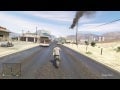
Like many of the millions of Americans who got Grand Theft Auto V on or soon after its Sept. 17 release, I spent much of that first weekend in Los Santos, the game’s fictional mega-metropolis. Having bought, binged on, and beaten the game, I can mouth my own oohs and ahs.
It’s bigger and better-looking than any of its predecessors. It’s better-written, less tonally dissonant, and more engaging than Grand Theft Auto IV. And it does a bit more than the typical big-budget sequel to shake up the series’money-minting formula, primarily by giving the player the ability to switch between three characters. You’d be hard-pressed to get more game out of any release that doesn’t require a monthly subscription.
So it was confusing, at first, to discover that for all the enjoyable hours I spent on it, GTA V left me feeling unfulfilled. It was immersive enough—when I took a walk outside to reacquaint myself with the weekday world, I was disappointed to find that I couldn’t hijack the helicopter parked a few blocks from my building. But for me, at least, the experience was missing something. And eventually, I realized what it was.
I wanted it to be a little less forgiving.
That’s not a backdoor brag about how great I am at video games. At best, I’m no better than the typical player who sank a considerable number of his adolescent hours into the franchise—anyone who watched me crash my car into parked vehicles from one end of Los Santos to the other can testify to that. Over the course of the 30 hours it took to complete the main story, plus some side missions and excursions into the countryside, I was flattened by a semi-trailer truck as I wandered obliviously across a freeway, sliced to pieces by the rotor of a helicopter I had just jumped out of, and thrown through a windshield after colliding with one of the countless objects that got between where my car was and where I intended it to be. The game did a decent job of reminding me that I wasn’t immortal.
So it’s not that I needed more bad guys or bullets. It’s that I wanted some stakes. And it’s hard to have high stakes when failure has as few consequences as it does in GTA V
Balance is one of the toughest tasks of a video game designer’s toughest. Make a game too easy, and players will be bored by it or waltz through it without thinking. Make it too hard, and while you might attract some sadistic gamers in search of the next bullet-hell shoot-em-up ike Ikaruga, you’ll risk driving off casual players who aren’t into beating games for the bragging rights.
But there is a sweet spot where upping the challenge encourages the player to get more creative and, crucially, feel some suspense or emotional attachment. XCOM: Enemy Unknown, one of 2012’s top titles, allowed the player to customize and upgrade the abilities of each of the squad members under his or her command. When one of those squad members was killed, that death couldn’t be undone (short of resetting the system). As Luke Plunkett put it in the Kotaku review, “The feeling of loss once a veteran, beloved soldier goes down is crushing. In a good way. Not many games will take your best toys away from you so swiftly and so permanently, and so not many games really force you to look after them and appreciate them as well.”
GTA V will make you laugh (thanks particularly to Trevor, one of the series’ most compelling protagonists), and it will eat up as many hours as you have to offer it. But it won’t take your toys away. And since it won’t take them away, it can’t make you miss them.
One of Grand Theft Auto V’s most welcome qualities is that it doesn’t insert speed bumps to ease you in. The early hours of previous GTA titles were a tease, tasking you with a series of mundane tasks, forcing you to make do with melee weapons and handguns, and limiting you to a relatively small section of the map until you’d done enough to unlock other areas. The scope of GTA V’s missions expands quickly, and the game’s entire territory is unlocked almost immediately.
But there’s a downside to GTA V’s willingness to take off the training wheels so soon: you’ll never need money (or anything else, for that matter). Several hours into the game, you pull off the first of several elaborate heists, each of which provides a pretty big payday. After that point in my playthrough, I always felt flush.
Nor did frequent run-ins with the law detract from that sense of security. When you’re arrested in a Grand Theft Auto game, you lose your weapons. That’s a real nuisance; not only do you have to take a trip to the store to rearm, but depending on how large a stockpile you’ve assembled, you’ll have to pay a hefty price.
But based on my experience, it’s almost impossible to be busted in GTA V. In fact, I finished the game without having it happen once. The tactics of GTA V’s police force escalate quickly; whereas the cops in earlier GTA games tried to bring you to justice unless you’d been really bad, they’ll now use lethal force for a minor offense. Either you elude them, or you end up dead.
In GTA V, it’s usually better to die than to be arrested.
That sounds like it should make things more difficult. In practice, it has the opposite effect: in GTA, it’s usually better to die than to be arrested. When you’re “wasted” while roaming around Los Santos, you don’t lose your weapons, as you did in the games before GTA IV—the cops are kind enough to pack your arsenal into the ambulance. You’ll lose a little money, but not so much that you’ll notice after you have a heist under your belt. At worst, you’re out a few minutes of driving from the hospital to wherever you were before you bled out. Dying is merely a minor annoyance when you wake up with the same assault rifle, sniper rifle, and RPG you took to the grave.
The result is that there’s never any real sense of urgency, no point where you’re crushing the controller out of need to see someone survive. Compounding this problem is that there’s a smaller penalty than ever for failing a mission or dying during one. In previous games, failing a mission meant making your way back to the starting point and taking it from the top. In GTA V, even short missions have multiple checkpoints at which you can respawn and try, try again, brute forcing your way to success (you can also quick save at any time, and even skip missions after failing them a few times).
Checkpoints do take away some repetition and tedium, and there’s so much to see in Los Santos that every second saved can be put to good use. But they’re distributed so liberally that there’s no incentive to treat characters as anything other than cannon fodder. And how closely can you identify with someone you’re so willing to sacrifice?
Another nitpick: GTA V’s easy access to cash and low value on life do the title’s incredible array of extracurricular activities and gameplay mechanics a disservice. Los Santos is full of non-essential side jobs, most of which are ways to make money. You can, say, speculate on the stock market or buy properties that yield weekly takes. But I wonder whether players would have been more drawn to those activities—and more driven to explore off the beaten path—had cash been harder to come by. As it is, it’s easy to get through the game without them. There’s more to do, and less reason to do it.
Similarly, each of the three central characters has his own assortment of attributes that can be upgraded as the game goes on; theoretically, at least, one is best suited for driving, another for flying, another for shooting, and so on. This wrinkle could have added an extra layer of strategy to the multiple-character missions, had more of them pushed the player to exploit any edge. But aside from a few special circumstances—Trevor isn’t much for triathlons—you probably won’t notice the difference. On many of my missions, the designated getaway driver rode shotgun, and I didn’t die. Or if I did, I don’t remember.
As large as Los Santos is, GTA V offers a series of mostly linear missions set inside an open-world game. You can take as much time as you want to explore the environment when you’re not advancing the story. But once the mission cutscene starts, you’re more or less locked in. On-screen text gives you a goal, glowing circles on the radar and on the ground tell you where the target is, and a glowing line tells you what path to take.
Oh, so that’s what I’m supposed to do with this vehicle that was designed to drill holes in things.
Occasionally, there are multiple ways to achieve an objective, but the game rarely encourages that kind of creativity. One mission, “The Construction Site,” asks you to assassinate a target on top of a building. The HUD directs you to shoot your way past some thugs, take an elevator up, blow away more guards, and take another elevator to the top.
As I found out when I replayed it later, there are other options; you can, for instance, take a helicopter to the top, or even land on a nearby building and shoot the target from there. But there’s no on-screen indication that you’re allowed to deviate from the script. Would it have been so bad if the instructions stopped at “Assassinate the target” and allowed the player—by that point, an accomplished killer—to arrange the rest?
At its most pulse-pounding, GTA V made me forget these complaints. One of the game’s most exciting missions, “Caida Libre,” involves a headlong dirtbike descent down a mountain in the wake of a crash-landing plane. Deep down, it’s as linear as any other mission—the plane comes to a stop in at the same spot every time—but at least the lack of choice is well disguised. For once, there’s no destination marker pointing you toward a particular place. There’s no road to follow. It feels like freedom.
But compare even “Caida Libre” to a mission like “Arms Shortage” from GTA III. It’s a simple setup: go to Phil’s Army Surplus, and defend it from the Colombian Cartel. The specifics, though, were left to the player, and there were any number of ways to prepare. Rocket launchers were prohibitively expensive, but if you didn’t come up with some strategy—barricade the entrance, use a car to climb on to the boxes, etc.—you probably wouldn’t make it out alive. And if you died, you had some driving (and shopping) to do, which gave you the opportunity and desire to do something different instead of recycling the same approach until you beat it by attrition.
At the risk of sounding regressive, a GTA V mission like “Blitz Play” might have benefited from an injection of GTA III’s pioneer spirit. In theory, it’s an exciting armored car heist, but in practice, it’s such a play-by-numbers exercise in following Rockstar’s instructions that I half-expected Fi to pop out and tell me my odds of success. Steal a garbage truck. Park it in a particular location (“Across both lanes, remember.”). Watch a cutscene triggered only by positioning the truck perfectly, then ram the armored car with another vehicle that you can’t even control aside from pressing the accelerator. You feel more like a passive observer than an active participant, and the ensuing score comes without any sense of accomplishment.
The downside of GTA III’s open-ended instructions was, once in a while, not knowing what to do. But in a sandbox game, especially, occasional confusion is better than constant certainty. Pair the technical brilliance of the GTA V engine with an “Arms Shortage”-esque chance to make your own memorable moments—instead of laying everything out in pursuit of the spectacular setpiece—and you’d have something special.
Much has been made of the planning that takes place prior to heists like “Blitz Play,” but little of it is left to the player. You get a choice between two predetermined routes—guns-blazing or stealthy—and can select some of the non-player characters who accompany you. The choice of NPCs comes down to their cuts of the loot, and since you never need money, there’s no reason not to recruit the best available option. Some missions are memorable because of the exciting setup—stealing a train, hijacking a jet, robbing a bank, etc.—but most leave little room for improvisation, and the high-concept scenarios aren’t worth the price of player agency. You won’t want to tell your friends how you went about beating them. They’ll all have the same story.
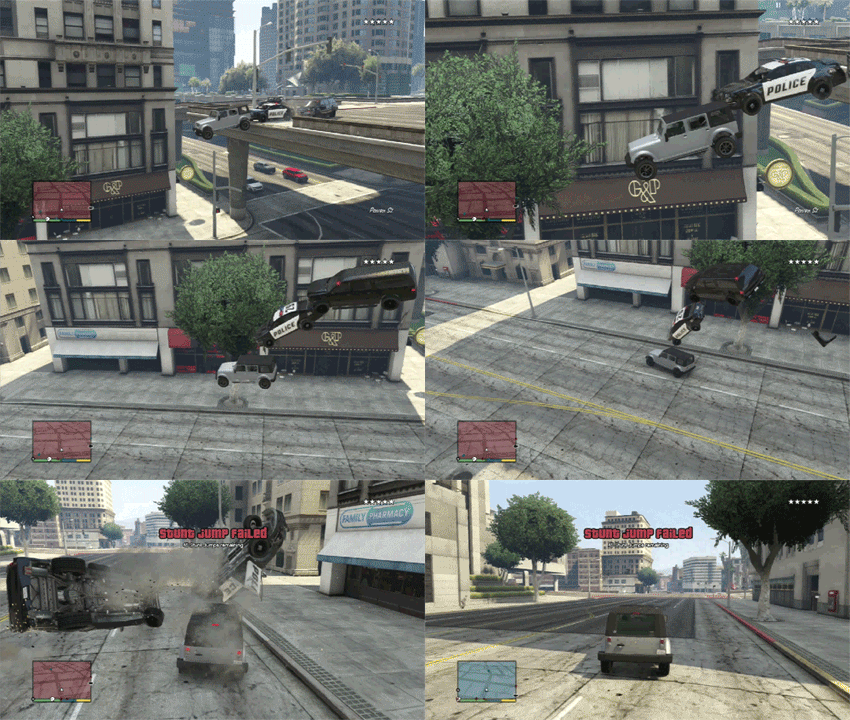
While fleeing the scene of the crime in one of GTA V’s climactic missions, I drove off a bridge with police in pursuit. For a moment, the speed of the chase gave way to a serendipitous, slow-motion tumble through a stunt jump, and then a clean getaway.
It was one of those signature GTA moments that arises organically when the action intensifies and the outcome of a mission hangs in the balance. Under those circumstances, pressure should mount, and success should mean more. But in this case, it didn’t much matter how the cop cars came down. In case of a bad bounce, the game had made me a handy checkpoint a minute before.
Although it’s doing just fine financially, the GTA user experience suffers somewhat from the franchise’s success, and the success of the clones and homages it’s inspired. Today, there’s no thrill in taking taxi fares, which felt fresh when GTA III jumpstarted the sandbox gaming craze 12 years ago. The satire is still clever, but its objects are the same, and other series have since surpassed its shock value. In many ways, GTA V is better than its predecessors, but barring a boundary-pushing reinvention—and why mess with a profitable thing?—no GTA sequel feels as special as your first.
GTA V’s ease makes it more accessible to the masses of people playing it. But that accessibility comes at a cost. The serieshas so far stuck to a one-size-all difficulty setting; maybe it’s time to consider a tiered system, with options for stiffer punishments for failure, fewer financial windfalls, less hand-holding, and free aim by default. (The current default auto-aim system makes downing enemy choppers a cinch and turns every firefight into a formulaic affair.) Or maybe a mission failure could make an impact on the plot.
My desire for consequences doesn’t stem from nostalgia or electronic elitism: gamers have grown up, and many of them don’t have time to beat their heads against Battletoads. Games getting easier doesn’t have to be bad. It’s just that sometimes, erecting obstacles makes an outcome more earned.
People don’t play Grand Theft Auto for the realism. So it might seem counterintuitive to suggest that a game based on offering the player unlimited license to create chaos could benefit from a few roadblocks and a little more left brain. But if making mayhem in Los Santos came at an increased cost, it might produce a deeper connection.
Ben Lindbergh is the editor-in-chief of Baseball Prospectus, a contributor to Grantland, and the co-host of a daily podcast about baseball, a sport that would be better with robots. You can tell him on Twitter why whatever he wrote was wrong.