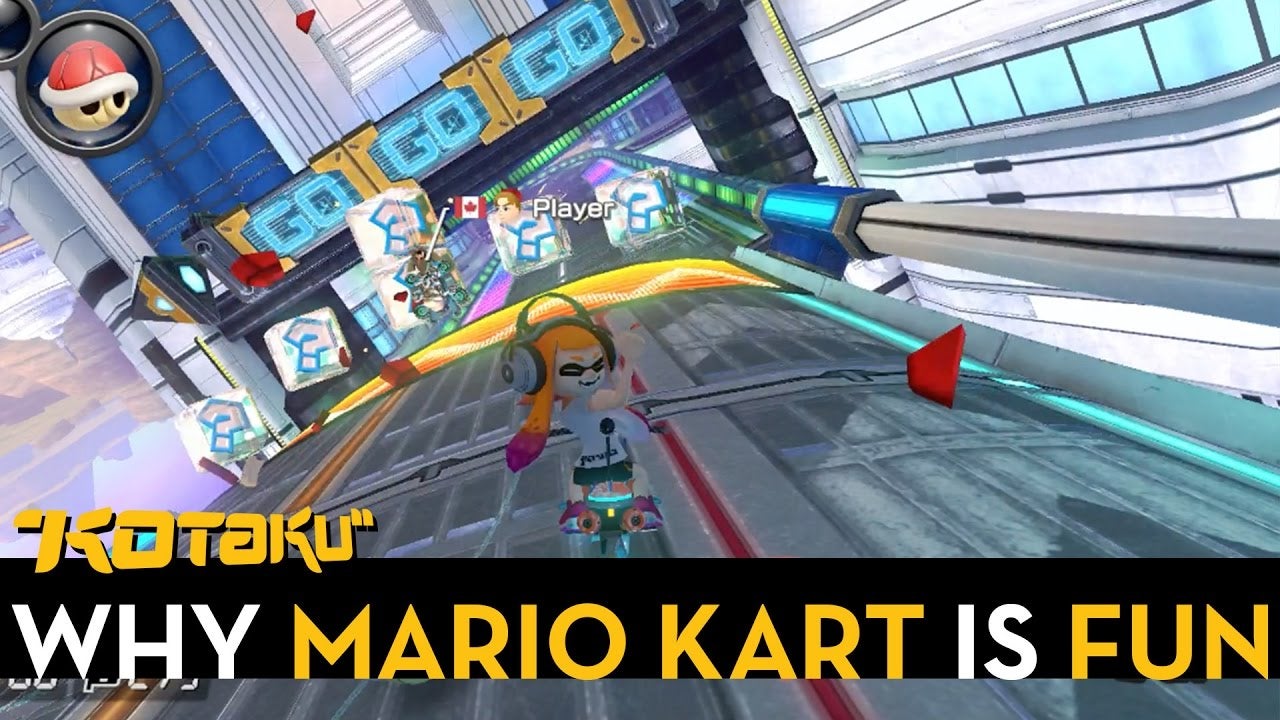
Mario Kart has been around for 25 years and the fun has never let up. How has the beloved racing manage to stay so exciting over the years? We take a look in this critical video.
Transcript:
There’s something inherently exciting about a Mario Kart race. The breakneck speed leads to frantic chases towards the finish line and the threat of wacky weapons keeps every moment exciting and packed with potential. It’s fun. But what does that word even mean with games? How does Mario Kart remain fun? How does it hold our attention? To do that, let’s look at a few theories of fun in games.
Codifying something as nebulous and personal as fun is a steep task and while I’m generally wary of academics on principle breaking down Mario Kart through various theories can help us understand what Mario Kart does well. First, we’ll look at Raph Koster’s thoughts from his book A Theory Of Fun For Game Design. A core tenet of Koster’s book is that fun arises through learning. “With games,” he writes, “learning is the drug.”
Koster says that games contain systems with recognizable patterns that we can memorize and then manipulate to our advantage. Learning to do this is what creates fun. This is the case in Mario Kart, but only to a degree. Koster’s idea of fun is frontloaded. You learn more when something is new, and Mario Kart offers new tracks to explore, shortcuts to find, and items to use. There’s plenty of things to learn and internalize, and players demonstrate their knowledge through superior performance.
But Koster’s theory of fun as learning has limitations. If fun is learning, it is also finite. There are only so many hidden paths on a track, characters to master, karts to unlock, and items to use. Games are fun but consumable. You drink them up like a milkshake.
How does Mario Kart remain fun after you’ve learned everything you can? What does it provide beyond the chance to learn and apply your knowledge? The game manages to generate a wide spectrum of unique reactions and feelings from moment to moment. This is closer to the position that Warren Spector, the designer of Deus Ex, raises in a piece called “Fun Is a Four Letter Word.”
Spector suggests that the need to make every game fun is myopic, and even has negative connotations that deprive games of wider respect. For him, games have the capacity to be troubling, disturbing, annoying, over the top, or ambiguous. We’ve all been hit by a blue shell near the end of a race or knocked off the edge of a jump only to watch everyone else speed by. That’s not necessarily fun, but it is engaging. It captures interest.
Civilization designer Sid Meier said that games are a series of interesting choices. If games are meant to be a series of interesting choices, Mario Kart defines “interesting” as surprising. Every race is different. Opponents react in different ways, items are hardly the same. This is doubly true with multiplayer, where you’re not just making interesting, in the moment choices about what you are doing but you’re also reacting to a host of similarly active decisions from fellow players. These choices pile up, asking players to react as they see fit.
Ultimately, it’s hard to decide what fun actually is. For me, I favor individual experiences. I favor the emotion of any given moment. Those moments are unique and belong only to the player and I generally think that attempts to codify fun start to take the magic out of games, that tiny spark of wonder that helped us fall in love to begin with. Looking at various notions of fun and applying them to Mario Kart shows that fun is ultimately in the eye of the beholder.
Mario Kart provides a host of things to enjoy and that broad scope ensures the game is appealing to all kinds of players. Be it the chance to learn, a chance to feel, or the opportunity to make important decisions, fun is whatever we want it to be and no matter which way you slice it, Mario Kart definitely is a whole lot of fun.