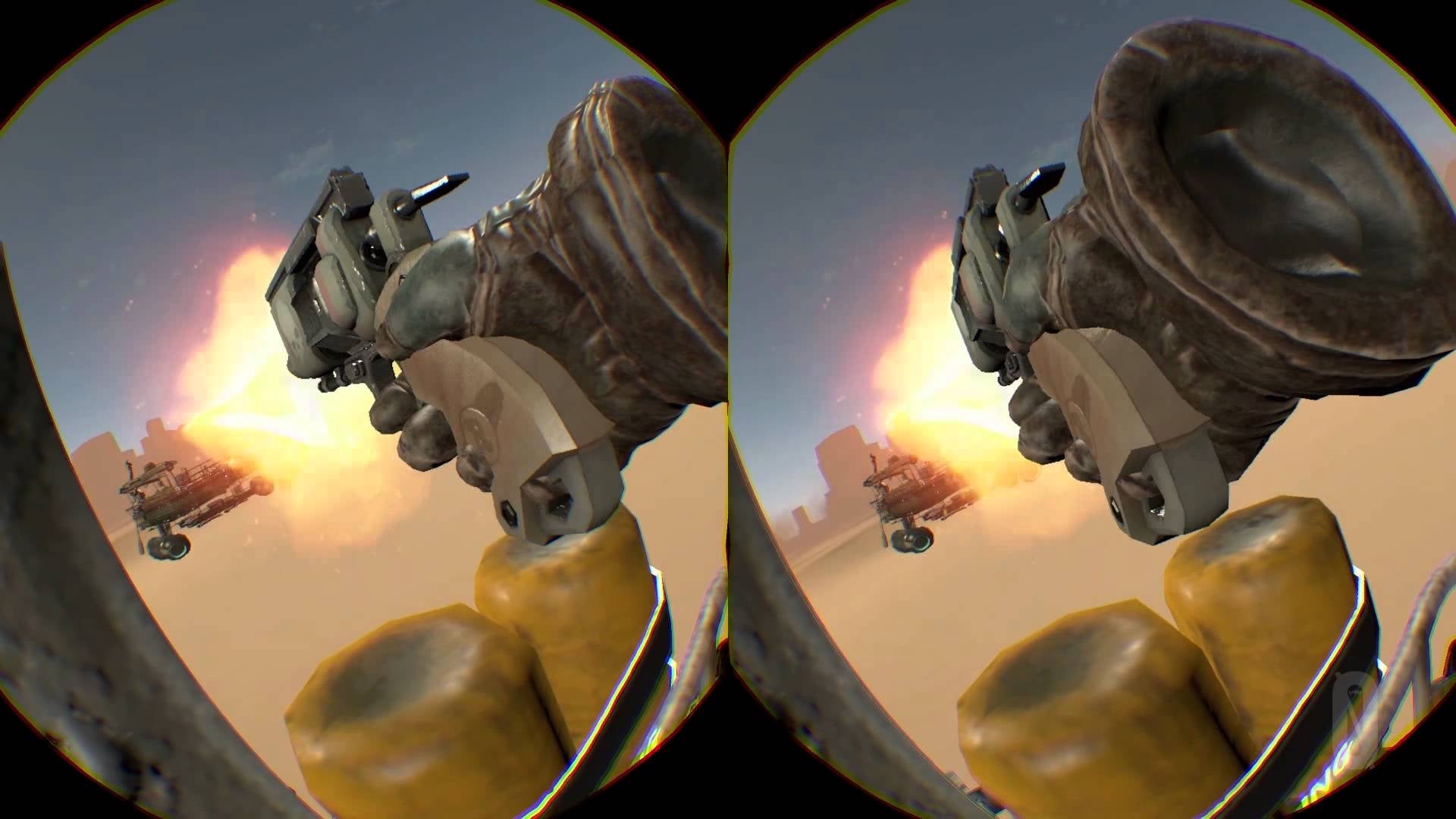
I whirled around and plugged two perfectly placed shots into an enemy player. I was finally getting the hang of Vive VR shooter Hover Junkers. I was in the zone. I thought nobody could take me by surprise. Then I watched as another player slowly raised a gun to their head and pulled the trigger.
Of all the games I played at a recent Valve VR showcase, Hover Junkers impressed me the most. In it, you zip around on hover barges while having Wild West gunfights. It’s goofy, frantic multiplayer fun. I was so into it that I didn’t even feel embarrassed physically diving behind cover, yelping in fear as shots pinged off my sheet metal shield.
The most interesting part, however, is that players have full control over their bodies. Any game can have a shootout, but a shootout with improvised non-verbal communication to the person trying to blow your head off? Now that’s unique. Say you’re losing a fight. You can physically raise your hand out of cover and wave it in attempted surrender. Or you could use the same hand trick to distract someone, then pop out on the other side of cover and fire away.
Hover Junkers’ developers have embraced this possibility space, enabling people to select from a range of gestures they can use while flailing around—for instance, pointing and middle fingers. Those things let players come up with all sorts of handy non-verbal cues, free of the restrictions a canned animation system would impose. For instance, one person surrendered to me, only to stop in the middle of handing me loot and point his fingers, spinning them in a motion that clearly meant, “Turn around! Fast!” Turns out, another player had sneakily parked their hover barge behind mine. I nearly got shot in the back, but I managed to duck just in the nick of time. It was crazy.
That much freedom, though, can also lead to situations like the one I described earlier. Mostly for shits and giggles, a player lifted their gun to their head and shot themselves. At first I laughed because I seriously didn’t expect it, and it was kinda funny in that very video game way that somebody killing themselves can be kinda funny.
But I was also surprised by the immediacy of it all. It’s one thing to see that act on a screen. It’s another to feel like you were there, like you just witnessed it with your own two eyes—watched a body that your brain subconsciously regarded as a “real” body crumple. In spite of myself, I found it a bit chilling.
Later that day, I spoke with Hover Junkers designers Alex Knoll and Brandon Laatsch about the considerations that went into letting players go through the motions of suicide, their animation system, and the weird shit nobody expected from VR until they started using it.
Touchy subjects
Kotaku: When I was playing Hover Junkers, at one point I turned around just in time to witness somebody bring their gun up to their head and shoot themselves. At the time I laughed because it was so surprising, but it was also some pretty, er, loaded imagery.
Alex Knoll: Our stance on it is, if we programmed it out—if you point a weapon at yourself and there’s no repurcussions—that’s obviously promoting unsafe firearm use. And we don’t want to do that, so we have to have some level of repurcussion for performing such an action.
Kotaku: Obviously, though, that puts you in a tight spot, because now people can kill themselves in ways that are intense, verging on reminiscent of what the act would be like in real life. It’s quite a thing to witness—not to mention have associated with your game.
Brandon Laatsch: It’s this moral quandary. You can turn the gun around and do anything. It’s something VR enables. But as a result, it seems wrong to have it not do anything, and it seems wrong to have it do that thing. So we’re going with having it behave as it would [in real life]. There has to be consequence to any firearm in any situation.
Kotaku: Absolutely, and that’s a super responsible way of looking at it. On the other hand, though, you’ve got people with trauma, people who’ve had friends or family take their own life that way or what have you. That’s what you get when you push into new territory, I suppose: impossible situations. I’m sure your head still hurts from thinking it all through.
Redesigning an entire animation system because of middle fingers
Kotaku: When we were talking earlier, you told me that a lot of your freeform animation system emerged not from shooting and stuff, but from people giving each other in-game middle fingers. How so?
Alex Knoll: A significant amount of our design decisions were made specifically for social interaction. The hands having a full system for reaching and that kind of thing. In real life you don’t really notice this stuff, but in a game if you see somebody controlling an avatar whose shoulders are completely locked, the realism immediately drops. There’s no line of action that runs through the body. You aren’t seeing a full length arm reaching. It’s just a strange creature that’s moving like a robot.
We figured out waving, middle finger, all these social interactions—that’s what looked the weirdest. In gunfights it didn’t look weird because [characters are in very specific poses]. But as soon as we started waving hands around and giving people the finger, we were like, “Uhhhh, it looks kinda awkward.” We wanted to make sure that gesture gets across.
Kotaku: VR teabagging sure will be something.
Alex Knoll: That really is why we spent so long making sure that body moves the way it does, though. We know people are gonna do weird stuff with it, so we want it to at least look good.
Kotaku: Sure. Those sorts of things are inevitable. Better to keep than in mind when you’re making a game than pretend they’ll never happen because your game will only attract nuns.
When VR fucks with your head
Kotaku: Today I’ve really been noticing how limited to vocabulary surrounding VR is. We’ve all been talking about it at this event, but the language is so clunky. Especially with the Vive, you have to be mindful of the real world while moving around, but you’re also occupying another space. So people are like, “In VR I was doing this one thing, but in the real world I kept bumping into this shelf in real life.” Or a friend of mine was talking about a time he was using an object in VR world as a point of reference for a horizontal surface in the real world, only the surface wasn’t actually horizontal, so he fell and hurt himself. It’s awkward to explain Vive VR even when talking to people who’ve used it, and I think it could hurt VR’s word-of-mouth appeal.
Alex Knoll: It’s really strange. There are so many things you just aren’t expecting, or you just don’t realize. One of the things we found is, people are very uncomfortable moving through geometry. It’s an object in front of you that’s not real, but at the same time you don’t want to step through it.
Kotaku: Yeah, I remember reaching my hands through buildings and walls and other surfaces and just feeling… I don’t quite know how to describe it. Almost yucky, for some reason. It felt gross. Unnatural.
Alex Knoll: However, once you’ve accepted that, in this universe it might not be the most comfortable thing to move through geometry, there’s still a level of acceptability with certain things. We’ve noticed that people will physically avoid anything that’s sharp or spiky or metal. But they’re a-OK with moving through pillows or cloth or a curtain.
Kotaku: Oh, that actually makes a lot of sense! That’s already similar to how we actually interact with those objects.
Alex Knoll: Exactly. So people will move through a chair because it’s already an object they move their body into. But they’ll go around a table, because it’s sharp and they’re like, “This isn’t something I move into.”
Kotaku: All the proximity stuff gets really interesting when characters enter the mix. For me, I was getting attacked by a zombie in Arizona Sunshine at one point, and my first reaction wasn’t, “Ahhh, a zombie is punching me,” but instead, “Hey man, you’re in my personal bubble. Step off.”
Alex Knoll: Oh, it’s really weird for us, because in Hover Junkers multiplayer, people are almost never willing to get their faces close to each other. There’s an in-game bar [that basically functions as a multiplayer lobby] where you’re just a floating pair of hands and goggles. You have no body. But nobody’s willing to get even their goggles up close to somebody else’s goggles.
Kotaku: You should let people do a little smooch on the cheek.
Alex Knoll: Sometimes we do a thing where we reach out and pat people’s faces, and we were talking about adding something where you can take their eyeballs. It’d be fun just to see how people react. They’d be like, “Oh my god, you took my eyes!” There’s a bunch of social experiments that’d be very fun to try out.
You’re reading Steamed, Kotaku’s page dedicated to all things in and around Valve’s wildly popular PC gaming service. Games, culture, community creations, criticism, guides, videos—everything. If you’ve found anything cool/awful on Steam, send us an email to let us know.
To contact the author of this post, write to [email protected] or find him on Twitter @vahn16