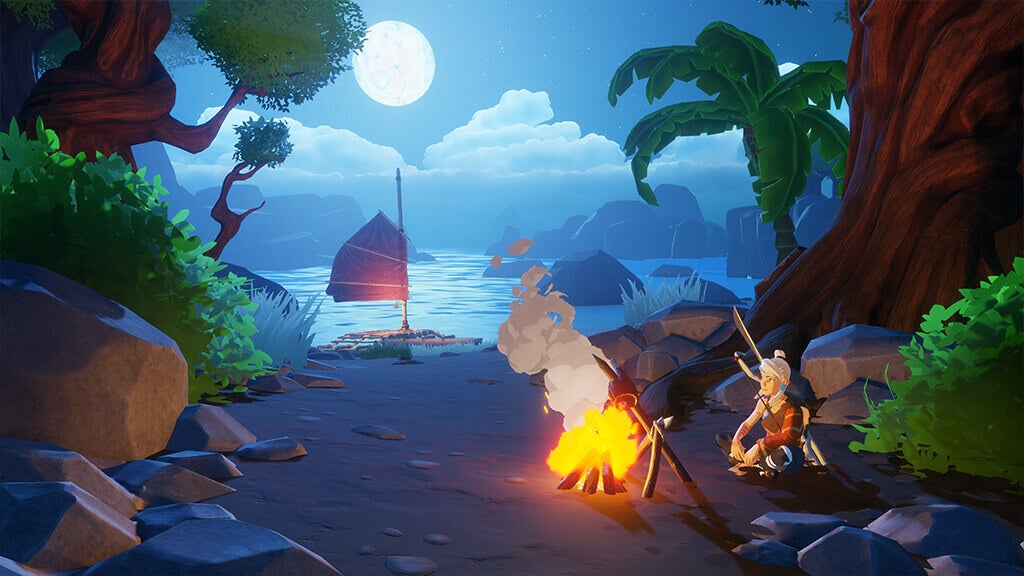
Six minutes into Windbound, I died. Shortly after the game started, I found myself stranded on an island with nothing but my wits and a knife. I saw a boar-like creature. It wasn’t bothering me, but it had something I needed. So I did what video games have taught me to do and struck it with my knife.
Fatal mistake.
The next run went a bit better. I built a boat. I visited several lush islands. I, thankfully, wasn’t gored by a nightmarish boar monster. Instead, I starved to death. Third run: A massive swell took control of my boat and sent it careening into a rocky outcropping. The boat shattered. I drowned.
Windbound, out now for Nintendo Switch, PlayStation 4, Xbox One (where I played), and PC, is a survival game set in an oceanic realm called the Forbidden Islands. Developed by 5 Lives Studios, Windbound was first announced in April, via a PlayStation blog post. It gained some attention for bearing resemblance to The Legend of Zelda: The Wind Waker. Both have whimsical, cel-shaded graphics. Both feature no shortage of unexplained mysticism. Both require you to take to the seas.
While Windbound may share some DNA with that modern classic, it’s no Zelda game. You don’t explore puzzle-packed dungeons and banish evil men with unhealthily orange hair. Your goal, as far as I can tell from six hours playing, is to explore the horizon. In each chapter, you have to find three bronze ammonite shells, all of which are perched on top of a towering stone structure that you have to seek out. Once you find all three, you’ll be able to open up a portal to the next chapter—if you can sail to it before you run out of stamina.
Windbound doesn’t give you a compass or waypoints or anything of that nature to help with your journey. Even the map of each level starts off fully shrouded in fog, though it slowly clears as you sail around. Don’t think about memorizing the lay of the land or snapping screenshots: The islands are procedurally generated. Success is hinged, simply, on getting lost. To do so, you need to collect resources, which you can use to build and improve increasingly sturdy boats. You’ll start out with a simple rowboat. Eventually, you’ll craft a sail and even a second hull, turning your vessel into a rudimentary catamaran.
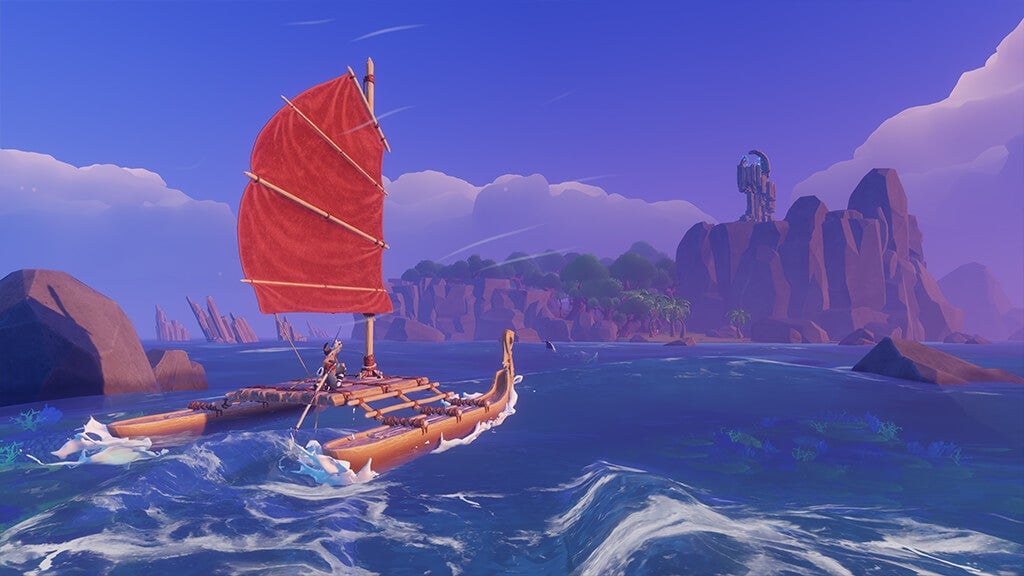
Crafting happens in real time, kind of like it does in The Last of Us. (Make sure no boar-beasts are nearby!) You start out with just one crafting recipe, but will slowly learn more as you play. It’s a nice quality-of-life touch: You don’t need to spend time hunting for recipes. They’ll just appear in your crafting menu.
Windbound also has some roguelite elements. By design, you’re forced into situations in which you lose over and over again, respawning each time with only the items on your person. At the start, your inventory is pittance, and consists of some key items—for instance, your trusty knife or, eventually, an oar with untold magical properties—plus seven other slots. It doesn’t help that Kara, the player character, isn’t exactly made of steel. You have to watch both her health and her stamina bars. Stamina steadily depletes over time, the longer you go without finding food. Go too long, and that hunger will cut into your health bar. Even if you don’t get mauled by a wild animal, death in Windbound is near-certain. Smartly curating those seven slots is imperative.
There are two difficulty settings in Windbound. Survivalist, “the full Windbound experience,” sends you all the way back to the first chapter upon death. Storyteller is a bit more forgiving: You keep your chapter progress. A start-from-scratch roguelite structure works well in action-packed games like Wizard of Legend or Dead Cells. Windbound is a slow burn, and dying can erase a lot of tedious progress, so I’ve preferred playing on Storyteller.
Between chapters, you’ll find yourself in watery corridor stages where you need to sail from one portal to the next. For your efforts, you’ll be rewarded with the option to purchase a permanent ability for your character. (They’re not exactly game-changing, but some, like one that reduces your stamina depletion, are moderately helpful.) In those levels, the music kicks up, and the ocean swells reach hurricane status. It’s here where Windbound truly shines for me.
I grew up in an oceanside city and, as such, spent a good chunk of my childhood zipping around our local bay in a small motorboat. More than once, I’ve gone out so far I couldn’t see land. Even in bluebird conditions, when you’re that far out, the swells can, well, swell to uneasy proportions. When the wind kicks up, they’re downright terrifying. On those days, finding your way back to safe harbor becomes an adrenaline-pumping exercise where, yes, you still have control, but you feel like it can be wrenched away from you at any moment.
And then you make it back to calm waters. Your relief is palpable. To be on the water is to balance two feelings. You have to recognize that the ocean is a vast, terrifying beast (one that, by the way, we’ve only explored five percent of). At the same time, there are few things more peaceful than kicking back in a slight breeze and getting rocked gently by small waves. Windbound nails this dichotomy. It’s a feeling most games—including, sorry, the venerable Wind Waker—don’t fully grasp.
I’ve sailed through the first few chapters now, and still haven’t killed any creatures. So far, I haven’t needed to. I hope I don’t have to.
More sailing the seven seas:
https://lastchance.cc/assassins-creed-iv-black-flag-the-kotaku-review-1453735783%3C/a%3E%3C/p%3E
https://lastchance.cc/sea-of-thieves-the-kotaku-review-1825046876%3C/a%3E%3C/p%3E