This story is part of our new Future of Gaming series, a three-site look at gaming’s most pioneering technologies, players, and makers.
With evolutions in game design and advances in hardware, new opportunities for creating memorable narratives and immersive storytelling emerge. We often hear and see the visually spectacular results of technology like ray tracing in Cyberpunk 2077, or the dramatically improved loading times from faster game storage in titles like Spider-Man 2. But is it always for the better? How have technological advancements evolved game design and narratives in the last few decades, and where is it likely to go?
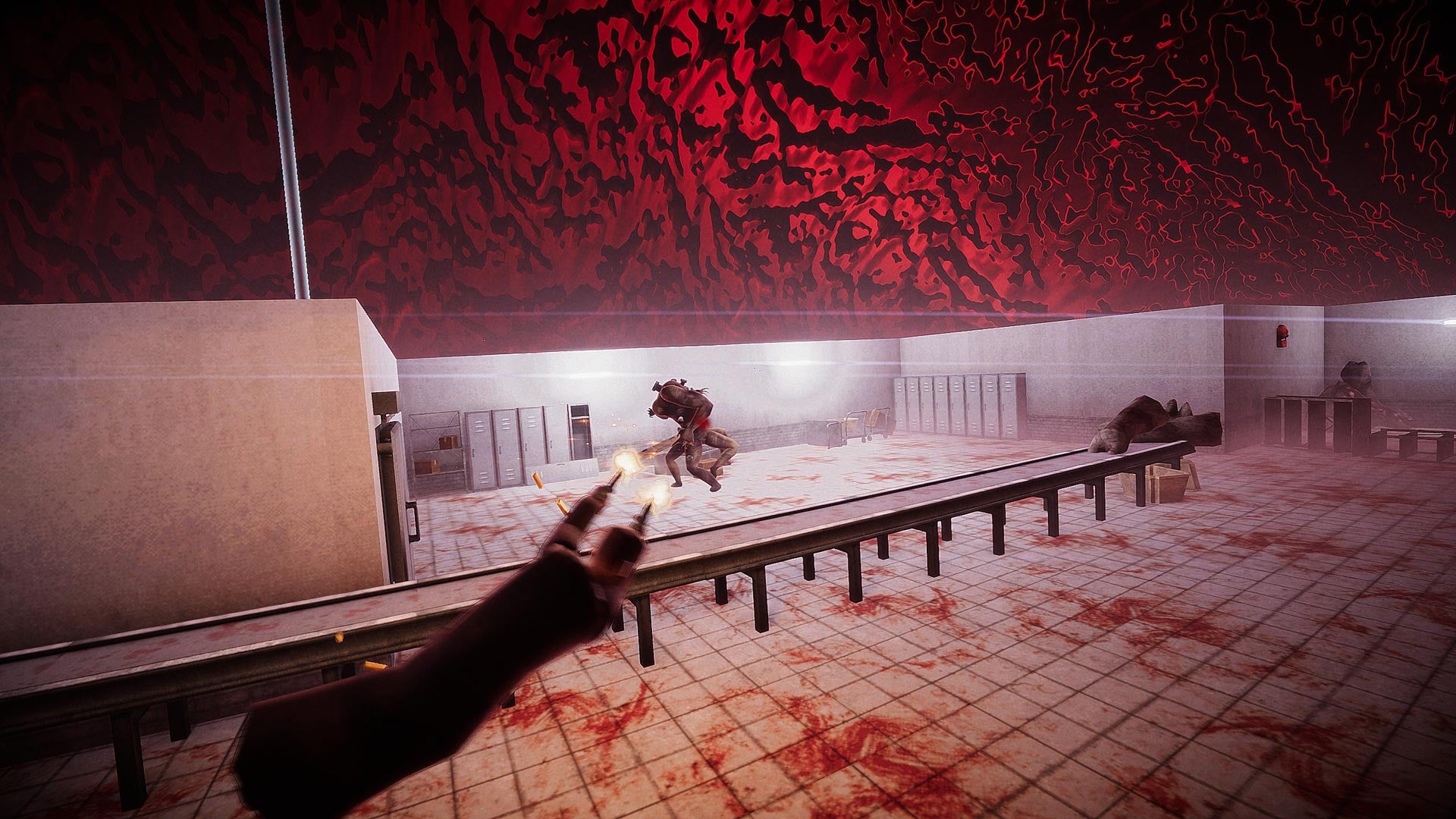
To answer such questions, Kotaku spoke with BAFTA-nominated game designer Xalavier Nelson Jr. over video call, who’s responsible for beloved indie games like An Airport for Aliens Currently Run by Dogs, Space Warlord Organ Trading Simulator, and most recently, the excellent Max Payne-like, El Paso, Elsewhere.
Read More: Max Payne + Creepy PS1 Vibes = One Of The Best Shooters Of 2023
Nelson’s development studio, Strange Scaffold, aspires to deliver games quickly and cheaply, but never at the cost of the health of the humans actually crafting these digital worlds. In our conversation, Nelson discussed the incredible opportunities made available by technological accomplishments, but stressed a holistic approach that centers the quality of life of those who make games. He talked about how technological advancements are just singular pieces of the larger puzzle that is making a game, and how recent games like Shadows of Doubt and Hitman: World of Assassination demonstrate the potential for experiences of the kind we can only see in today’s world, with an eye toward what might be possible as we move forward.
The allure of technological advancement and the impact of it on game design
Starting out in the industry as a games journalist, Nelson’s shift to game dev broadened his understanding of storytelling in games as something that goes well beyond just writing scripts. “I realized that I didn’t give a shit how good the story was,” Nelson said. “Frankly, storytelling in games is very often not down to the execution of the narrative designer or writer.”
Nelson described the game-making process as “a team effort that relies on collaboration and on […] destroying as few human lives as possible in the process,” which is why he pays particular attention to areas like production, management, and business development. He was keen to talk about one specific area of game design and its impact on narrative and storytelling in games: The influence of increased fidelity as a result of technological improvement.
“In the past 20 years, a prominent thing that we’ve seen rise in games is something that I think is going to in fact be the focus of the next 10: the consequences of fidelity on storytelling,” he said.
The “technology to have photorealistic characters and environments,” Nelson told Kotaku, has the effect of creating “a drive purely from a technological level to attempt to fit games into as high resolution a mold as possible, even if they’re stylized.” This has dramatic effects on development.
The more elements that are involved, whether it’s motion capture, whether it’s voice acting, every little bit of polish and what we could call “fidelity” that gets added actually alters the stories you’re able to tell […] and sometimes whether you can tell them at all.
But Nelson suggests there’s a risk in including the best possible tech to increase a game’s fidelity. Universal voice acting in Larian Studios’ 2017 RPG Divinity: Original Sin II created an arbitrary mark of “quality” that put pressure on other studios making similar games to follow suit. That pressure isn’t always inline with creative visions for a game, and can cause undue demand on the people making the game.
The emergence and presence of new tech isn’t always about making things bigger and better. Voice acting, for example, is something that many would regard as a net positive. Why wouldn’t you want to skip walls of text and instead have exposition and dialogue delivered with talented voice actors? Nelson offers a counterpoint to such a sentiment, asking, “How is your game going to be held back by having a voice actor?”
Speaking to the narrative effects of voice acting, Nelson highlighted Bethesda’s recent Starfield, which features a protagonist who does not speak, and by extension creates more space around the player for “more characters and more scenarios across the game world.”
Starfield’s narrative strengths and weaknesses are a conversation for another day, but there’s no denying that viewed alongside Fallout 4, which Bethesda shipped in 2015 and which does feature a voiced protagonist, the overall tone of each game is dramatically changed by the presence or lack of a voice actor.
Read More: Starfield: The Kotaku Review
For Nelson, increased fidelity is a double-edged sword, capable of forging new paths for games, but always with the risk of harm to those under the pressure to use new tech and keep up with trends.
In the past 20 years, we’ve had massive increases in fidelity, all these new technological barriers broken in all these ways that allow us to connect with stories in ways that we couldn’t before. And the next 10 years is going to be about having really honest conversations with ourselves and with our audience about how the choices we make, now that we have these tools, actually enable or compromise certain stories.
That’s why, for him, the game to watch is the upcoming Silent Hill 2 remake, and how developer Bloober Team will approach it. “So much of the Silent Hill series has been based around obfuscation of information, a certain amount of clunkiness and jank and very specific information being communicated in very specific ways,” he said.
When [Silent Hill 2] gets hit with the full AAA remake treatment, I think we’re going to have some really heated discussions around how the arbitrarily applied polish of modern day game development compromises or in some ways enables its vision.
Preserving a narrative vision is a matter of considering the player’s experience, Nelson said, which necessitates that devs consider things like “the aesthetic and the narrative and the mechanics and the choices made in every department, from audio, all the way to performance, all the way to the marketing. All of those things have an important part to play in the player experience and they all have to be holistically considered.”

That holistic consideration is a reminder that no singular element of a game’s development process is responsible for its success (or failure). A great story or script will only go so far. Likewise, new technological improvements can only advance gaming when their benefits (and drawbacks) are considered in light of the vision of a game.
Silent Hill will be a valuable lesson. Without limitations on what could be visually rendered at a distance, would the original PlayStation’s haunting, fog-soaked backdrops be as impactful? The original 1987 release of Metal Gear is another, having only developed its stealth genre in response to the technical limitations of the MSX console. The “arbitrarily applied polish” that Nelson speaks to isn’t always a net positive. But what of games that are taking advantage of such advancements? Which games are getting it right? And how?
Looking forward: Impressive games emerging from impressive tech
Nelson pointed to ColePowered Games’ detective sim Shadows of Doubt, released in Early Access on April 24, 2023, which he characterized as “weaving together an entire procedurally generated, immersive sim city.”
A friend of mine was playing [Shadows of Doubt] and saw that the milk carton in their in-game apartment had a fingerprint on it that wasn’t theirs. And they were able to use the in-game tools and construction of that procedurally generated city in order to literally track down the person who put a fingerprint on their milk carton in what was a system that was intended to be used to track down a serial killer in the world of the game.
For Nelson, Shadows of Doubt’s dynamically simulated city and the kinds of complex scenarios it’s capable of creating show off the “wide-open [spaces] that we are really getting to see as we hit this threshold of technology and what’s possible and then say ‘OK, we have these tools, if we change the balance and ratio of how these tools are used or what prominence they take, what stories does that enable us to tell.’”
Nelson also pointed to Hitman: World of Assassination (the 2022 title formerly known as Hitman 3) as another game capitalizing on technological advancements in clever ways. “[That game] would not be possible in any other age than the one we currently live in.”
He explained that “advances in the internet, graphical technology, processing power, speed, and frankly, a studio that was allowed to survive long enough to build its tool set has produced something unlike anything else in video games.”
Originally debuting on Windows in 2000 in a time where computational power was a mere fraction of what’s available now in the 2020s, Nelson said that “Hitman as a series has always kind of strained against its foundations, not just because its creators were finding the formula as they went, but also because it was a dark comedic sandbox running off miniscule processors in hindsight.”
After years of progress in “scripting, level design, and graphical fidelity,” Hitman’s narrative experience reached new heights—especially in 2016, when IO Interactive’s soft reboot of the franchise was offered as a downloadable episodic series instead of a single package of levels.
Here comes Hitman 2016 kicking down the doors and saying with next-gen technology, they not only had the ability to deliver a more fully realized sandbox, a deeply holistic sandbox built from the ground up, but also one that through its very design taught players how to think through the dark comedy world of what it meant to be playing a Hitman game.
With its episodic format, Hitman, according to Nelson, “[taught] the world how to think about Hitman because they were left with one level at a time that they played through again and again, discovering new possibilities.” Seasoned Hitman players could then gain mastery over constant repetition, meanwhile newer players could take in the game’s formula in bite-sized portions.
Added challenges and community features delivered via regular updates allowed players to gain mastery over its notoriously difficult challenges via “Groundhog Day style meta repetition.” This fed into 2023’s rebranding of Hitman 3 into Hitman: World of Assassination, which Nelson describes as the “[original] sandbox in its complete form, built up over a decade now, with a roguelike mode, with thousands of community-made contracts, and self-directed play objectives set into this world.”
More powerful technology, as Nelson discussed, has helped grow Hitman into something that’s not only more flashy and visually impressive, but that also expands on the initial premise of 2000’s Hitman: Codename 47 and the sequels that followed. But, as Nelson stresses, so much of that isn’t just from the new tech, but rather from allowing a team to continue to grow and learn—which can be at risk with demands to “always escalate the scope” of a title.

Sadly, there’s good reason to be concerned about the future of the video game industry and whether or not its business practices are at all sustainable, as brutal, crunch-laden work conditions often end in swift and sudden layoffs. In this year alone, we’ve seen industry goliath Epic Games shed over 800 jobs, while Microsoft laid off 10,000 employees with significant hits to its gaming divisions. Recently, Sony’s Naughty Dog is also going through a wave of cuts, with the status of the studio’s long-awaited Last of Us multiplayer title feeling increasingly uncertain.
Though they’re often the products of hundreds of people and millions of dollars, Nelson says that games still come from a very human place: “the practice of making games, and the production processes that we take for granted in making games, have deep, inherent flaws and human pain built into them.”
The crunch and layoffs dramatically impact the lives of those making games, and it’s not a story that’s exclusive to the latest headlines about the industry. Nelson said that the failure to achieve sustainable working conditions to allow devs to grow and thrive leads to a loss of potentially incredible games:
I think with all the studio closures we’ve seen in the past few years, players are going to feel the absence of teams that have been allowed to hold together and produce things like Larian has [with Baldur’s Gate 3] or like Mimimi Games did with its swan song [Shadow Gambit: The Cursed Crew] before closing. A world in which IO Interactive breaks up after a couple of games is not one in which they produce Hitman: World of Assassination
Nelson says that loss of potential, from teams failing to survive ever increasing demands, is something “we are being made terrifyingly aware of” right now. But he adds a note of optimism: The rising public awareness of the pressures of game development “gives us a unique opportunity to push against these systemic factors.”
Video games easily fall into the trap of “bigger, better, faster, now.” And they almost certainly will be bigger and faster in the years to come. Whether or not they’re better experiences for it, I think, will depend on, in Nelson’s words, how future advancements consider the “holistic” experience of the player. Flashy inclusions of technology may fly well in marketing speak, and may excite investors, but when they burn out employees, set up impossible financial goals, and crumble in the end, all we’ll be left with is fragments of what could’ve been.