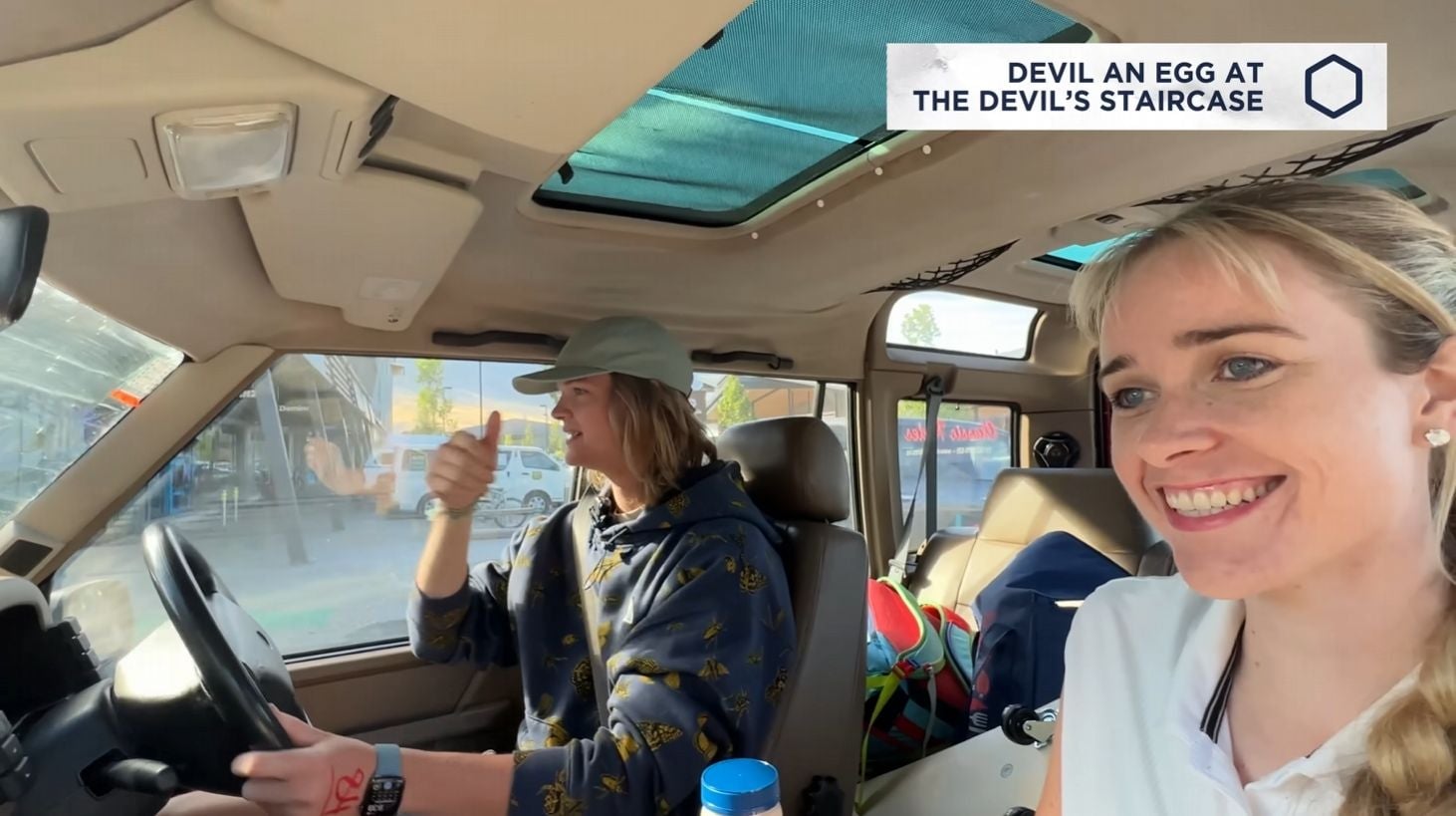
There are some who use their YouTube success to fund excessive lifestyles of debauchery, coveted cardboard, and opulent mansions. However, there are others who try to do something interesting. That’s undeniably the case for educational YouTube channel Wendover, which last year launched Jet Lag: The Game—a globe-spanning series of challenge-based board games, where the board is the planet, and the pieces are the players. As their sixth season draws to a close, we take a look at why this is something you’ll want to watch.
OK, so, everyone’s heard of The Amazing Race. It’s that long-running CBS show that isn’t Survivor, the one where teams of two “race around the world,” flying from country to country to complete challenges, attempting to be first to arrive on the mat and be greeted by the ever-grimacing Phil Keoghan. Except, if you’ve watched it, you’ll know that if there’s one thing it isn’t, it’s a real, ongoing race. The show is so astonishingly artificially rubber-banded, and the challenges so carefully produced, that the artifice often obscures the view. It’s tremendous fun, of course! But it’s very, very television
Step in, Jet Lag: The Game. Created by the minds behind Wendover’s Half As Interesting channel—Wendover creator Sam Denby and writers Ben Doyle and Adam Chase—it began with the ambitious goal of playing Connect 4 across the United States of America, claiming states as counters. But perhaps more importantly than the geographic scale of this ambition, they also approached it as a board game design challenge, with all the intricate detail and balance this involves.
Since that initial game of Connect 4, they’ve circumnavigated the globe, played tag across Europe, and are just finishing airing an epic game of capture the flag over the whole of Japan. And with each season, they’ve further refined the many elements that make this show so compulsively watchable. Oh, and Ben getting drunk.
Connect 4 with the United States as the grid
Connect 4 Across America worked right away. The concept was reasonably simple. In a barely post-covid-restrictions America, Sam, Ben, Adam and guest Brian McManus from Real Engineering needed to fly to U.S. states (well, the 22 West of Mississippi) and complete challenges. By completing a challenge, the state became theirs, played like a counter on a Connect 4 board. The goal was to claim four in a row, or of course to block the opponent team’s attempts to do so. And the means was public or commercial transport of any type, including a lot of flying.
This immediate success was definitely helped by what had essentially been a pilot season, called Crime Spree. Not officially a Jet Lag season, this Nebula series had Sam attempting to break as many obscure laws across American states as he could, while pursued by Ben and Adam simply guessing where he might be and trying to fly there to find him. It was fun, but deeply janky, and due to illness, didn’t even properly conclude. But they clearly learned a lot
With the game designed by its players, and so many lessons learned, Connect 4 was a whole other vibe. While filmed on phones by the players themselves, it immediately looked great, boosted by fantastic post-production efforts, from superb on-screen graphics to excellent editing. It felt like TV, but with the hands-on sensibilities of YouTube.
Each pair of players had a starting budget of $5,000, from which they needed to pay for their transport, food, and hotels. After that, the rules were that they had to inform the other team (by text) as soon as they had successfully claimed a state, and only then would the opponents know where the other team currently was.
The combination of the logistics (the subject that Wendover’s channels have always focused on) and the personalities makes it all immediately enjoyable. Ben and Adam immediately showed an incredible partnership energy, the two of them so outlandishly nerdy, while enormously witty, and in another life they’d clearly have become writers for late-night TV. Ben has the vibe of the lovely best friend in a romantic comedy, while Adam is destined to play a young Richard Kind in the biography of the actor’s life. Meanwhile, Sam and Brian were far more serious, and somewhat antagonistic. Sam is the person who completed a bungee jump for the first time, and responded to it by being glad about how efficient it had been. These two opposite approaches gave the show all the drama and fun it required, allowing viewers to side with the pairing that matched their own personality.
The challenges were fairly simple, but offered entertaining viewing. “Catch three different local bugs,” for instance. Or, “Bowl a strike.” Incredibly tame-seeming, compared to the complexity or silliness of challenges in the show’s more recent runs, but enough to delay them in their attempts to claim a state. Oh, and there was also—in the very first episode (above)—“Get one team member intoxicated.”
Getting drunk on YouTube is hardly an original idea, but the magic here was that Ben, the player who did the challenge, barely drank at the time. His tolerance was low, and his drunkenness was bizarrely endearing. It would become A Thing, a highlight of each following season.
Circumnavigation as a board game
By the second season, their ambitions grew enormously. Perhaps, it could be argued, a little too fast. Race to Circumnavigate the Globe in 100 Hours, while definitely worth a watch, is definitely the weakest of their adventures. As cumbersome as its own title (how was it not called “Around The World In 4.1666667 Days”?), the series failed to properly define its terms, explain its boundaries, and in the end proved to be much more of a straight travelogue than an exciting race.
Yet, it’s still a great watch, purely thanks to the personalities at play. Sam’s rigorous seriousness, and his clear nerdlove of transport, contrasts so splendidly with Adam and Ben’s comedy double-act. This time Sam was joined by RealLifeLore’s Joseph Pisenti, who usefully poked at Sam’s severity. But let’s skip ahead to the real meat…
Because then comes Tag Across Europe, and this is where the show really finds its stride. Simplifying things somewhat by not having a guest, the core three set out for a 72-hour game of tag, where each of them is trying to reach a different distant point around the continent. Whoever is “it” runs on their own, trying to make ground toward their finishing goal, while the other two pair up to chase them. And this time, the players are wearing trackers so the chasers can see exactly where they are.
Beginning in Charleville-Mézières, France, and because of “no tag-backs,” Ben begins as the first runner by charging toward the train station to get to Lille using his 45 minute head start. Ben has figured out that it’s the longest distance he can gain from the soonest train, that the others can’t immediately follow. We then cut back to Sam and Adam perfectly describing which train he’ll choose to catch and at what time, and how they’ll respond to this by heading straight to Brussels to cut him off later.
That’s the key here. They’re so damned smart. This has been shown off in previous seasons, but it really shines here. As much as the board games they’re playing may be of their own creation, they’re never not playing chess.
But as much as the dynamics between the personalities contribute to our viewing enjoyment, there’s another element that elevates Jet Lag: The Game, and it’s here that the series distinguishes itself so distinctly from that most obvious comparison, The Amazing Race. It’s game design.
In Tag Across Europe, there’s a lot of up-front design to see. Players are able to travel based on a complicated system of coins. It costs 25 coins to travel for 1 minute on high-speed rail, but only 10 coins for the same on low-speed rail. A minute on a bike or scooter will only cost a single coin, but the same time on a plane is 100. Coins are gained through completing challenges, which of course delay a runner, but can’t be avoided if they need to travel. And it can all be augmented with Powerups, expensive options that have big effects, like 1,500 coins to turn your tracker off for 10 minutes, or 250 coins to double the value (and veto penalty) of your next challenge.
All of these cards and counters provide the very board-game approach, and each is partly based on the lessons learned from previous seasons, but it’s a lot deeper than that, because the contestants have theory-tested every season multiple times before they even head out.
Simulation ahead of stimulation
The three behind the show craft each game via meticulous simulation. Based on maps, guesses and instinct, they’ll play through their design over and over, working out timings, refining rules, and balancing, balancing, balancing. It’s here that the team implements their own rubber-banding, that essential part of good TV that prevents teams from running away with an insurmountable lead early in the game.
In The Amazing Race, this is achieved by the most brute-force means imaginable. Challenges teams have to complete will only open up at certain times of day, for instance, meaning a three-hour lead is entirely wiped out by having to wait for a Chinese temple to open at 8am, by which point every other team has rolled up too. Or there are fixed flights they’re allowed to book on, again buffering all the teams back to regimented slots.
However, in Jet Lag, everything is far more subtle, and ultimately, far more fair. While the players have certainly encountered situations where locations for challenges are closed by the time they reach them, they generally plan to prevent this from happening, and have back-up challenges available. As a last resort, they also have veto rules in place, meaning teams can opt out of a challenge for a time penalty, and of course a lack of coins or cash earned.
Instead, the rubber-banding is pre-built into the game design itself. Take, for example, what I’d argue is the best season so far, the horribly named We Turned New Zealand Into A Real-Life Board Game. Here, Ben and Adam raced against Sam and Tibees’ Toby Hendy, to travel from the northern tip of New Zealand down to its southernmost point. Using hired cars instead of public transport (causing some amount of controversy among its more, er, dedicated viewers), each pair could pick different pre-defined routes, based on their length and the nature of the gating challenges along their way.
There were shorter routes, but featuring more complicated or even luck-based challenges, or longer roads that had far more perfunctory goals to achieve. Through simulation, they had worked out many route options that would allow a team to catch up, but with higher risk, and incentives for teams in the lead to take slower roads for an easier life. Then, there were the many extra elements in place to further scupper a team, like the excellent Curses.
Curses were drawn at random from a Curse deck, at a high cost of tokens earned from challenges, with the gamble that some were a lot more effective than others. One team being forced to listen to Tom Lehrer’s “The Element Song” on loop for two hours might have been a form of torture, but it didn’t slow them down. Not being able to say words that use the letter “e” without incurring a five-minute time penalty, however, proved enormously problematic.
The current series—We Played A 96 Hour Game Of Capture The Flag Across Japan—sees Ben and Adam square up against Sam and Scotty Allen from Strange Parts, and as you might have gathered from the grimly YouTube title, they’re…well, you already know. It’s back to public transport, although this time entirely restricted to rail travel, in a game that takes place on an ever-expanding board of larger and larger sections of Japan. And while the addition of Toby Hendy gave the previous season a much-needed different temperament (and, it must be said, the first and only time a woman has been involved), it’s fair to say they’ve never got the game design as perfect as this.
What now appears to be a core element of the games remains in place: travel is paid for by an in-game currency, which is earned by completing challenges. But this is a whole different approach, with the two teams trying to get to specific vending machines in the country to get a specific item, and then return it to their own defined territory without being “tagged” (clearly filmed) by the opposing players. This time, there’s lots of splitting up, as well as the introduction of game pieces called Towers, that impose bizarre and infuriating restrictions over a certain radius around them. You can only walk sideways, for instance, or you have to be holding a slice of pizza. The latter sounds silly, until you realize it means getting off a train at the first opportunity to try to find some, while someone else is pursuing you to reset your flag.
Colonialist routes
I’ve done my best to be pretty vague in much of my description here, because everything’s a spoiler in a show like this. But if you’ve ever been of a mind that YouTube is just filled with yobbish rich kids or trashy low-quality bitching to camera, then Jet Lag is essential. It demonstrates the incredible power of what can be done by a bunch of 20-somethings, without a production company and network behind them. While its five-to-seven episode runs wouldn’t work for network TV, everything else about the show easily would. It just…doesn’t need to.
It’s also worth noting something else the show impressively avoids: cultural insensitivity. The Amazing Race is astoundingly garish in this regard, the way each country it visits is reduced to stereotypes through the challenges arranged and the locations in which they take place. Jet Lag mostly avoids this, by its challenges’ tendency toward the general, rather than specifics of any particular country. When designing challenges that could potentially be completed in any given nation, they’re far more likely to lean on the ubiquity of McDonald’s than patronizing some country’s national dress or local tradition, as The Amazing Race so often relies upon.
Even in its most “touristy” season, the New Zealand race, the spots they choose are as obscure as a clock museum or a refuse site nicknamed Mt. Cleese. Concerned by not wanting to annoy or patronize Maori culture, one stop required the players to simply “admire” the Tāne Mahuta tree for a set amount of time, their motivation always being not wanting to be “annoying YouTubers” at any point. Plus, it’s always a lot more entertaining to watch Adam and Ben failing to remember the words to “The Okaihau Express” while standing in a deserted railway tunnel than it is to watch white Americans trying to learn some local dance between commercials for washing powder.
The latest series in Japan, that draws to an end on YouTube next week (and already finished for Nebula subscribers), has spectacularly avoided all that grim fetishizing of Japanese culture that’s all too often the focal point of any travel show that visits the country. It’s just four guys trying to use a notoriously complex train network to play a game, while getting in no one else’s way or spoiling no one else’s day, on the planet on which they live.
Where they certainly do fall down is in their own diversity. It’s incredibly noticeable that five out of six seasons have featured four young white men, while the other managed to feature one young white woman. They’ve called themselves out on it, but—you know—that doesn’t do much. As much as they do a great job of avoiding behaving awkwardly in Japan, it remains awkward that the show features almost no one who’s Japanese.
It’s this latter aspect that is, perhaps, the game’s defining barrier. When they focus on areas like their home nation, Western Europe, or even New Zealand, they avoid the uncomfortable resonating tones of colonialism that would accompany their shining white faces if they tried to play across countries like India or Nigeria. Clearly this is a barrier that could be lifted by their having the nous to create teams with YouTubers who live in such countries, allowing somewhere like Pakistan, say, to be presented with the same back-alley nonchalance with which they approach the U.S. or France.
What Jet Lag: The Game unambiguously achieves, however, is demonstrating what a small planet we’re on, and how extraordinarily accessible so much of it is. It’s hard not to view this with a soothsayer’s eye, wondering what our grandchildren might think of a time when kids were leaping on airplanes to traverse the globe for pure entertainment. But given the 10x carbon offsetting for all their travel, and the fact they’re actually traveling internationally for just a handful of days a year (perhaps a total of 10 or 15) compared to the average businessperson, it’s disingenuous to condemn this as unacceptably egregious. You can strongly disagree, and absolutely not like it, certainly, but I see it as eminently defensible. (And heck, if we compare it to The Amazing Race’s footprint, it’s a mouse’s paw.)
Instead, I see Jet Lag as a celebration of our planet, combined with a love for board game systems, grabbing what is possibly the only moment in all of human history when such a combination is possible. It’s also some incredibly smart people being entertainingly intelligent on camera. Heck, even when Ben’s drunk, he can complete a math minute without making any mistakes.