The Legend of Zelda: Breath of the Wild manages to be both massive and unusually detailed. The sprawl of Hyrule will take weeks or even months for most of us to explore, not just because of its square mileage but because of how much there is to see and do in a given field or forest.
I’ve played around 40 hours of the game (my Switch tells me I’m past 80, but I think the Switch exaggerates). In that time I’ve completed three major dungeons, broken countless weapons, and solved dozens of shrines. Mostly I’ve just wandered, marveling at the level of detail around me.
Here are some things I’ve noticed while playing. Let’s start small.
If you cut enough grass, you’ll get crops.
The grass in Breath of the Wild is so lovely that I usually want to just lie in it, not cut it. But using your sword to cut grass is a time-honored Zelda tradition. If you slice through enough grass, you’ll eventually get some sort of cooking ingredient for your trouble.
In this particular area, every time I cut through a bunch of grass I got some Hylian Rice. Who knows what other grass might bring? Maybe I’ll retire from this adventuring way of life and start a farm.
If you shoot a bird on a volcano, the meat cooks.
Here’s one anyone who’s visited Death Mountain has probably noticed. The burning volcanic air causes all sorts of complications with your gear and food. If you pull out a regular arrow, it becomes a fire arrow. Pull out a bomb arrow and… well, don’t pull out a bomb arrow.
If you shoot a bird or other creature, their remains fall onto the ground and quickly cook.
However, you don’t get just any old cooked meat. You get roasted meat, which is slightly different from what you’d get if you used a cooking pot and a fire.
Link’s climbing animations convey so much information.
It took me a while to realize just how many different animations Link has for climbing. When you’re going up a slight grade, he pulls out from the wall and crab-walks a little. When you’re going sideways he relaxes. When you slide back down, he braces and bends. And when you’re going straight up a hard incline in the heat, he sweats.
These animations aren’t just for show. Like so many things in Breath of the Wild, they’re communicating important information. In this case, they show you how hard Link is working and thus how quickly his stamina is draining. If you’re going sideways, it’s not draining too quickly. If you’re going up a lazy incline, it’s no sweat. If there is sweat, your stamina is draining quickly and you’d better be close to the next ledge.
This lizard that slapped me with a skeleton arm.
Just yesterday I was playing the game and I saw something new in combat. I was climbing around near Death Mountain at night when a couple of Moblin skeletons appeared and attacked. I also angered a nearby lizard, so I threw a bomb into their midst. The bomb knocked a skeleton’s arm off and also knocked away the lizard’s spear. Rather than chasing down his spear, the lizard grabbed the severed skeleton arm and slapped me with it.
This kind of shit happens all the time in this game. This particular thing had never happened to me before, and it cracked me up. Not only did he slap me around with a severed arm, he even did a stupid dance afterward. “Ha ha, I slapped you!”
My colleague Heather Alexandra captured a video of something that knocked my socks off the first time I saw it in the game, too: A frustrated giant Moblin decided that rather than pick up a weapon, he’d pick up a nearby smaller Bokoblin and throw him at me.
I’ve had Bokoblins pick up little rock monsters and throw them around, too. One of the reasons I have so much trouble making story progress in this game is that regular-ass combat is so consistently surprising and engaging that I never really want to stop messing around.
Giants wear loot around their necks.
You can find giants lurking (or napping) in many of the corners of Hyrule, and if you can take one down, you’ll usually get some pretty good loot for your trouble. Maybe a royal broadsword, or a souped-up knight’s bow. I fought five or six of these guys before I realized that you can actually get a preview of the loot they’re carrying because they’re actually, physically carrying it around their necks.
I haven’t been able to go up and actually pluck any loot off of a giant’s neck, though as a commenter pointed out, this very screenshot indicates it’s possible. (Maybe you can shoot the ropes to disconnect the gear?)
You’ll occasionally have use the William Tell method to get fruit.
As I was exploring in the desert, I came upon some cactus fruit. I wasn’t able to reach all of the pieces of fruit to pick them up, but realized they made for a perfect target. I shot one with my bow and arrow, and here’s what happened.
Not only did the arrow perfectly pluck the fruit from the tree, it lodged in the fruit so that I could pick it back up. As the fruit rolled down the hill, its roll took on a lopsided angle as the game accounted for the arrow sticking out of the side. The only thing missing was an actual animation of Link carefully pulling the arrow from the fruit before picking it up. Something to shoot for in the sequel, I guess.
The wolves act like wolves.
Here’s a little one. Sometimes when you’re exploring, you’ll catch the attention of a pack of wolves. They’ll begin to circle you. Shoot one with an arrow, however, and the rest will usually run away. They’re pack hunters, after all. One of those minor details that makes the world more expressive and believable.
The famous Zelda theme music has been beautifully buried.
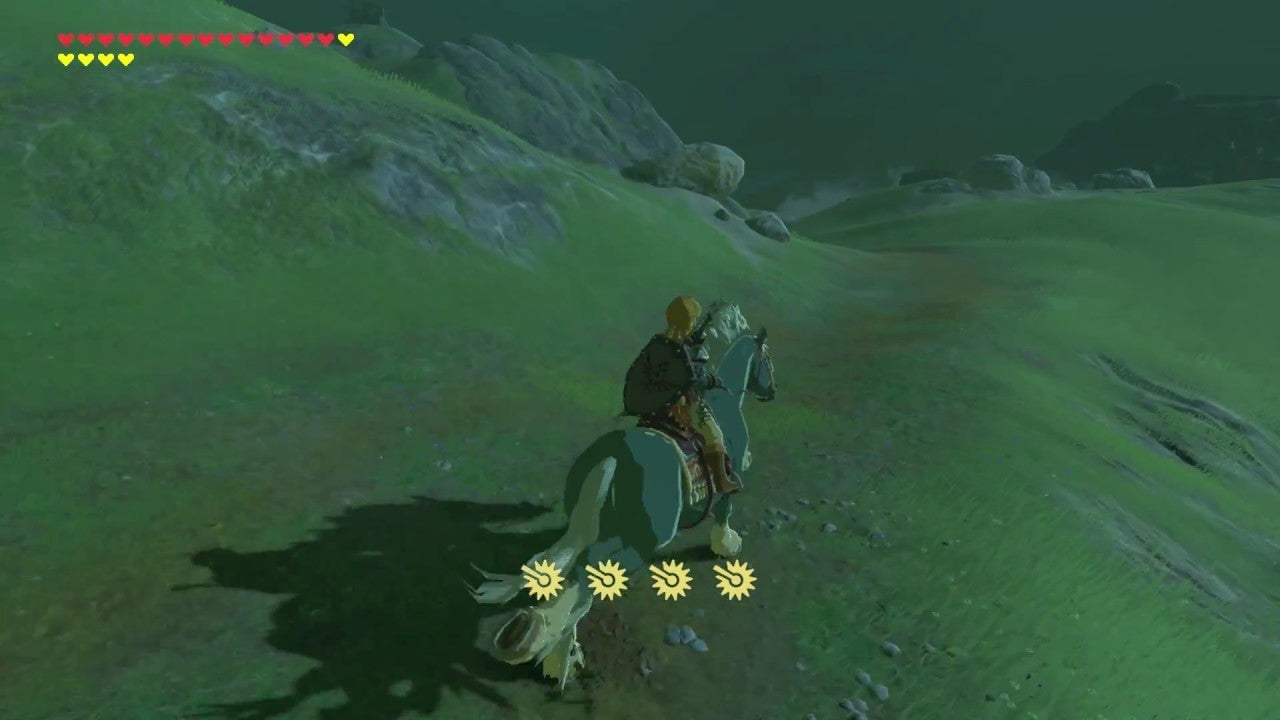
With its focus on space and silence over melody, lead composer Manaka Kataoka’s wonderful musical score is a marked departure for Zelda. I played several hours wondering when I would first hear Koji Kondo’s legendary Legend of Zelda theme, and I almost missed it when it finally showed up.
Listen here:
Any time you’re on an extended horseback ride, Kataoka’s signature piano tinkles begin to play. At first they sound almost random, then softly in the background, a string soloist creeps in. Before you know it, you’re hearing that classic Zelda anthem. It comes and goes so quickly, it’s almost like a mirage.
In Breath of the Wild, Link is scouring a land that’s largely moved on from his days of heroism. The legend of Zelda, and Link, and their friends, is largely that—it’s a legend, a story from a bygone age. The game’s use of the iconic theme perfectly captures that. It’s a half-hidden memory of greatness, shimmering to the surface and vanishing just as quickly.
You must never underestimate chickens.
I found most of the things in this article myself, but this one from YouTuber Dunkey’s recent Breath of the Wild video is too good not to mention. Everyone knows that in a Zelda game you don’t want to mess with chickens. Attack them, and they’ll attack you right back.
In Breath of the Wild, however, you can take that one further, carrying a Cucco into battle and tricking your enemies into making a mortal mistake.
I wouldn’t have thought to try that, and I love that it’s possible. I will now be carrying Cuccos with me anytime I go exploring.
The helpful painter is bad at painting.
Pikango the painter is one of the most helpful characters in Breath of the Wild. He turns up at many of the stables and villages in the game and is happy to help you find the memory locations you’ll need in order to see the game’s full story.
He seems like a pretty cool guy in general. Which makes me love it even more that he’s just not a very good painter.
Every place you find him, he’s working on a different lousy painting.
I sense that for Pikango, it’s not really about the quality of his work. It’s about the journey. What his paintings may lack in technical polish, they make up for with charm. I’d totally hang one of those up on my wall, if I could.
Pikango’s routine is, of course, as detailed as the rest of the game. He doesn’t paint at night and he’ll pack up his easel and paints if it starts raining. It’s fun to watch him perform his violent brand of brush technique, too.
After watching him paint, I’m a little less surprised at the quality of his work.
Last week at the Game Developers Conference in San Francisco, the directors of Breath of the Wild gave a really cool talk about how they approached constructing their game. Among other things, they discussed the concept of “multiplicative gameplay,” which they aimed to make possible by layering so many interlocking simulations on top of one another.
They achieved their goal and then some, but simulations alone only go so far. What sets this Zelda apart from other simulation-heavy games is how detailed and handcrafted it all is. That expressiveness is the key to its charm, and why Breath of the Wild feels less like a collection of whirring digital gears and more like a functioning, believable world.