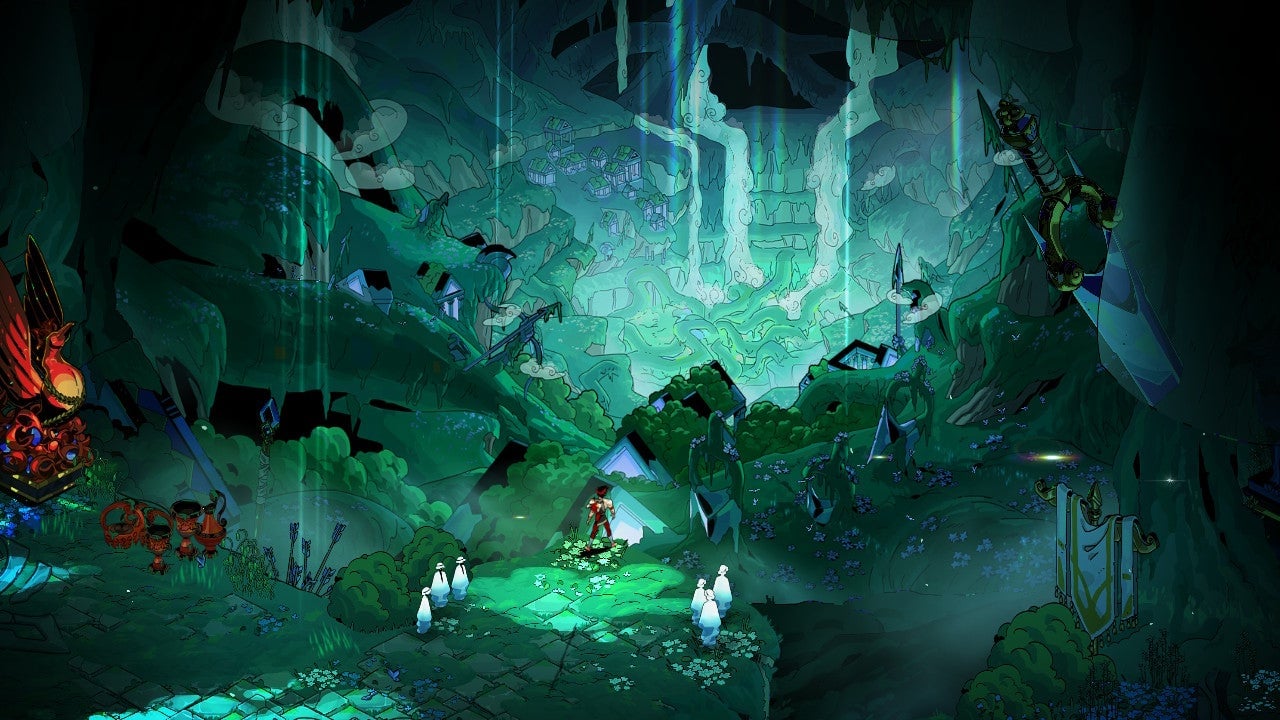
Hades, the well-received roguelike from Supergiant Games, is very obviously rooted in Greek myth. So what better way for a cadre of the games’ most devoted fans to pay homage to the source material than by staging a cover-to-cover reading of The Iliad, arguably one of the most recognizable stories from the Greek mytheme?
Six months in the works, the Iliad Project is a community reading of Homer’s timeless epic, initially streaming live on Twitch later this month. Leading the charge is Wriste13, a Hades speedrunner who’s played the game since well before its official 1.0 release last September. (If you’ve kept tabs on the game’s speedrunning community, you’ll recognize him as the champ of the Hermes Cup.) More than two dozen members of the community—from other speedrunners to actual Hades voice actors to some folks who just love the game—will participate. The Iliad Project even tapped Greg Kasavin, Supergiant’s creative director, to draft and read an introduction.
(Update: 6/22/2021, 1:15 p.m. ET: The Iliad Project is now available via YouTube and Spotify.)
“The main goal is that the Hades community produces something like this…and that we get a nice wide swath of readers in terms of variety,” Wriste told me over a Discord voice call last week. “We have familiar names, like Jawless Paul, who is a YouTuber, and we have Courtney Vineys, who did the voices [in Hades] for Dusa and Aphrodite. But we also have a lot of smaller streamers and some people who aren’t even streamers, or who barely have a social media presence. They just love the game.”
Though there are literally countless retellings of The Iliad, both verbal and written, The Iliad Project will rely on the Robert Fagles’ translation, widely regarded as the definitive modern rendition. If you’ve taken a Greek lit or world history class of any sort, you likely know the one: faded gold motif, offwhite text, a blue bar on the lower third. (This one.) It also happens to be the iteration Kasavin himself had on-hand when talking to me over Zoom last week about his involvement with the project.
“It’s the one that I engaged with first, so it’s the one I’m most familiar with, and it’s the one that enthralled me in the writing, in the poetry of it, and the emotional intensity of it,” Kasavin said. “It’s very readable, for the most part. It’s not as difficult to parse as, I think, many would expect. You think about even books from the 19th century, or something, your eyes may start to glaze over even just thinking about it. [The Iliad] is challenging. There’s a ton of names, a ton of locations, but, I don’t know, people got through Game of Thrones. It’s not that different!”
“The Fagles translation is very friendly,” Wriste told me. “It’s a lot of fun.”
So, why The Iliad and not, say, The Odyssey, or The Aeneid, or any other of the other gazillion epics about Greek heroes with washboard abs and nerves of steel?
Easy: “The Iliad, at least, has that very clear intertextuality between itself and Hades,” Wriste said.
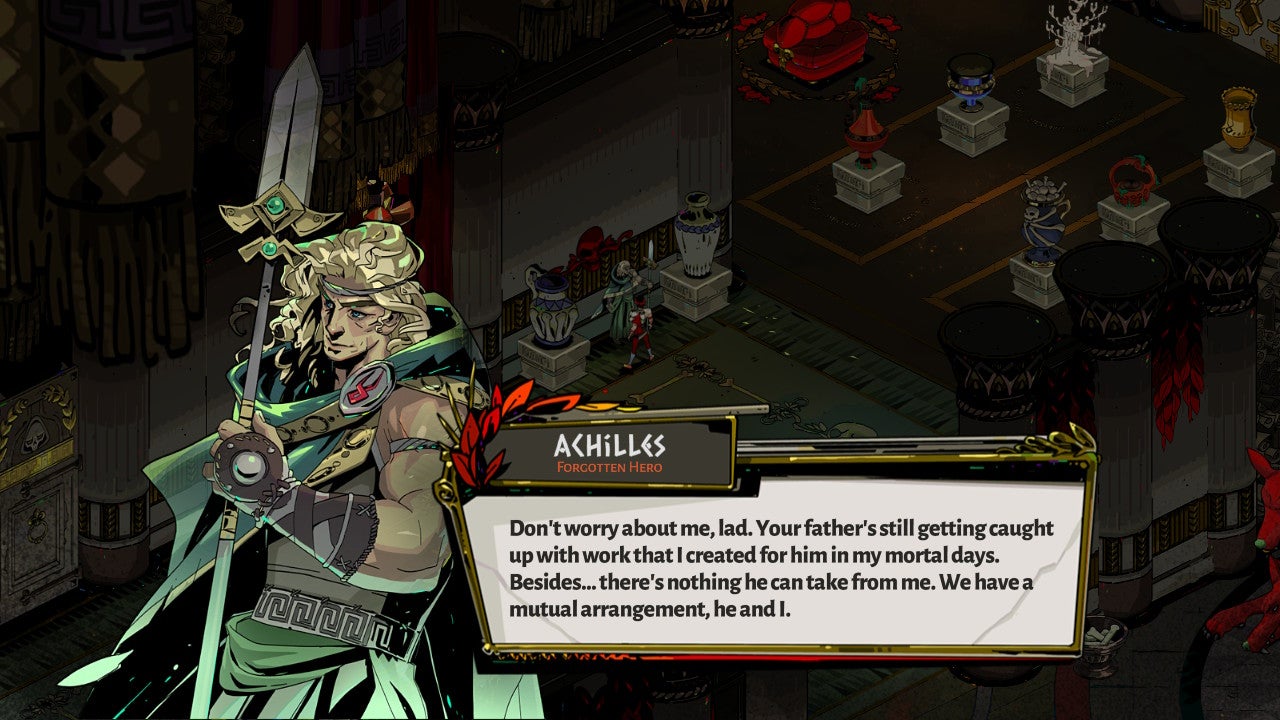
That intertextuality, for those who haven’t played the game, is most apparent with one character: Achilles. Yes, the guy with the most infamously vulnerable heel in literature plays a major role in Hades, serving as a mentor of sorts to the protagonist, the guy you play as, Prince Zagreus. Your goal, simply put, is to escape the claustrophobic rule of your dad, Hades, which means fighting your way out of the sunless realm over which he rules. Every time you fail, you’re sent right back to where you started. Between your attempts at escape, Achilles offers you consolation, words of wisdom, and the occasional tale of glory and gore from another life. Later on, you can unlock a “weapon aspect”—an alternate form of the weapons you use in the game—bearing his namesake.
One thing is clear: The Achilles of Hades is not like the Achilles of The Iliad. He’s not overcome with rage and pride. He’s more reserved and melancholic, a mournful man who suddenly has the rest of forever to consider his actions—in other words, certainly not a circa-2004 Brad Pitt. (Kasavin told me he sees this mellower version of Achilles not as a reimagination of the Homeric character but as a continuation. “It was easy to imagine Achilles as a character who would look back on his life choices with a great deal of regret, and it was exciting to think about him as someone who had been humbled in death in this way.”)
As you make your way up and out of the underworld, you’ll end up in the vaunted realm of Elysium, where you meet another character from The Iliad: Patroclus. In Homer’s telling, Patroclus and Achilles are close knit friends and warriors. In the Trojan War, he’s killed by Hector, the Trojan prince, spurring Achilles to battle. Though Achilles does not die in The Iliad, it’s widely understood that he’s killed in the war—that damn heel—and has his ashes buried alongside Patroclus.
“The Iliad is so closely tied to Achilles and Patroclus, which is I think a much-loved story in Hades, it demands that, if a project like this happens, it is The Iliad,” Wriste said.
“The heart of The Iliad is this relationship between Achilles and Patroclus,” echoes Kasavin “Achilles refuses to enter the war until Patroclus’ death drives him over the edge, and what is the depth of emotion and despair that would cause this to happen?’.”
Hades players can attest to the following, but it takes an eternity to get Patroclus to say a word in the game. When you first talk to him, he’ll toss you a healing item and essentially tell you to fuck off. Eventually, after trial and (much) error, he opens up, and you can start working toward reuniting the duo—in a manner that’s a bit more than “old war friends,” if you catch my drift. Among the many, many narrative arcs in Hades, reuniting Achilles and Patroclus is easily among the most satisfying. And, of course, it’s spawned some amazing fan art
Wriste says 27 people will read, with duties split across The Iliad’s 24 books. Those books, of course, vary in length. In some cases, readers will read an entire book alone. In other cases, they’ll split the load. And before you get any ideas, no, this is not the sort of reading where each reader will take on the role of a specific character, which Wriste said would split the workload among readers unfairly—too many characters—and would also be a logistical nightmare to boot, far beyond the scope of the project’s goals. (Wriste told me that the roadmap already ballooned past its initial one-month time frame into a six-month endeavor.) This is a reading, after all, not a play.
“There are only two things we all really have in common, which is that we love Hades and we all agreed to do this project,” Wriste said. “That’s it.”
That’s what strikes me most about the Iliad Project: You cannot deny the beating heart at the core of this thing. Some people reading are equipped with top-shelf microphones and recording equipment, and bring to the table a seasoned level of experience that can only be honed from being a public figure on the hellishly unforgiving internet. Others, as Wriste mentioned, don’t even have social media accounts. From tip to tail, the Iliad Project is a love letter to a game undersigned by a collective of people who were inspired by Hades—itself inspired by a 3,000-year-old epic—to pass the word.
“To me, it’s Greek myth working,” Kasavin said. “It’s doing its magic.”
The Iliad Project will stream live on Wriste’s Twitch channel on June 20 at 6:00 p.m. ET. It’ll be available on services like Spotify and YouTube after the fact. Personally, I’m considering an ideal post-E3 palette cleanser.