Yes, I gained a new ability! Now where the hell do I use it?
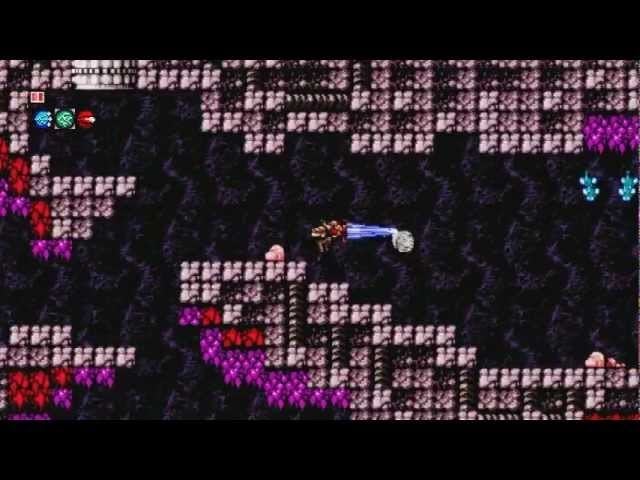
The thrill of obtaining a shiny new toy followed quickly by the frustration of wandering about looking for places to apply it are the major beats of Axiom Verge, an indie love letter to classicMetroid-style 2D sidescrollers. You know, Metroidvania, the portmanteau genre that made backtracking cool.
The concept is simple. The player traverses a map looking for something—a weapon, a power-up or special ability—that will allow them to access new areas. Did you pass a door too high to jump to? Well now you have a super jump, so haul your ass back to wherever that was and…oh, you’re lost? You probably should have been taking notes.
Axiom Verge‘s hero, Trace, seems the sort of fellow to take copious notes. He’s a vague scientist working on a vague experiment that fails in a vague sort of way, killing him in the process. But instead of the inevitable black nothing that awaits us all when we shuffle off this mortal coil, Trace winds up in a strange bio-mechanical world, where a renegade HR Giger sculpture urges him to start collecting all the things he’ll need to get to the end of the game.
In case you were taking notes during the story explanation point of our review, be sure to annotate them thoroughly before crumpling them up into a ball and tossing them over your shoulder. The story of this bespectacled scientist turned sci-fi action hero and his quest to aid giant metal female faces failed to capture my imagination. I collected hidden notes, but mainly because I thought they might be new abilities. And upon entering the odd room where I knew exposition was about to unfold, the plot points were drowned out by the relief of not having to shoot anything for a few seconds.
As I mention previously, Axiom Verge is a love letter to games like Metroid, and one doesn’t dedicate a large portion of a love letter talking about the one’s self. It’s unfortunate, really—part of what made the endless exploration of Super Metroid and Castlevania: Symphony of the Night so compelling was the promise of a satisfying payoff. Without it, running across a map to pick up a new gun is less epic adventure, more running to the hardware store.
That said, Axiom Verge has an excellent hardware selection once it gets moving—which takes a bit of time. Instead of kicking things off with an awesome ability—say rolling up into a ball, for example—Trace spends the first few hours of his journey as a man with first one, and then several guns and a drill.
The game really picks up once our guy acquires the Address Disruptor. At first glance it’s little more than a tool for making hidden platforms appear, once the realization dawned that this transformative tool could be used on enemies as well, my adventure got a bit more interesting.
Take an enemy that fires the most annoying red lasers in the world at our hero. Bathe them in the healing light of the Address Disruptor, and suddenly they are helpful creatures firing harmless beams with a tendency to vaporize walls, revealing secrets. One enemy becomes a stepping stone. Another transforms into a whirling dervish, taking out any pesky obstacles in its path. Eventual upgrades to the Disruptor make it affect larger creatures and glitched spots in this strange alien world.
What’s amazing and a little frustrating is that the game never tells you these things will happen. Axiom Verge is a game about exploration and discovery, and that includes exploring and discovering new uses for Trace’s abilities as well as hoofing it through endless enemy-riddled corridors.
And so it goes. Earn the ability to warp through thin walls, wander the map searching for thin walls. Acquire the grappling hook (I call it the Bionic Commando special), wander the map looking for spots that could use a little grappling.
I say “wander” because Axiom Verge‘s map is a huge mish-mash of rectangular shapes with very little to indicate what’s within them. The game’s generous checkpoints are marked. Red areas signify where pattern-memorizing battles against massive bosses occurred. But other than seeking out doors that have yet to be opened and bits of the room rectangles that haven’t been fully filled in, there’s little indication of what’s what and no in-game method of marking points of interest. At times it can be quite overwhelming. As can the game’s selection of weapons and gadgets and special abilities.
In the game’s later stages you’ve got a ton of weapons to choose from, gadgets and abilities mapped to every button on the PlayStation 4 controller. Between bouts of simply shooting I’d have to pause and recall which button did what before attempting to cross trickier terrain. Nothing is more frustrating than climbing to a lofty height, jumping from a platform and then falling all the way back down to the ground because you deployed a drone instead of your grappling hook.
Still, as frustrating as Axiom Verge can be, there are more than enough highs to outweigh the lows. Making a tricky jump, discovering a secret area in a map segment you’ve been through a dozen times before, discovering a new way to defeat a frustrating enemy—I’m looking at you, steam-shooting shelled critters—all stir feelings of triumph evocative of sitting on the living room floor in your PJs in front of the Super Nintendo. It’s enough to warrant a celebratory bowl of cereal.
What’s really mind-boggling is that Axiom Verge is the work of one man. It is a Thomas Happ production. He designed the game. He put together pixels that one minute feel borrowed, the next breathtaking. He made the steam-shooting shelled critters, the bastard. He even composed all of the music, my favorite part of the entire game.
I don’t think I’ve ever embedded a soundtrack in a review post before, but I had to share track eight’s otherworldly Middle Eastern vibe and track ten’s gorgeous opening. Track seven also features some strange background noise that made me think people were talking on radios outside my second story window. Maybe that’s why the rest of the game felt so cold—all of the passion is in the music.
Axiom Verge is not the next Metroid. It’s more a massive, sprawling theme park dedicated to the upgrade-and-unlock action-adventure sub-genre, instilled with a few fresh ideas and constructed with consummate skill. While it’s too occupied with paying homage to the games of old to establish a solid identity of its own, there’s more than enough here to keep fans of finding things coming back.
I certainly plan to, only next time I’m bringing graph paper.