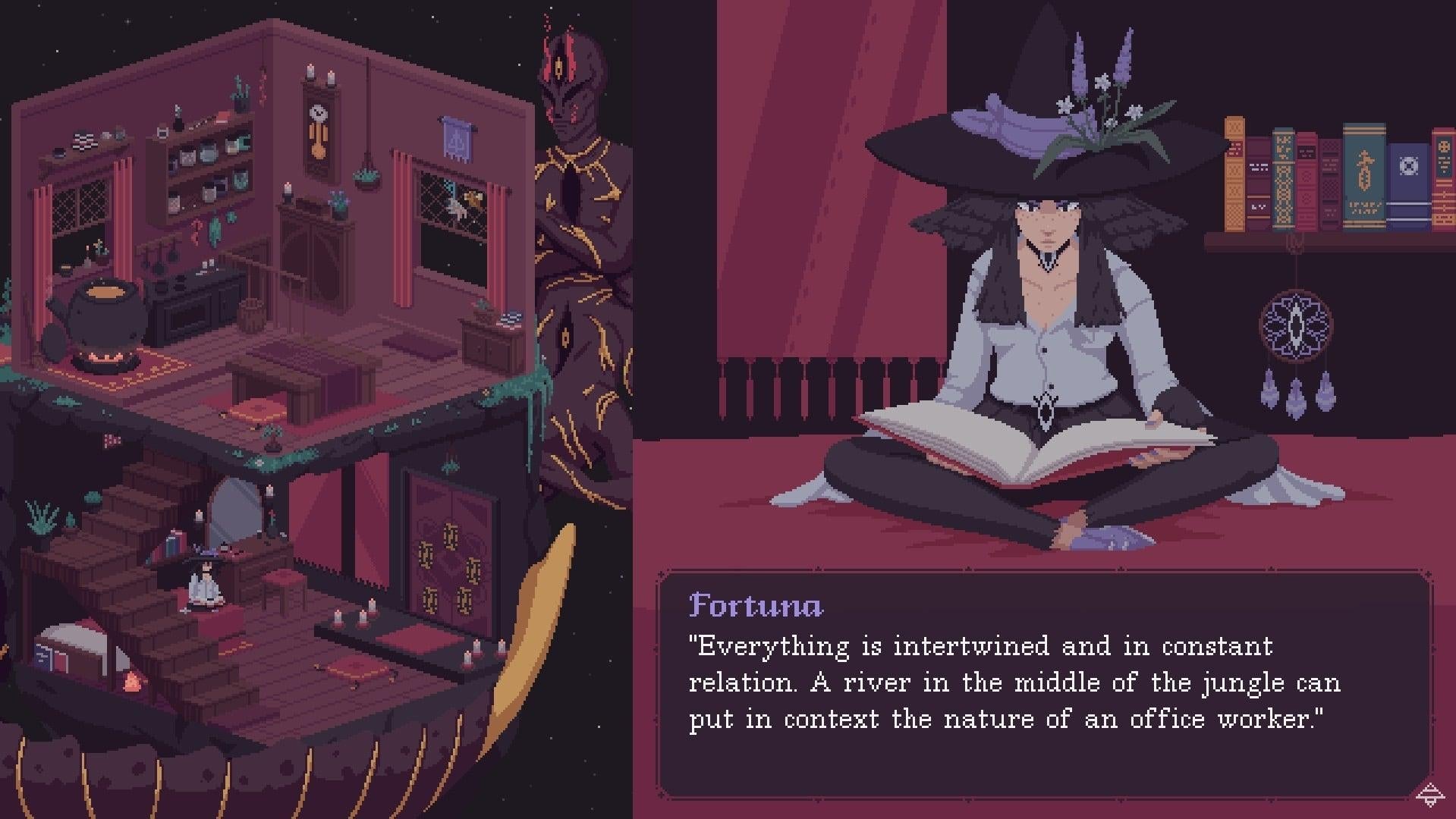
I find myself reaching again for The Cosmic Wheel Sisterhood soon after my first play session on Switch, moved by the inexpressible magic that comes when a game really clicks with you. The witchy narrative adventure has a simple, meditative story and gameplay, and four hours into its approximately seven-hour runtime, I’m attached to the routine.
I play as Fortuna, a blunt-haired and blunt-spoken (dialogue options permitting) witch who’s been living in a quaint, wine-colored house on an asteroid for the last 200 years. She, a skilled fortune teller, was exiled here and stripped of her tarot deck for predicting her coven’s destruction. Centuries of isolation have made her not introspective, but desperate. She summons the forbidden behemoth Ábramar—a serpentine cosmic being with many eyes, arms, and, as conversation with him reveals, a healthy sex drive, about which I feel conflicted—and agrees to his contract.
The contract’s specifics depend on the elements—air, emotional water, earth, and irascible fire, all of which are quantified and tracked in a four-square circle on the top right of my screen. These elemental points are the currency I use to make a new divination deck for Fortuna to give readings with.
What if deck-building, but Tarot
This is an unconventional “deck builder” game—I make or destroy cards as often as I want, and the size and content determines Fortuna’s psychic predictions, a more metaphysical consequence than those that appear in card battler Hearthstone. To create a card in The Cosmic Wheel Sisterhood, I need to select three components: a “sphere,” or background like an empty opera house or melancholy sunset; an “arcane,” or mascot like a flushed goddess tangled in her serpent lover; and a “symbol,” an embellishment, like a filled whiskey glass.
While all options are predetermined or unlocked as I progress, these components feel highly customizable, and creating cards quickly becomes my favorite part of the game, equal parts relaxing and soft October.
I gain my first few elemental points by simply participating in Ábramar’s binding contract, which requires me to answer questions that determine how characters interact with me for the rest of this chatty game. What is my innermost desire, power, romance, or knowledge? What am I willing to sacrifice in exchange for Ábramar’s energy: my immortality, my coven, or possibly a loved one?
I quickly see my choices in action. I want to be pitied, so witch officials deign to lessen my sentence and allow visitors, many of whom clamor for a reading from my unique new deck. A randomizer shuffles and selects a card for me (it could randomize better—in my playthrough, I repeatedly pull the same few cards). I assign it to the category, like past or present, I’m trying to decipher, and then choose an interpretation from a list of options. Each one, based on its cadence—sappy, like water, wrathful, like fire—earns me a number of specific elemental points so that I can make more cards for my deck.
As I keep the wheel of fortune spinning, making cards to read them, I remember how I told Ábramar that I desire romance more than anything else. One of my visitors suddenly professes their love, which I accept.
Magic like this is, I think, an interesting added layer to The Cosmic Wheel Sisterhood’s interactive narrative. With these kinds of games, as a player, I know my decisions are all-important. I usually don’t think about that fact for long, but this game’s persuasive magic gives that notion weight.
Aside from being constrained by dialogue—which, for my taste, sometimes relies too much on pain to get me invested (“I tried to kill myself so many times that I can’t even […] look at myself in the mirror,” comes up as a choice for Fortuna more than once; “If we don’t dig into the intense stuff we might as well just have a normal conversation,” she says another time)—I am powerful in this game. But in its customizable cards and in its story, in which witches are obsessed with strength and disappointing each other, The Cosmic Wheel Sisterhood encourages me to think about this seriously. How selfish am I? What matters more, me or my community?
I haven’t found an answer, yet, in the game’s pixel galaxy. But I keep looking.