The fall is usually a time for people plow through the latest and greatest games. This year, however, I’ve also been revisiting an old friend of sorts inDiablo III. But as I work my way through the game anew on my PS4, a big problem has flared up once again: something about its difficulty still feels…off.
Diablo III’s difficulty has been a point of contention ever since the game first launched for PC in its original form way back in 2012. Part of the problem that fans and critics have had assessing its impact on the game is that there are a number of different problems, the roots of which aren’t precisely clear. So let my start here by identifying my three main grievances.
First, the game is often far too easy—especially when I’m playing with friends. Second, it can be crushingly difficult at other times, in a way that makes the game feel unfair or simply not very much fun to play. Thirdly, and most importantly: Diablo III continues to be an inappropriately rigid game when it comes to letting its players choose between different difficulty levels, and do so in a relatively painless manner. I took me a while to appreciate this after revisiting the game on my PS4, because like many players, I’d settled into my own habits with the PC version of the game previously.
My experience playing Diablo III one recent Sunday shows how all of these different problems can manifest themselves over the course of a few hours. I started the day (Diablo-wise, at least) in the early afternoon. Not seeing any friends online at first, I decided to play on “Normal” difficulty while listening to a podcast—my go-to autopilot mode for playing Diablo III when I’m feeling meditative or hungover rather than competitive. This felt like too much a cakewalk, so I switched over to “Hard” after a few minutes and settled into a decent groove.
Jumping all the way to “Expert” could have made Diablo III feel meatier in certain ways, but I’d already found that playing it in single player just ended up adding a lot of time to the game. As far as I can tell, the biggest change that occurs when jumping between difficulty levels is that monsters hit points shoot up. Going all the way to “Expert” or beyond when playing on my own therefore leaves me stuck in many spots. Moments or entire passages where I’ve already figured out how to defeat a bad guy, but I still have to spend what feels like another five to ten minutes slowly chipping away at the bright red health bar above his or her head. It’s routine and familiar, though rarely in a good way.
An hour or so after I started playing Diablo III on “Hard,” a friend showed up and dropped into my game. We both noticed that we were breezing through things with little to no legitimate resistance, so we dialed the game up to “Expert,” the highest of the three difficulty settings you can access before you need to start unlocking stuff in the game. Once again, we settled into a comfortable groove. It still felt like “a game that’s a bit on the easy side,” as Mike Fahey noted in our original review back in 2012, but we both knew Diablo well enough to expect that at this point. Also: it was still a lazy Sunday.
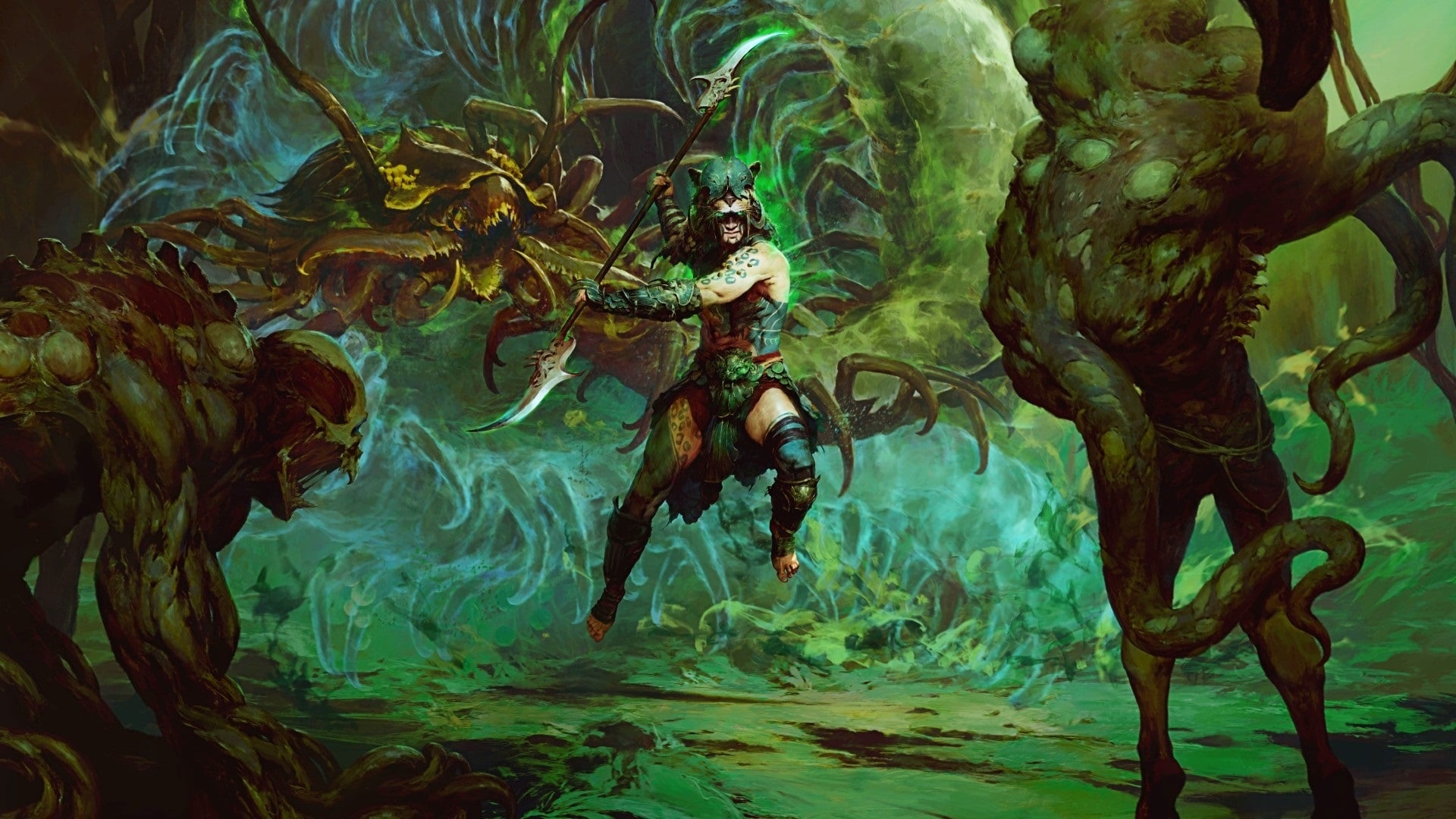
Then two more friends showed up, and Diablo III officially went off the rails. We were still in Act I simply because I had started the day playing a new Witch Doctor character I hadn’t put much work into leveling up yet. I hadn’t sunk enough time into the various holes Diablo III requires I fill before this Witch Doctor could grow into a fully-fledged character that’s fun to use when playing with any of my PSN-compatible friends. No matter what way you look at it, I just hadn’t done enough with this Witch Doctor yet. I still needed to kill more bad guys, collect more armor, fight more bosses, before he could really take shape. Veteran fans of Blizzard’s franchise understand all these steps as necessary ones, ingredients in the game’s special mixture of purpose-driven gameplay that enthusiasts refer to as “grinding.”
Two of my friends were much farther along in their games than my Witch Doctor was. Once the four of us got together and started going through the skeleton-filled crypts and dungeons around New Tristram, therefore, the game was beyond easy. We blew through levels so quickly it was hard to keep track of who, or what, we were fighting. At one point, one of my friends quipped that he felt like he was leveling up faster than he was actually attacking enemies.
Two years in, and the game still doesn’t respect my time.
There are a few specific reasons why things went down the way they did here, but they all point to one core issue I’ve always had—and continue to have—with Diablo III: this game asks for far too much of its players before it starts to give things back to them in return.
Reading the description above, for instance, you might have started to think: “Well, why don’t you just increase the difficulty again?” I would have loved to do that, but I wasn’t able to. I still haven’t officially beaten Diablo III’s campaign on the new PS4 version that I’ve been playing. The friends I was playing with hadn’t either. So while they were at a high enough level to make playing through Act I with them feel annoyingly light-weight, they hadn’t yet reached on to let us actually fix that somewhat arbitrary balancing problem.
This is an irritating middle-ground I’ve often found myself stuck in: between the sort of Diablo III experience that’s so easy it feels insubstantial and one that’s inordinately, crushingly challenging for all but the most seasoned pros. The latter group has settled into a number of different niches within the game depending on their particular preferences: either switching to the most extreme difficulty settings attainable (with the proper unlocks, of course), or playing in “Hardcore” mode, a specific setting you have to choose at the outset when creating a new character, and makes it so that that character can only die once in the game.
My first problem here is that Diablo III requires too much of a time sink before it allows you to make informed choices between these different difficulty settings. I reached out to Blizzard last week to ask why Diablo III’s developers continue to block off access to the game’s higher difficulties, and they responded by saying they still felt doing so was necessary:
We wanted to make sure players could take on the challenge of higher difficulties. You literally can’t succeed at the higher difficulty levels until you get a certain level of gear. We felt it was best to introduce the higher difficulties once players had a good feel for the game and had the gear to deal with the challenge.
I understand the logic here. But I don’t buy it. I’ve been playing Diablo III for more than two years at this point, and I feel pretty confident when I say that I have a solid grasp of how the game works. Even if I didn’t, Diablo has always been the sort of game that’s easy to pick up and learn on the go. It’s nothing like Wasteland 2, which took me several restarts just to get the basics down. Forcing me to master something I already think I understand fairly well is just creating a series of arbitrary hoops to jump through all over again for no good reason.
Now, many fans of the Diablo series (and the third game specifically) will counter this with an argument that blowing through the first chunk of Diablo III is a necessary evil—especially if you find yourself frustrated with the game’s balance in the first three difficulty levels. I understand that, and having gained access to the higher-level game on my PC, I also appreciate how much fun the rest of Diablo III will likely be once I get over these necessary hurdles again on my PS4. But I find the entire notion that gamers are meant to tolerate or endure something…unsettling, especially when it comes from a company that’s made some of the best games I’ve ever played. If the best defense that diehard fans can come up with for Diablo III’s awkward opening is that it’s meant to be tolerated, then I think Blizzard needs to rethink why its audience feels like it’s tolerating something in the first place.
Other Diablo III players, meanwhile, have recommended that people in my situation switch over to hardcore mode, which keeps the game fresh and exciting by adding a new dimension to its challenge. One Kotaku reader described his love of playing the game on Hardcore so well in a comment that he convinced me to finally give it a shot myself:
It’s not difficult when enemies are spongy, it’s difficult when you run into that blue pack with frozen + waller + jailer + fire chains and you use teleport, potion, and you watch helplessly as your health drops as fast as the radius of your sphincter. Then, in an instant all of your hard earned work is gone. Unstable anomaly procs, that moment comes where you think you might actually make it out of this alive only to scold your friend who said you were going to be “just fine” farming Torment 3 Rifts, only you get instantly jailed and frozen. You stare blankly at the screen, thinking of what you could have done differently. You don’t stare for long though, your friends are now max level without you, and you must make hast to level up another wizard to join them on their demon slaying adventures.
Those moments—when you suddenly feel trapped, helpless, maybe even a little scared—are what I’ve always loved about Diablo. And I have to admit, playing on Hardcore does put me on edge (in a good way) far more often than playing Diablo III sans-permadeath does.
I’d also argue that Hardcore mode only succeeds as a temporary measure. It livens up the game, sure. But it only does so by raising its stakes to an insane degree. In the process, it places many other parts of Diablo III that I love (the fun of developing characters, exploring its many beautifully surreal settings) at a nearly constant risk of being lost with barely a moment’s notice.
Earlier this month, I wrote about the new “Nemesis system” that Blizzard added to Diablo III‘s console versions for the game’s Ultimate Evil edition. I like these giant scary Xenomorph-like monsters because they shake up the pace of a game that’s become increasingly predictable as its legions of players continue to trod through the same well-worn dungeons and hallways over and over again. Looking back at my first encounter with a Nemesis after my recently lazy Sunday with Diablo III, I think I realize something else that I love about the game’s new class of super-villains. They don’t just up the ante or modulate hit points or damage-per-second levels; the Nemesis monsters change your entire relationship with the game—albeit just for a few seconds. They pose a challenge that’s so dynamic, so surprising, that it manages to feel wholly new.
I hope Blizzard keeps experimenting with new ideas like the Nemesis system. Because as much as I love Diablo III, I’m becoming more and more aware of the fact that I still haven’t bothered to finish its campaign on my PS4. The game just hasn’t given me a compelling enough reason to jump through this hoop once again.
To contact the author of this post, write to [email protected] or find him on Twitter at @YannickLeJacq