Last fall, a producer for CBS This Morning called me to talk about the video game Hatred. I had been on CBS a year earlier to teach co-anchor Gayle King how to play Grand Theft Auto V, the biggest entertainment property in the human-discovered universe. This time, instead of talking about a game made by some of the most accomplished designers in the medium, I was being asked to go on network television to talk about a commercial on YouTube for a game that didn’t yet exist made by a studio that basically no one had ever heard of. “It’s causing quite a stir online because of its intense killing spree nature,” I was told by email. Of course I said yes.
The interview was booked; the car—TV people always offer to send a car because they don’t pay you except in the currencies of increased self-importance and back-seat bottled water—on its way. But the producer wanted to get a sense of what I planned to say. Did I think Hatred was “going too far”?
I gave an answer that was ambivalent and possibly incoherent, and within 90 minutes, my morning-show appearance was cancelled. They didn’t tell me why, and to be honest, TV news shows cancel interviews about as often as the cable guy shows up in the last 10 minutes of your four-hour appointment window. But I’ve always hoped that CBS News cancelled the segment, because I mentioned that the people at Destructive Creations, the studio behind Hatred, wanted exactly this kind of news coverage. The game—no, not the game, the advertisement for the game—was tossed into the digital ocean with the intention of creating ripples of outrage.
Eight months later, however, Hatred is actually here, and it’s one of the top-selling games on Steam. If only the designers at Destructive Creations were as good at making video games as they are at marketing them. I still don’t know, though, whether Hatred goes “too far.” Somehow it manages to go too far while simultaneously not going far enough.
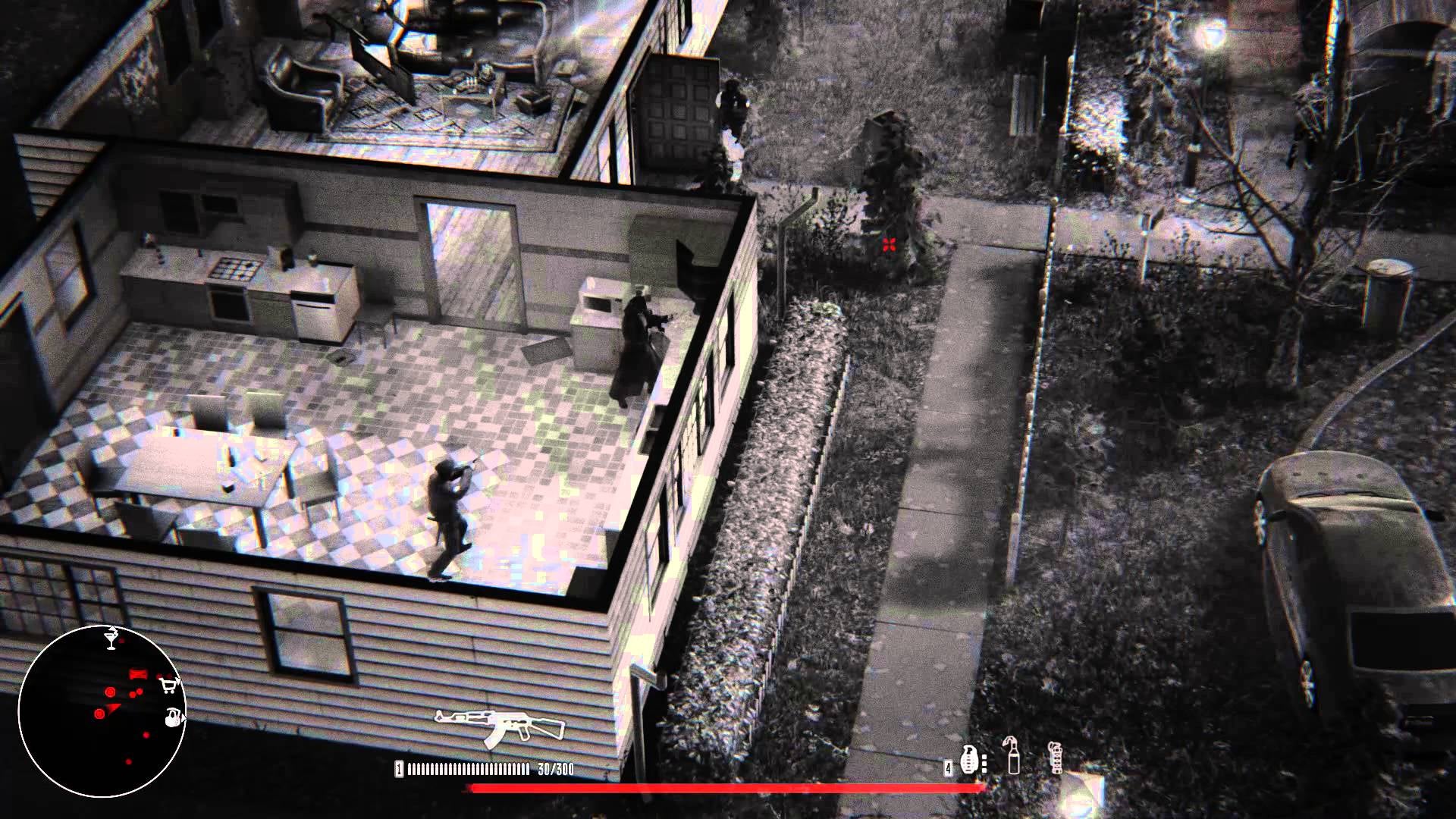
Hatred is a twin-stick shooter—I played with a gamepad, though you can use your keyboard—that displays its dreary world from an overhead perspective. , The player is cast as a nameless antagonist, a long-haired Danzig roadie (OK, that’s a supposition) who has decided to go on a mass killing spree. He shoots his way through neighborhoods, sewers (of course there are sewers), outdoor shopping areas, military bases, and more. Literally the only things he can do are move and kill. Well, that and grumble drivel like “Can you hear your guardian angel crying?” When he is wounded, he heals himself by executing victims as they crawl along the ground, typically while a graphic video of the execution plays on screen
If he chooses not to kill, people run from him in terror anyway, which makes the game sadder and more interesting. The police will eventually arrive and shoot him to death despite his nonviolent resistance.
https://www.youtube.com/watch?v=pWmAd6gRi3o
Killing people in video games can be gleeful and silly, or it can be harrowing and disturbing, or heart-racing and exciting, or even strategic and deliberate. Hatred aims for all of these sensations and achieves none of them.
There are occasional attempts at humor that poke through the game’s otherwise monotonous tone and black-and-white imagery. “Are You Drunk?” the game asks in its options menu, a wink that this is all a late-night lark. (You get an achievement if you choose “Yes.”) While you’re slaughtering—maybe flamethrowing—people at a train station midway through the game, the station announcer dryly observes, “Ladies and gentlemen, the train to New York City will be delayed; we’re sorry for the inconvenience.” You are rewarded with a “Mainstream Guy” achievement for killing hipsters and with a respawn point for murdering customers who are waiting in line for a new “aPhone.” Fire 10,000 rounds, and you’re bestowed the “Liberal” achievement. Fire 25,000, and you’re “Conservative.”
More often, the game feels sincere, motivated by a mystifying belief that it’s transgressive in video games to murder cops and soldiers, men and women. Hatred looks like a parody of what a Columbine-era parent feared about video games. Yet the experience of playing it is more American Movie than American Psycho. I began to think of it as an interactive Coven (pronounced, as devotees know, with a long “O”), the misbegotten short horror film chronicled by the cult 1999 documentary. On the other hand, that’s unfair to Coven
Hatred is distasteful and unpleasant to play, partly because of its gruesome execution scenes and partly because of its repetitive action and frustrating controls. The game is more disturbing in easy mode than on hard (I didn’t play “extreme,” nor did I drink Surge), precisely because reducing the difficulty correspondingly reduces the amount of thought required to play it. As the second-by-second decision-making recedes, the stomach-roiling images become more visible. The player begins watching more and doing less. This may be why the YouTube video last October became a brief sensation. Viewing clips of Hatred, especially execution sequences, is more sickening than playing the game, because to a viewer the violent imagery is experienced in isolation, away from the buzz of doing and choosing.
The most haunting portion of the game is set on a commuter train that, for me, evoked the Long Island Rail Road massacre of 1993. Few of the passengers have weapons, and some cower in their seats. You can walk up and shoot them or pass them by; the game offers no rewards and passes no judgment. It’s a rare instance when the player has time to reflect: What am I doing, and why? (The game is set in New York, although there is little effort, other than occasional text, to conjure a specific location.)
https://www.youtube.com/watch?v=AkgAcV4qBWU
Another level, at a truck stop, brought forth (perhaps unintentionally) memories of the 1991 Luby’s Cafeteria shooting in Killeen, Texas.
https://www.youtube.com/watch?v=0ktu5oiumHU
I chased down a single, unarmed man who was praying the “Our Father.”
https://www.youtube.com/watch?v=ZO0_NbdWDOU
The game gestures incoherently toward political assassinations, the threat of nuclear terrorism, maybe the shootings at Fort Hood. But this is not a skillfully made piece of shock culture. After 10 hours, I was begging the game to shock me. Instead, it appalls by volume, as death scene after death scene make you feel like you’ve been sentenced to a particularly ineffective regimen of aversion therapy out of A Clockwork Orange
Hatred wants to be outré enough to make its players feel they are violating taboos without being brave enough to confront the reality of mass killers like Charles Whitman, or Dylan Klebold and Eric Harris. There are no schools or children here, no recreations of historical killings like we once saw in JFK Reloaded
The game’s logo resembles Doom’s, which I think is meant to suggest that Hatred is part of a continuum of video game history, that we can thrill ourselves with the sensations of virtual murder and then throw up our hands and say it’s just “fun” when someone asks us why we are thrilled. Except Hatred isn’t exciting or frightening or intense or funny or even thought-provoking, except in the sense that playing it left me feeling so empty that I’m wondering whether that means there is something wrong with the game, or whether there is something wrong with me.
Is the problem merely a failure of (sorry) execution? If Hatred were a well-made game, it might inspire some genuinely interesting tensions, some reflections on our love affair with death-dealing in video games, especially among people who despise Hatred but otherwise adore slitting virtual throats and no-scoping computer-animated foreheads. Unfortunately, Hatred isn’t worth hating.
Chris Suellentrop is the critic at large for Kotaku. Contact him by writing [email protected] or find him on Twitter at @suellentrop