Somehow, horrifyingly, it has been nearly a full year since most of us went into lockdown to wait out covid-19. And while there is a light at the end of the tunnel in the form of a slowly, confusingly distributed vaccine, we’re still in the thick of it. On this week’s episode of the Splitscreen podcast, we reflect on the pandemic’s one-year anniversary and talk to the creator of Plague Inc, a game about creating a killer, globe-ravaging virus that came out many years before covid, only to experience a painfully relevant resurgence in recent times.
To begin the episode, Ash Parrish, Mike Fahey, and I talk about the games that have kept us from losing our minds while stuck inside, from time-devouring JRPGs (Persona 5, Dragon Quest XI) to multiplayer games (Final Fantasy XIV, Valheim) to Animal Crossing, which is in a category unto itself. Then we move into our world-famous FAQ segment, AFQs, which of course stands for Ask Fahey Questions. Fahey, you see, recently received his second vaccination shot, so we decided to quiz him on what the experience was like, in hopes that if you’ve got questions, he’s got answers.
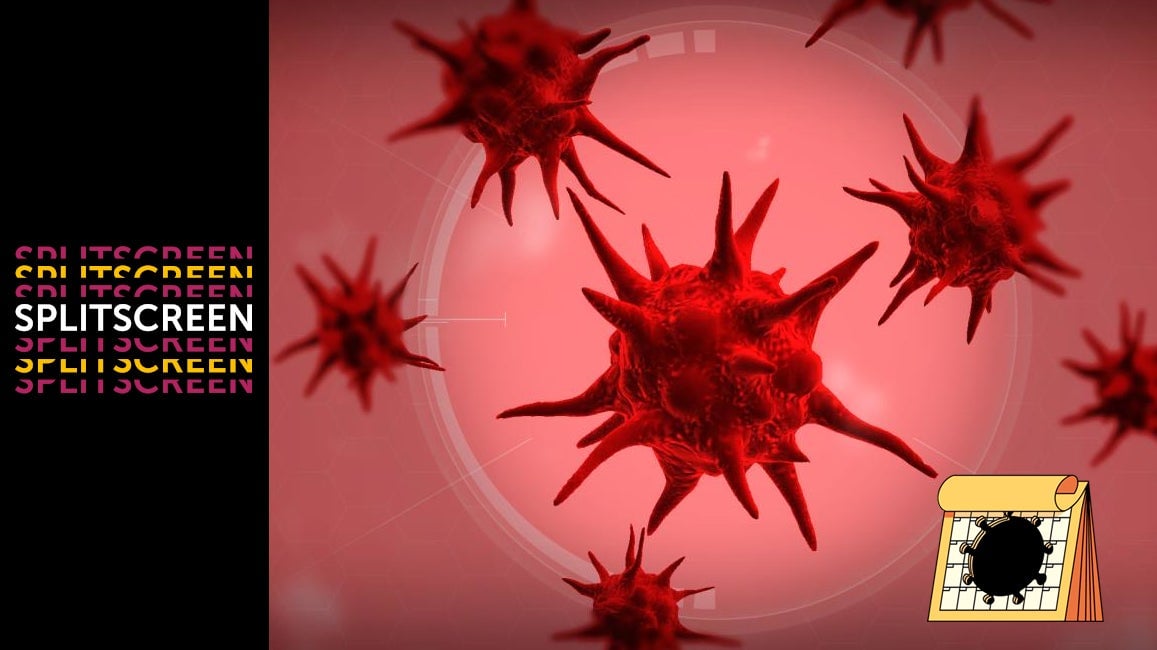
Lastly, we bring on a guest, Plague Inc developer James Vaughan, to talk about what it was like to watch his game suddenly become reality and how he and the rest of the team at Ndemic Creations went about developing “The Cure,” a DLC expansion about saving the world from a deadly global pandemic, rather than destroying it with one.
Get the MP3 here, and check out an excerpt below.
Ash: So how does it feel to be responsible for the destruction of humanity through a rampaging virus?
James: It’s been a very difficult year for us as a studio, actually. Seeing a game that I made way back in 2011 play out in the real world was a very uncomfortable feeling. I can remember sitting in my bedroom trying to look up films, doing research on how a pandemic might happen, and then fast forward 8-9 years, and suddenly I’m seeing it all happen in the real world news. Awful.
Nathan: When it started to become apparent that covid-19 was something that would impact a lot of people—that wasn’t just going to go away—what was your feeling? I imagine a lot of this probably coalesced into “The Cure” DLC, but at the time, when the shock of it first really hit, where was your head at?
James: I think a lot of it was wondering why people weren’t reacting to it more strongly. I remember when it was really getting going initially in China, and the world seemed so confident that the disease wasn’t going to spread anywhere else. I wanted to believe it as well. I thought, “Well, everyone else seems to think it’s going to be OK and we don’t need to shut down our borders and stuff. I’m sure they must be right. I just made a game. I don’t know as much as the experts.” It felt very surreal seeing it kind of slowly happen after that.
Fahey: I played “The Cure” a little bit this morning. Even through the tutorial, I found it horribly nerve-wracking. It gave me perspective on the efforts, because you have that whole dynamic of “What if people don’t believe you? They suddenly won’t believe you.” And then looking at current events of course, there are people who still, even now, with all these millions dead, are like “Nah.”
James: The way I kind of tackle these kinds of things is, when I’m doing the research, I come up with a list of the key themes I want to tease out in the gameplay. Because with games that are based in the real world, it can be tempting to throw everything in, to squeeze it all in and make this lumbering monstrosity which nobody engages with because it’s got too much stuff. So for us, it’s always like “Here are the things we’d like to get in it. Now how can we try and fit this in? What if we change this mechanic? Can we introduce this other mechanic?”
I really wanted to make sure we got the concept of the economy into the game. Because when people were playing Plague Inc, they were like “Why don’t they just shut down everything as soon as one person is infected?” I wanted to show people that it’s not that simple. You won’t get people’s support doing it. You’re going to need to provide economic support even when they know there’s something going on. That’s where the issue of noncompliance came into “The Cure.” A key message that I hope comes through in our games is that the world is not black and white. It’s all a murky, complex shade of gray. There’s no easy decisions. There’s no perfect information. Everything is complicated. I wish it was nice and simple and easy.
Nathan: So you talked about the themes you wanted to explore in “The Cure.” As you consulted with various entities like the World Health Organization and made sure you were making “The Cure” DLC in an accurate and responsible way, how did the themes and ideas you wanted to explore shift and change?
James: I do quite a lot of research on topics before starting, and I think one of the joys about basing things on the real world is that it’s very easy to get a lot of visibility on topics you want to get across. Certainly with covid, you can’t look at a news site and not be exposed to a lot of information, a lot of the complexities and dilemmas. Because we donated to the World Health Organization, they had donor calls where they had some of their senior leadership talking to donors about the things they were doing.
One message I can remember them talking about quite early on was how rapid access to funds was allowing the WHO to help with supply chains for PPE equipment being maintained in countries which might not be able to get access to it otherwise. So actually, when I originally donated, I thought, “Oh, it will be used for medicine and drugs and stuff.” But actually, a significant chunk of it was spent on hiring logistics planes. It’s not remotely what I was expecting, but actually, when the planes stop flying, you can make all the goods in a factory, but if you can’t get them to where they need to go, you’re gonna have problems.
So one thing I really took from that call is the importance of global supply chain management. It doesn’t feel like something that’s relevant for a pandemic response, and yet actually, it’s vital. It’s a great example of something that’s potentially deeply hard for some people to understand—some might consider it boring—and yet it’s vital to the world response.
I also remember when I was talking to some of the guys from CEPI, a vaccine organization, and at the time, there was concern about Russia skipping various checks for its vaccines. So we were thinking maybe we should model in an area that lets people have a less safe vaccine, because they’re panicking about it. And these vaccine experts said, “Whoa whoa, you’ve got this all wrong. The concern about Russia isn’t the safety of the vaccine. The vaccine is safe. The concern is more about how effective it will be. Just because they’ve skipped some of the large-scale trials doesn’t mean it hasn’t already passed all the safety stuff.” So we were able to improve the messaging to make it clear that the vaccine was safe regardless. It was just concerns about how effective it would be, that was being reflected there.
It lets us add an element of realism to the game that we wouldn’t otherwise be able to capture. Because people who do this stuff do it on a daily basis. They know it all intuitively. Whereas for me, I’ve got to spend a whole load of hours over a Wikipedia page or a library book trying to work out what’s what with it.
Nathan: I was also curious: What has been the reaction to the game from people to the game more generally during these times, and have you heard from any anti-vaxxers? Do they freak out about your game?
James: We get a lot of messages. I don’t read all of them anymore, but I used to. I can’t think of any anti-vax messages. The game probably isn’t that comfortable for anti-vaxxers. It shows the power of vaccines, I think. Certainly with Plague Inc: The Cure, there’s no way to get rid of the disease or win the game unless you go through a vaccine. We are actually planning on having a game mode that looks at anti-vaxxers more broadly. A player started a petition a few years ago wanting us to put an anti-vaxxer mode into the game, and it got X tens of thousands of people signing it, but then “The Cure” came along, which meant we had to kind of re-jigger priorities. But we are gonna get something in there around anti-vaxxers.
We also have a fake news scenario in the game as well, which we did with a number of anti-fake news charities like Full Fact in the UK and Politifact in the US. It was actually very interesting, because the mechanics you use to model an infectious disease spread work really well with fake news. In the fake news mode we’ve got, people can design their own fake news and use various techniques to spread it. So you can make quite an anti-vaxxer kind of approach there.
Nathan: As a joke I was going to ask you when Bill Gates mode is coming to the game, but I guess it’s already in there.
For all that and more, check out the episode. New episodes drop every Friday, and don’t forget to like and subscribe on Apple Podcasts, Spotify, or Stitcher. Also, if you feel so inclined, leave a review, and you can always drop us a line at [email protected] if you have questions or suggest a topic. If you want to yell at us directly, you can reach us on Twitter: Ash is @adashtra, Fahey is @UncleFahey, and Nathan is @Vahn16. See you next week!
Recommended Stories
https://lastchance.cc/how-one-of-the-worst-video-game-movies-of-all-time-got-1846364978%3C/a%3E%3C/p%3E