Can you turn two young girls into master wizards in just three years?
Girlish Grimoire: Littlewitch Romanesque is set in a world where magic is in decline. A thousand years before the start of the game, wizards lived in magical towers and wielded god-like magical powers. Now, wizards are just another guild—more concerned with money and status than the exploration of the magical arts.
Enter Domino, the youngest and newest Archmage—one of the nine most powerful wizards in the world. However, unlike his brethren, Domino is not content with sitting in the capital getting fat and, after speaking out against the complacency of the wizard’s wizards’ magical academy, he is forced to put his money where his mouth is. Exiled to the ruins of an ancient magical tower, he has three years to turn the academy’s two worst students, Aria and Kaya, into full-fledged wizards.
The way the story unfolds in
Littlewitch Romanesque is rather interesting for a visual novel. The game takes place over 156 weeks. Playing as Domino, you conduct weekly training sessions with Aria and Kaya by having them learn new spells or by sending them on quests. Each new spell they learn and quest they are sent on comes with a unique story scene all its own. On top of those scenes, there are also set events in the main story that always happen during certain weeks, events that are unlocked through performing certain combinations of quests, and random events that are truly random. (Even my third time through the game I encountered more than a few of these I’d never seen before.)
So when it comes down to it, a standard week in the game begins with your choice of what to do with Aria and Kaya. Then you watch that scene play out followed by any story scenes, unlocked scenes, and random scenes for that week before repeating the process for the next week.
In this way the story unfolds as a mixture of cute slice-of-life moments as the girls grow up and come into their magical powers and a series of overarching epic tales that develop as you further your relationships with the other characters in the game through questing.
Questing also grants items that can be used in other missions, powerups necessary for learning many of the game’s later spells, and diplomas which affect Aria’s and Kaya’s futures after their graduation.
Much of the gameplay in Littlewitch Romanesque is based around time management, much like the classic Princess Maker or the more recent Long Live the Queen. Each quest in the game has a time limit. To complete the quest, Aria and Kaya are required to have certain spells. To learn the required spells, the girls utilize a system much like Final Fantasy X‘s spirit board that expands with new spells each time the girls find a new spell book. And while Aria’s and Kaya’s boards start out similarly (as both are learning the wizarding basics), by the end they are far more different than alike, thus reflecting their own personal strengths and weaknesses when it comes to magic.
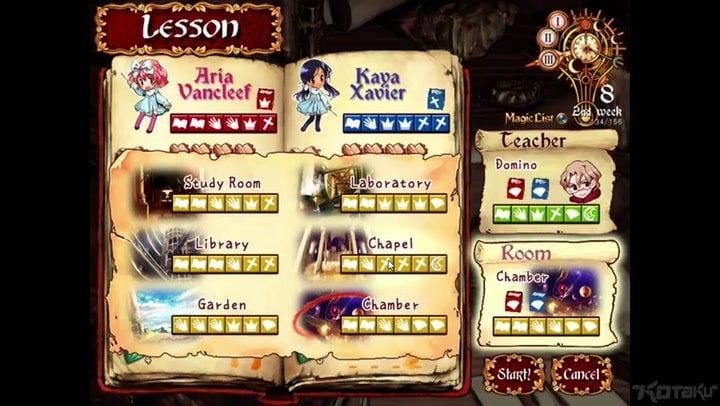
This is where Littlewitch Romanesque differs from similar games. To gain the various types of experience points, Aria and Kaya must attend lessons. What XP they gain is based on a series of dice rolls. Each side of the die has a symbol corresponding to one of the five XP types—and a special extra symbol that grants XP for all types at once. On each of the six days of study, the girls roll three dice each—one corresponding to the individual girl, one to the corresponding classroom, and a final one for the corresponding teacher.
The dice representing each girl, teacher, and classroom have different sides. For example, the die for the chapel has three sides of spiritual XP but no treasure XP, while the study room has at least one side for each XP type. And while you can’t change a girl’s dice, you are able to tweak the odds of getting the type of XP you need to learn the spell you want by swapping out different teachers and classrooms.
However, there is far more to the system than simply rolling the dice. Each dice combination will activate one of Aria’s and Kaya’s spells—assuming you have already learned it. These spells affect the roll in some way—doing everything from summoning an extra die or making each side grant additional XP to creating obstacles that give additional XP when hit by a die or summoning a meteor that slams into the dice granting tons of extra XP.
But it’s not all up to luck. By sacrificing all the points you have gained in your rolls so far, you are able to choose what spell will be cast in any given roll. Thus the beginning strategy becomes one of spending your first few rolls making extra die and powering them up before letting the dice fly on their own for the final rolls—netting you a few dozen of each XP type. Of course, as the game goes on, you get new spells and can develop rolling combinations. By the end of the game, I could consistently get a good 3000 XP per type each week through creative spell usage. Discovering these new strategies and the intricacies of how the dice system works is half the fun of the game.
Though the primary goal of
Littlewitch Romanesque is raising two girls to become wizards, master and students are far from the only characters in the story. After Domino, Aria, and Kaya arrive at the Dark Tower, they encounter a large number of reoccurring characters including a ghostly knight who guards the tower, an angel found in the tower’s dungeon, two wizards sent to check up on Aria and Kaya’s studies, two different traveling salesmen, a holy knight, Aria’s overprotective brother, and even the literal Queen of the Fairies.
And while each of those characters has a part to play in the storyline, most of the non-Aria/Kaya scenes are spent fleshing out the numerous perspective love interests for Domino who move into the tower. There is an avant-garde architect who wants to study the tower; a princess (with a cat girl maid) who wants to use art and the exploration of ruins to promote peace and understanding; a beatified saint with the power to heal who secretly wishes to be a normal person; a gladiator turned bounty hunter with a mysterious past; and an immortal elf who was one of Domino’s party members during his adventuring days.
Many of Aria’s and Kaya’s quests will positively impact one woman or another’s relationship with Domino. If enough of these quests are completed, you are given a mission for a special romance ending to the game (often ignoring Aria and Kaya’s fate as the game thus ends prematurely). These endings are the real payoff to the game, however. All of them are grand in drama, scale, and romance with some even being truly epic in scope.
Of course, like most PC visual novels,
Littlewitch Romanesque has several hardcore sex scenes. However they are largely contained to the respective romance endings. In fact, the only ones outside of those endings happen whenever you build a new study room for the tower (which flips the architect’s switch, so to speak) and a random event where the cat girl maid goes into heat. These scenes are bit of a mixed bag. In some endings, they feel needed—a natural evolution of the relationship. In others, they simply feel obligatory and derail the story rather than add to it.
And now we get to the game’s biggest sticking point: the fact that Aria and Kaya are both possible romance options—complete with corresponding sex scenes. While their ages are never explicitly mentioned, they are children—and while they could conceivably be adults in the legal sense by the end of the third year, they look as young as the day the game began. Domino, in contrast, is likely in his late twenties at the very youngest. Beyond the sex scenes, there are also a few random scenes where Domino walks in on the pair changing, bathing, or something similar with a corresponding picture of them scantily clad or topless.
And honestly, because of these scenes, I hesitate recommending this game to others despite how enjoyable I found the rest of it to be. As it stands, I think only those deep into anime or visual novel culture will be able to overlook the game’s questionable elements (as things of this nature are somewhat common in anime and visual novels)—especially as there is currently no way to outright skip these scenes and/or censor the young girl nudity.
However, JAST USA, the Western publisher of the game, has announced that an all-ages version of the game will be coming to Steam sometime in “early 2015.” Thus, it is with that information that I give
Littlewitch Romanesque a stamp of:
All in all, I had more than a little fun with
Girlish Grimoire: Littlewitch Romanesque. It was a real joy to, through Domino, take these two girls from novices to master wizards—watching each small adventure they had along the way. Bolstered by great art and voice acting, it was never boring even as I spent hours with all the tower’s inhabitants, slowly but surely deciphering their back stories.
Outside of the story and characters, the game is chock full of choices and requires large amounts of both strategy and planning to get the best spells and endings. Simply put, if it weren’t for the inability to turn off the sex scenes and objectionable content I described above, I’d gladly recommend this one. But as it stands now, I’m inclined to wait for the all-ages version and see how that holds up.
Girlish Grimoire: Littlewitch Romanesque was released on December 18, 2014, for the PC. It is available for purchase from JAST USA’s official store
Kotaku East is your slice of Asian internet culture, bringing you the latest talking points from Japan, Korea, China and beyond. Tune in every morning from 4am to 8am.
To contact the author of this post, write to [email protected] or find him on Twitter @BiggestinJapan