The history of Madden NFL in the age of the Xbox 360 and PlayStation 3 is a history of inconsistent execution, of hit-and-miss features, some more easily marketed than implemented or understood. Of all the memories Madden NFL 25 could evoke in the series’ silver anniversary year, the strongest are of the gimmick Maddens, thanks to an unnecessary new gameplay mechanism and under-delivered promise across the board.
Remember the Quarterback Vision Cone? Remember “Weapons”? I can only hope that the Precision Modifier, for running backs and ballcarriers, meets the same fate: Introduced in one year and abandoned the next. The modifier, a left-trigger super move applied to ballcarrier actions, is the most, if not the only, noticeable difference in gameplay. I do not consider it an improvement.
Supposedly this “precision modifier” anchors the “Run Free” marketing tagline given to the game. But these new ballcarrier moves reek of back-of-the-box bullet-point development, a critical weakness that I thought Madden had overcome last year, when it overhauled its basic gameplay while supplying a truly innovative career mode. Precision running, as I described in my impressions of the game’s demo, is a button modifier that amplifies the effects of a ballcarrier’s speciality move. Jukes are jukier, stiffarms are stiffer, spins spin—more? More tightly?
Why anyone would need to tell Madden “OK, here’s a juke—but now I really mean it,” is ridiculous to me. As they strive to recreate the balletic acts we see live and in highlight reels, sports video games forget that a lot of this stuff can and should be handled contextually (lest EA Sports haters get too smug, the NBA 2K series, with a head-spinning menu of gamepad commands, is an even worse offender in this regard.)
“Precision modifier” loads it on you to make Adrian Peterson more Adrian Peterson-y. I don’t choose the Minnesota Vikings because implementing Peterson’s elusive style represents a greater artistic challenge. I choose them because Peterson’s innate talent should make things easier. And when you’re dealing with an inferior runner, like Ryan Mathews of the San Diego Chargers, the learning curve of “Precision Modifier” steepens to the point you get better results simply making hard cuts with the left stick only—which is at least a credit to the realistic weight and momentum supporting the game’s physics engine.
You know what would let me run free? Any kind of sensible or predictable blocking intelligence away from the line of scrimmage. Much was made of Madden putting a former collegiate lineman, who later had a brief NFL career, on this task, but I only observed improvements in line-on-line engagement. As such, backs and offensive schemes who are better suited to running between the tackles may genuinely feel like they’re playing an improved game. Still, against a 3-4 defense, which half the league uses, offensive linemen will repeatedly choose to double-team a defensive end with a linebacker plainly assigned to their gap, who will flatten you for a loss.
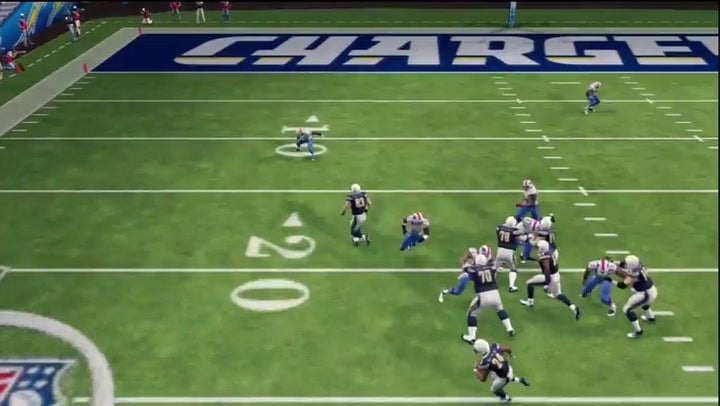
Case in point: Watch the tight end on the left here. This is a running play. After the left tackle takes on the defensive end, the tight end makes no effort to engage the linebacker staring him in the face. Guess who brings me down.
The focus on line blocking does conspire to make running between the tackles a little easier, but seeing the holes is going to determine the success of your run more than any trick move. This game’s sibling, NCAA Football 14, would have runners contextually put their hands out and push off teammates who got in their way. I didn’t see that at all in Madden NFL 25, whose core gameplay team works on both titles. While we’re on this subject, yes, I actually will bring up NFL 2K5, whose runners would “get skinny” or turn sideways as they approached a narrow hole, to try to fit through it. Simply copying over these two ideas would do more for the running game than the precision modifier.
In the open field, blockers still seem unable to carry out simple assignments and in some cases actively thwart you. See this video, and watch the fullback.
While there’s a reasonable debate that I should have cut back to the hole in the middle (I forget if this was Power O or a counter, but there’s a pulling guard in it) the fact remains it’s my prerogative as the runner to see the field and run where I can gain the most yards. When I took the handoff, I saw wide-open space on the outside left, with all of the defense engaged except for one man, and a fullback in front of me to handle him. He is not running a passing route; this is not a draw play. At minimum he should just continue running along this vector and I can use him to screen off the defender. Instead, he runs away from the safety, engaging a linebacker who has nothing to do with the play at this point, leaving the safety to maul me for a loss of yardage.
Is that cherry picked? Here’s another example. While I’m taken out by the lineman who, yet again, flattens Antonio Gates’ useless ass, what the hell are Robert Meacham (No. 12, on the far left) and Keenan Allen (No. 13, right of him) doing? Why on earth would I run out of a bunch formation, if not to use them to block or run off the defensive backs? You’d think one of these two would try to get in the way of the cornerback, but again, they avoid him.
These things happen all the time, and Madden‘s solution, rather than resolve its endemic poor blocking, is to give you a super move and let you dance your way out of trouble on your own. While I realize that rewriting integral components of Madden‘s codebase is surely no small task, it shows what many perceive to be an iterative sports title’s greatest weakness: that the things it truly needs to fix are so buried and entangled that they simply cannot be repaired. I haven’t even begun to address passing, which will require users to tune CPU accuracy down with gameplay sliders or suffer 75 percent completion ratings on the short routes the game constantly throws at you, turning defensive play selection into a slot machine gamble for all but seriously knowledgeable fans.
Last year’s gameplay improvements are dragged down by a needless gimmick.
In my impressions of the Madden NFL 25 demo, I remarked that things away from the field would bear the responsibility of keeping me engaged. They don’t. The opportunity to play through a season as an all-controlling owner adds some new wrinkles but, unless you are moving a franchise to a new city (or playing an online league with four other Snidely Whiplashes you can trash talk) the mode does not serve up enough interaction to keep its experience distinct from being a coach.
Of particular note, if you don’t import your face, the models you may choose for your owner all come from the coaching body models—this means your owner may wear a sweater vest, or a t-shirt and khakis. That’s pretty weak. So is the fact you can’t create a woman. No, I’m not being politically correct, not when this league has seen visible female executives such as Amy Trask (formerly of the Raiders) and the late Georgia Frontiere. All-male restrictions in players and coaching staff may reflect reality; in ownership, they do not.
The goal in Owner Mode is to increase the value of your franchise, which generally translates to making a lot of money and then spending it on free agents, better staff, and stadium upgrades. Money is very loose and easily accrued, especially if you make a Super Bowl run. I dropped the prices of my players’ jerseys (including Kellen Winslow’s) at the end of the year as a gesture to San Diegans losing their team. All four of them—Eric Weddle, Philip Rivers, Antonio Gates and Manti Te’o—were the top four merchandise-sellers in the league, and my overall merchandise revenue more than covered player and staff salaries, and the lease on the deluxe-o, fully upgraded stadium I chose to build in Los Angeles.
The paperwork of setting hot dog and memorabilia prices isn’t what makes me feel like a football tycoon. Enjoying the success of my team, playing a unique role in it, and seeing myself playing a powerful role is. Over a full season I saw only a handful of cutscenes featuring my owner in his box. Zero on the sideline at the end of a game. I relished the thought of facing questions from the media as the season unfolded. I only took four, and none after the midpoint of the season, which is disappointing as the San Diego Chargers went to the Super Bowl and one of its best players, Gates, was lost for the year in week 14 with the division already clinched. Owner questions may be limited because they will have a financial effect, or an effect on “fan happiness”—which seems not to be that important because I improved the team’s value 10 positions with last-place fan happiness. That said, a few questions to no great end, just to role-play this a little more, would have helped.
Moving a franchise to a new city is where you will be most involved, though realistically this should only happen once. When you move a team, you may choose from a list of 17 cities—some of them plainly unrealistic options (there is no way the league would allow a second team in Chicago or Houston, much less would any city build a second facility for it.) If you wish to rename the team, you’re given three choices and then up to three uniform designs for each one. They’re pretty generic although, to Madden‘s credit Paul Lukas, the eminent critic of uniform aesthetics, does show up in the Twitter feed and lay down the law.
But once I built my new football palace I never got to see it, except from the inside. In a new stadium, all the pregame cinematics shift to a locker room; there’s no overhead shot. That underlines the game’s presentation, which can be described by two words: repetition, and repetition. I’m one of the few football fans who does not hate Jim Nantz or Phil Simms, and even I got tired of hearing a cookie-cutter banter that marginally describes the action on the field. Simms is unable to distinguish any injury other than “upper body” or “lower body” and has the same response to every bad pass. I was outraged when, facing Russell Wilson and the Seattle Seahawks in the Super Bowl, Nantz introduced him with a mention of his statistics from 2012, as if this was the first game of the year and not the finale. And an advertisement glaringly appended to Nantz’s postgame sign-off suggests these two were not brought in for much additional work this year. That’s unacceptable, considering the duo is in their second year with Madden, and while barebones commentary can be tolerated in a transition year, the honeymoon ends there.
Two words describe the presentation: Repetition, and repetition.
The presentation is so lacking in variety, much less improvement, as to make me suspicious EA Sports poured all of its efforts into the version of Madden due to arrive on Xbox One and PlayStation 4. If it didn’t, then this series will be in real trouble, maybe even worse than its last console transition.
Madden NFL 25 is not a bad game. It’s still one of the best multiplayer sports titles available, thanks to consistent, well supported infrastructure and features like Madden Ultimate Team, which extend the game’s replayability with features like Online Seasons and challenges. And on some level, yes, this game is “better” than last year’s simply by updating the context surrounding your season. With Madden 25 in the house, I’m not going to go back and play Madden NFL 13 out of protest.
All of this is emblematic of the problem I often face when reviewing sports video games by a simple yes/no standard. It’s not unplayable, and it’s not unenjoyable. But it’s not recommendable considering how little it improves on Madden NFL 13, much less delivers on the milestone standard Madden 25‘s timeshifted name implies. It is true I made a consumer recommendation to buy this game’s $100 special edition, but that was to football fans, for the solid value of a satellite broadcast package delivered to the PC or mobile device at a steep discount. You could look on it as getting NFL Sunday Ticket and a modest upgrade from Madden NFL 13 for free.
The game, on its own, is even less recommendable to those who are buying an Xbox One or PlayStation 4 and intend to see Madden on it. Perhaps with next generation computing and visual power (and, who knows, maybe a new controller makes this modifier more useful) my biggest problems with this series will be magically resolved.
The anger over Madden on this console generation comes from the fact the only standard to which the game is held is the one it created in the previous. This brand and this sport in particular, in the North American market, should be held to a higher standard than that, and it’s one this game does not meet.
To contact the author of this post, write to [email protected] or find him on Twitter @owengood