If I was writing a book of personal gaming records, I’d mark up a page for the Ouya: New console that stayed in the box, unplayed, longer than any other one I’ve ever had. Three days. Sealed. No urgency to play the tiniest console I’ve ever seen. It’s so tiny, yet I still wasn’t sure I had room for it in my life.
Who asked for the Ouya, anyway?
Many people did, actually. Many people helped crowd-fund it on Kickstarter last summer—63,416 backers, contributing $8,596,474 (the Ouya people had only asked for $950,000).
Last summer, however, was the season to dream of a $99 hackable Android-based console on which at least a portion of every game would be free.
This summer is reality. And this is the summer when anyone who loves games can decide whether the Ouya makes sense.
For me, this is a summer that already includes an Xbox 360, PS3, Wii U, and PC in my house, all of which can play some very good games. I often carry an iPad, a 3DS and/or a PlayStation Vita in my work bag. They play great games, too. So does my iPhone, which is usually in my pocket. I’m not hurting for gaming machines or for games. I recognize that maybe the Ouya isn’t for me. But, here’s the craziest thought: maybe it is.
My Ouya had been sent to me by the Ouya people. I’ve interviewed them. And, as game companies tend to do, they sent me hardware to review. This Ouya came in its Dachshund-sized box. It had some games pre-installed on it. That was nice. The Ouya people were making my life ultra-easy. Just start playing and have fun, they were saying. Review this thing.
Unlike other consoles, The Ouya doesn’t promise a brilliant future. You get the Ouya for the now.
I carried the Ouya box back and forth last week, optimistic that I’d play it at work. No, at home. No, at work tomorrow. No, really, at home tonight. Guaranteed.
On day four, I unboxed it and then spent a day carrying the absurdly-small console (Rubik’s Cube, large tomato… pick your size comparison) and the system’s wireless controller. The Ouya also requires an HDMI cable and a power cord with a small brick on it (computer mouse-sized? toddler’s fist?). That all fit into my bag. And it stayed in my bag for another day.
The Ouya really is easy to resist. This is, for now, one of its big problems.
We are immersed in video games. They are everywhere. If you’re reading this, you’re probably currently using a device that plays good games and you’re probably within shouting distance of a second or third one that does, too. What draws me or you from one to another is the same thing that draws anyone to a device that plays games: the games. What draws people to new game devices is the promise of new games. Day one—hell, year one—of owning a Wii U or a PlayStation 3 might be a drag, but you know Nintendo and Sony are eventually going to deliver some instant classics. You can look past the year one clunkers.
The Ouya doesn’t promise a brilliant future. It sells at $99 using a less than top-level Tegra 3 quad-core processor (full specs here). As an Android device, it signals that it’ll probably be displaced by a better iteration as chip prices go down. Ouya execs have said as much. There’s no 10 year lifecycle on Ouya 1.0.
You get the Ouya for the now. You get it for the summer of 2013 and the fall. You get this to wedge it in the gaps of your gaming life or in place of bigger, beefier consoles you can’t afford.
You get this console to play the Ouya games of the moment.
You plug it in on day five or six. You get ready, possibly, to play Towerfall, a game that is well worth your time and the most ballyhooed Ouya-debuting game.
These games are tiny. And the first bite is free. So, download, download, download…At launch, my favorite of the bunch is Knightmare Tower.
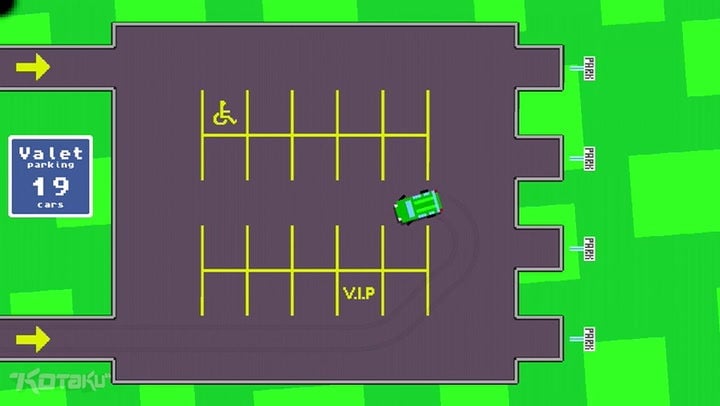
But here’s the cool/hilarious/progressive/insane/oh-so-Ouya thing: You turn the machine on, sync the controller, connect to the Internet, pick the “Discover” option on the system’s menu, access the online shop full of games that are all free to download, you start queueing them up with the gluttony befitting a gamer accessing “free” games, and suddenly you’ve got this machine full of new games and discover that two of the ones you downloaded begin with levels that require you to… park vehicles.
Yes, people, the Ouya is already saturating the market with parking-based games:
That first game, No Brakes Valet, had a title screen that had worse art direction than an NSA PRISM slide. At least the game was kind of fun.
The second, The Little Crane That Could, is only about parking in its first level and is then about using the crane to pick stuff up.
You start playing the Ouya and it hits you: oh, yeah, this really is an Android-based machine. This is mobile gaming come to TVs, people. Meaning, this is the wild west. Good games, bad games, games running on timers before asking you to pay, games locking off most of their content but giving you the first few levels for free.
Look, it’s Canabalt!
And, what’s this? Here’s a game that looks like Canabalt! (And is good in its own right.)
Is this a poor man’s Gears of War?
Is this a twin-stick shooter set to dubstep?
Wait. Someone made a twin-stick shooter set to dubstep? It’s called Dub Wars. I don’t like dubstep, and I don’t know if I’d pay for that, but if I can download a twin-stick shooter set to dubstep for free—see, the ship only shoots with the music, you only control the aiming, and when the drop hits, enemies better look out!—this is how the Ouya begins to hook you.
Soon you’re playing Nintendo 64-looking puzzle platform games about a guy wearing a monocle. It’s Monocle Man!
Soon you’re playing a hilariously hideous game—game? “game?”??—about bouncing a frog through a city. You’re then playing this splitscreen and are sure you’ll never spend a dime on it. You’re also sure you’re doing nothing at the moment that helps further the appreciation of great games, but, damn it… it’s The Amazing Frog
Super Crate Box, anyone? That’s an actual good game.
Mrs. Dad? Not only is it the best-named game on the Ouya, not only is it good, but two people can play on one controller. Three people can play on two controllers.
Bear in mind that these discoveries happen this fast. The Ouya’s online shop is a buffet and the fliptop plastic container you get to stuff full of games can handle about 5GB of content. These games are tiny. And the first bite is free. So, download, download, download.
And then it happens…
You find a really good game. One you never heard of. Because, this is the wild west, and sometimes there’s treasure among the varmints.
I give you.. Deep Dungeons of Doom… a sort-of-real-time series of role-playing-game battles.
DDoD is also available on iOS, of course, which is the rub for a lot of these Ouya games. The Ouya lets you at least play with a controller. As if—ha ha—these games on the Ouya weren’t nearly all still optimized for touch controls and not the system’s so-so dual-analog controller. Good luck figuring out how to pause half of them.
The killer app for Ouya, they’ll/we’ll tell you, is Towerfall. It’s like Smash Bros. with bows and arrows. It’s got neat retro graphics (as do, it seems, half of the Ouya games).
It’s good. It’s fun. It’s, I’ll declare, not the most fun game on Ouya. At launch, I’m giving that accolade to Knightmare Tower, a game so good that somebody already cloned the Flash version of it on iOS. Play as a knight who bounces off the enemies he’s stabbing in order to jump and fly every higher up a tower. Earn money to get better gear to soar higher and attack with more vigor. I paid for this one. Four bucks. (I bought Towerfall, too. It was $15.)
Most of the games on Ouya kept my attention for a few minutes before I moved on. Knightmare Tower hooked me for over an hour, and I had to force myself to stop playing. It stands out as one of the very few satisfying single-player games I found. The system’s library seems to cater toward couch multiplayer experiences. Hence the love for Towerfall
I have a soft spot for interactive lunacy, and I don’t mind downloading some bad games if it costs me nothing. But the Ouya people need to make it more clear that they’re serious about this platform thing.
The Ouya team may be exploding some preconceptions about what a game console should cost or how its games should be delivered, but there are certain console expectations that they are failing to meet. The most basic one is this: things just need to work. This is the foundational promise game consoles have delivered on for thirty years. Consoles are not personal computers. They might offer less opportunity for technical experimentation but they provide greater security to gamers that any and all games will run well on them. Controllers need to function and function reliably. The console should convey the feeling that it’s built on a stable platform not on a bunch of struts that may or may not have been tightly screwed in.
The Ouya does not feel like a stable, properly functioning platform. It’s close, but it’s not there.
Its main controller occasionally failed to read my inputs or sent signals to the console that I didn’t send. It might have been a game-specific problem or something that’ll be patched out. Who knows? It doesn’t bolster confidence.
The console’s essential online store—its Discover area—is underserved by a worst-in-class internal search engine that only finds games by title and not by developer or any other category that’d be useful in a marketplace as crowded as this. Don’t rely on the genre classifications which lump the system’s beat-em-up action games with its pinball games, for some reason.
Some games are missing product descriptions or have ones that say nothing informative about the game.
The lack of polish and tolerance of sloppiness on Ouya are the things that most make the console feel cheap.
Games on Ouya inconsistently use different buttons to pause the action and usually fail to signal how to quit them (it’s not intuitive, but double-tapping the controller’s Ouya button quits games).
One game, which I tried to play solo while a second controller was synced, split the game’s controls across the two controllers. The sticks on one controller and the buttons on the other controlled the action. Feature or bug, you decide!
The framerate in the Ouya version of Chronoblade is a stuttering mess.
Yes, this is an Android machine. Yes, Android doesn’t standardize things the way Apple does on iOS, let alone the way Microsoft, Sony and Nintendo do on proven game consoles. The lack of polish and tolerance of sloppiness on Ouya, however, is off-putting and are the things that most make the console feel cheap. The extent to which things are improved—the extent to which the Ouya “just works”—will indicate how serious and how capable the Ouya people are about running a platform gamers can support and believe in.
When we’re reviewing games at Kotaku, we endeavor to answer the question: “Should you play this?” When we review consoles, we change what we’re asking: “Is it time for a gamer to get an Ouya? Is it a must-have?
The Ouya sets the bar low with its $99 price tag and its initially-free games, but it’s not even clearing that well enough. There are some good games, but not many. They’re hard to discover, don’t always work well with the system’s controller and risk being lost in a mess of substandard attempted amusements that don’t belong on your TV any more than they deserved to be on your phone.
The system is a fascinating experiment and can be fun for those for whom $99 isn’t much to plunk down for a lark or a risk. I’m not so sure that’s who the Ouya was made for. Buyer beware, for now. If the Ouya and its library get better—and they should given how far this system has come, out of nowhere—we’ll let you know.
To contact the author of this post, write to [email protected] or find him on Twitter @stephentotilo