There are two new games called Sonic: Lost World coming this month. I’d like to refer them as “the good one” and “the bad one,” if you don’t mind.
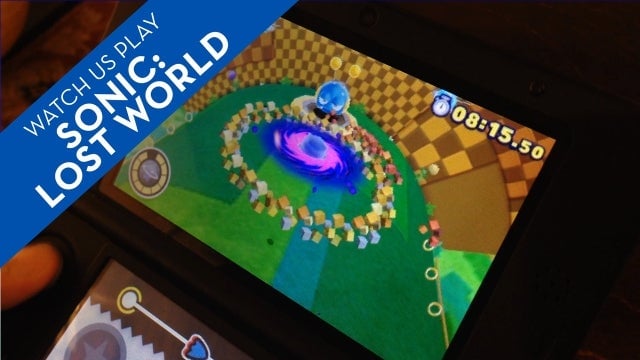
The good one is on the Nintendo 3DS and is co-developed, apparently, by Sonic Team and Dimps. It’s a mostly-3D, occasionally 2D Sonic game that slows Sonic down a tad, introduces a new parkour system, pits Sonic against a group of foes called The Deadly Six and is spread across seven worlds themed to forest, desert, a tropical coast and so on.
The bad one is on the Nintendo Wii U and is developed by Sonic Team. It’s a mostly-3D, occasionally 2D Sonic game that slows Sonic down a tad, introduces a new parkour system, pits Sonic against a group of foes called The Deadly Six and is spread across seven worlds themed to forest, desert, a tropical coast and so on.
These are Sonic games, of course, so some fundamentals hold true, as they pretty much always have. You’re a blue hedgehog. You can run really fast. You have to collect gold rings and, if you hit an enemy, those rings spill out. If you don’t collect any in time and an enemy hits you again, you die. You are expected to learn the levels you’re running through and to be able to dash through them fast. The levels have multiple paths. They reward players who master their controls and who daringly take the roads less safely traveled. Oh, and you’ve got a menagerie of friends, though this is one of the Sonic games that lets you only play as Sonic.
In several ways, both Sonic: Lost World games are the same game. Same storyline, same cutscenes, some general gameplay concepts, same presentation of a hexagonal world map marked with four levels, including a boss battle, though the 3DS version treats the boss battles as a separate levels. Both games want you to learn Sonic’s revised movement pattern—his varying speeds, his wall-run and his special power-up moves brought over from Sonic Colors
In possibly the most important way, however, the Wii U and 3Ds versions of Sonic: Lost World are two very different games. The difference is in the level design. That’s pretty much it. And that’s pretty much all that matters.
The two games’ levels may have the same themes, but the different level layouts—the intuitive, flowing, player-friendly levels of the 3DS version vs. the badly-explained, choppy, punitive levels of the Wii U version—separate the portable and the console games so sharply that I would only recommend that you play one of them. (Unless you’re writing a thesis about the difference that good level design makes; then play two.)
The differences in level design are hard to articulate. How can I express that the flow of the 3DS levels’ is more satisfying without you thinking I’m praising them for being easier? How can I convey the difference between good level design and infuriating?
It’s difficult, but I can start with a video of Sonic: Lost World on the 3DS. This is the first level of the game, and what you’ll see is a game that unfurls gracefully, that queues up its obstacles in a way that helps the player learn its basic moves through repetition, provides safe ways to try them out and accents its action with pace-changing elements—such as the brief adoption of a special power—in ways that are easy to understand and fun to move through.
Here, watch the 3DS game in action…
Many of the levels in both the 3DS and Wii U versions of Sonic: Lost World float in the sky and can be run across all sides, just like the spherical worlds of Super Mario Galaxy and, earlier, the planetoids of Sonic Adventure 2. That level design concept freed the creators of both games to make Sonic levels that have few boundaries, but the 3DS designers are the ones who kept things tight, who didn’t create what on Wii U feels soon enough like a choppy, momentum-killing series of deathtraps.
It’s not that the Wii U version is simply tougher—it’s that it is tougher in ways that the 3DS version shows it doesn’t have to be and that seem hostile to the player. Again, this is somewhat hard to explain with words. I made a video of the Wii U version.
Check out the Wii U game in action:
The Wii U game is not terrible, it’s just…off. And, as it gets tougher, it becomes wearying. It’s the one that made me dislike playing it. Both games got harder, but the 3DS one kept drawing me happily back in. The difference is the level design, I’m telling you.
The Wii U game is also marred by some strange design choices that give the impression of a game that needlessly had bad ideas wedged into it.
Take the two or so bland levels that feature Sonic in perpetual cross-screen flight with the player only able to change Sonic’s elevation with a button press. Those levels are a Sonic clone of the popular mobile game Jetpack Joyride. Their inclusion is regrettable.
Or take the achievement system that always gives the player a new trio of challenges—wall-run for this long, kill this many enemies, etc.—which also feels lifted from Jetpack Joyride and other games and, worse, yields the player marginally useful co-op vehicles, all the while the game starves players of extra lives and rescued woodland creatures which behave as a sort of currency for unlocking boss levels.
Or take the game’s Super Mario Galaxy-style co-op that lets a second player pilot a radio-controlled vehicle to fetch collectibles and attack enemies, as the main players runs through as Sonic. It’s not a bad idea, except that there is little for the co-op player to do most of the time and the camera constantly jolts or strands the RC player. Sadly, the co-op proves most useful as a single-player exploit for putting the main controls down in order to fly an RC chopper around as “player two” in the interest of desperately farming extra lives.
One more… take the game’s awkward circus mini-games that it presents in order to give players a chance to stack up on those woodland creatures. The worst of these is a game that ostensibly displays the same playing field on the Wii U GamePad and TV but actually crops the top portion off on the GamePad. This would not matter if the game didn’t essentially require players to play that mini-game while looking at the GamePad and if the game didn’t involve having to send your characters to the part of the level that the GamePad can’t show. See?
Perhaps that’s supposed to add to the challenge. Well, it does. Unpleasantly.
The 3DS has its own peripheral nonsense. It has bonus missions that involve using the 3DS’ motion sensors to fly Sonic through collectible airborne orbs. It also risks losing gamer goodwill by needlessly mapping some main-level sections to the 3DS’ motion sensors. We don’t really need to tilt the 3DS to steer the rocket Sonic is riding on, do we? Isn’t there a circle pad for that? But the 3DS mostly keeps its main missions free of any distractions and gives the player ample opportunity to progress. Even when it slows the action down drastically and becomes—in parts of a handful of levels—more of a walk-around-and-jump-on-things platformer a la Super Mario 64, it gets on with things quickly enough and keeps introducing new ideas and then developing them.
One of the stranger and more controversial twists in both Lost World games is that Sonic moves more slowly. This may seem like apostasy to some fans, but it’s an interesting literal change of pace. On the 3DS and Wii U, pushing only the circle pad or control stick will make Sonic walk and then, if pressed more, jog. On both machines, players have to hold down a button to trigger a run, at which speed Sonic will do parkour moves. He’ll automatically clamber over low obstacles and will climb up walls. He’ll do Prince of Persia-style wall runs, too. (Sonic also inherits some of the problems with free-running up the wrong wall, famously seen in most Assassin’s Creed games, a problem that seems more prevalent on the Wii U version) Both games also allow Sonic to curl into a ball and do his signature spin dash. This is Sonic’s fastest speed. It’s blazing but also intentionally and correctly hard to control. Sonic can’t parkour when he’s rolled up. I like the idea of giving players more choice in how recklessly they maneuver Sonic. It may be strange to experience so many sections of levels that require Sonic to move at more of a Super Mario speed but, again, with better level design (see the 3DS version!) the slower sections aren’t buzzkills.
The ideal Sonic games are those that put the player on the edge of control and chaos, that allow the player, as Sonic, to achieve great speeds while moving through levels that they’ve had to think about, often with little time to prep. Slowing down the pace does defy that ideal. These games are best when they’re flowing ahead, worst when they simply don’t flow. But in the best levels of Lost World, there’s ample proof that slowing down doesn’t hurt the series as some might fear. Even the slow sections can be played quickly as you master the targeting and attacking controls, as you learn the movement system and as you find the games’ many multiple paths within their levels. Guess which version of Sonic Lost World shows this potential best?
To contact the author of this post, write to [email protected] or find him on Twitter @stephentotilo.