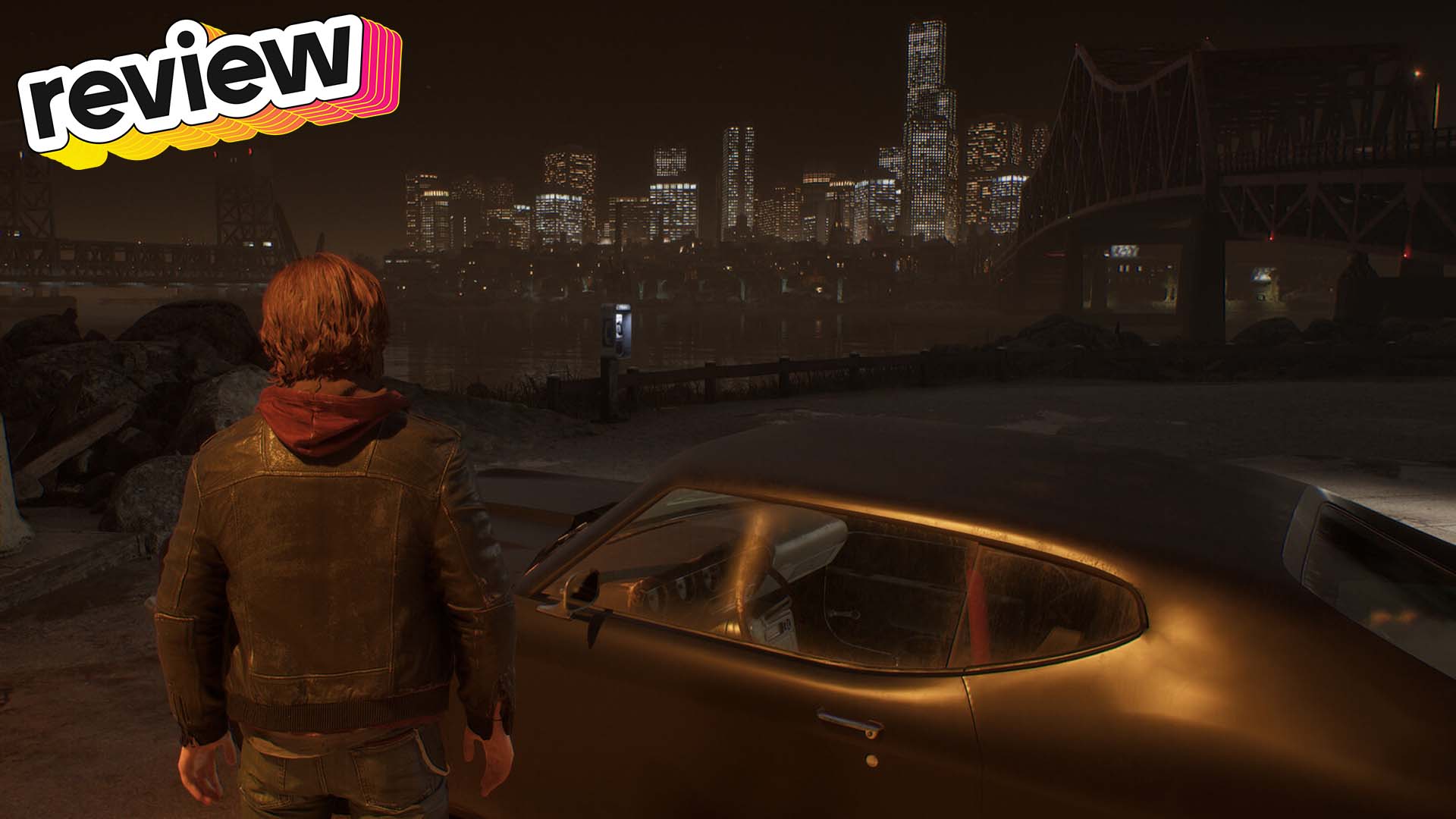
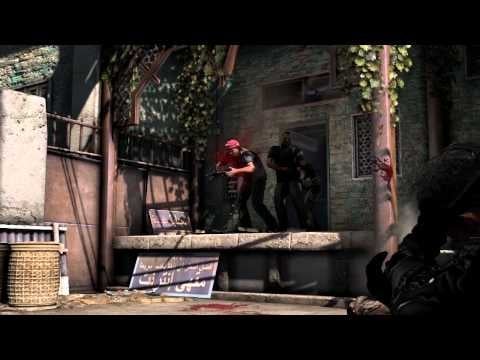
Sam Fisher is on the phone with his daughter. He’s talking about his feelings. He’s telling her he worries about her. “See,” the game says, “This is not just another technobabble Tom Clancy military gunfest. This game has heart.” Sam hangs up the phone, ready to go to… to somewhere in the Middle East and fight… some terrorist dudes about… something. Oh, damn it all.
Yes, Splinter Cell: Blacklist is, in fact, totally just another technobabble Tom Clancy military gunfest. In fact, it plays like (and has been marketed as) a sort of “greatest hits” collection of the most popular aspects of each of the previous five games in the series. This is the ultimate technobabble Tom Clancy military gunfest. That’s not necessarily a bad thing: the game is a good deal of fun a lot of the time. But an increasingly stodgy approach to stealth combined with several of the series’ seemingly unshakeable bad narrative habits upend the game’s balance and leave Blacklist a less satisfying whole than some of its parts would suggest.
https://lastchance.cc/splinter-cell-has-changed-just-look-at-the-box-art-5980615%3C/a%3E%3C/p%3E
Blacklist is the most fleshed-out, complete-feeling Splinter Cell game yet released. In addition to a 6-7ish hour singleplayer campaign, it comes with four different types of challenge-room side-missions that can be tackled solo or co-op and a beefy “Spies vs. Mercs” multiplayer mode that pits asymmetrical teams of sneaky spies against lumbering mercs in a game of hide-and-seek. It’s a generous offering, particularly for those who like to play games online.
As enjoyable as the multiplayer and co-op portions of the game are, the single-player story campaign is easily the weakest part of Blacklist, not for lack of trying but for lack of new ideas. That starts with the narrative setup, which feels like a patchwork of every other one of Ubisoft’s Tom Clancy games, from Ghost Recon to Rainbow Six. An international consortium of terrorists called THE ENGINEERS have set into motion a plot called THE BLACKLIST that will destroy a major American city or piece of infrastructure every few days until America agrees to withdraw its troops from every country in the world and cease worldwide operations. Only Sam and his cohort at Fourth Echelon can stop them. Okay.
The questions raised by The Engineers’ ploy—This doesn’t make sense! Why put things on a timer? Why did they tell us where they’re striking? Where do they get all these henchmen? And their goal is such an obvious feint!—are often rendered moot by the various twists and turns in The Engineers’ REAL TRUE PLANS. But by the time those plans were revealed I was so exhausted by this type of ultimately pointless story that I’d stopped asking questions at all.
It’s startling just how much difference a voice-actor makes, too. With Fisher’s longtime voice-actor Michael Ironside out of the game, Sam becomes a generic military brotagonist with a shocking quickness. I lost interest in him so immediately and so fully that I had to ask myself: Was Ironside’s charismatic performance singlehandedly keeping this series’ storytelling afloat this whole time?
https://lastchance.cc/hey-guys-your-voice-sounds-weird-everything-okay-511985539%3C/a%3E%3C/p%3E
Credit where it’s due—the dialogue is generally more interesting and well-written than recent Clancy games, and there’s nary a Fisher-Fest in sight. (Often, enemy characters will speak to one another in un-subtitled non-English languages, a small but crucial step in the right direction.) Last year’s Ghost Recon: Future Soldier remains the pinnacle of narrative incoherence among Ubisoft’s Tom Clancy games, but that Blacklist is more narratively cohesive than that hot mess is faint praise.
https://lastchance.cc/why-video-game-characters-say-such-ridiculous-things-5921878%3C/a%3E%3C/p%3E
By the midway point of the campaign, I realized that I may have simply had enough. Enough of the jargon, of the pointless turnabouts and tension-free revelations. Enough of the right-wing ‘Murica-ing and “Guns are literally as sexy as women” gear fetish of the Clancyverse. (Actual term.) I’ve been to this rodeo a couple too many times.
I’m not the only one. When Ispoke with Blacklist creative director Maxime Béland at a press event earlier this year, he told me the following:
“Our lead writer on Blacklist is Richard Dansky,” Béland said. “When I called him, I said, ‘Hey Richard, we’re making Splinter Cell six, do you want to write it for us? And his first question was, ‘Do I need to come up with a story that’s gonna require Sam to take out 800 guys?’ And I paused for a second and I said… ‘This is sad, Richard, but I think so. We can talk about it, but I think at the end of the day… we want it to be more and more “ghost,” [to have non-lethal options], but yeah, at the end of the day, it’s just Sam Fisher and bad guys and maps, right?'”
Just Sam Fisher and bad guys and maps, indeed. Most of the levels take place within military compounds and industrial facilities that might as well all be the same building. There are some detours: A level set in a South American drug-smuggler’s estate is nifty—though it’s surprising that Sam can’t swim—and one of the story’s better levels takes place in [REDACTED] which is a pretty fun level, but which I can’t tell you about because my review embargo asks me not to. I guess it’s technically a spoiler, so no big deal. But even with a couple of bright spots, the whole thing is all so rote that at this point, even the guys making it—and I should stress that I think a lot of Béland, who is clearly a smart, talented guy—seem resigned to rote-ness.
When I look at how generally well-made most other aspects of the Clancy games are, I can’t help but wish they’d just tell more interesting stories. I don’t know if the power to change course rests with longtime Clancy game-writer Dansky, creative leads like Blacklist‘s Béland, or a roomful of suits somewhere at Ubisoft that remain under the impression that this kind of boring junk is what people want, but it’d be great if someone, somewhere, could hang a hard right.
Note: Our verdict has been updated from “NOT YET” after spending some time post-release with the game’s online modes. Additional multiplayer impressions can be found at the end of the review.
The tendency toward dark, industrial interiors is no doubt due to the way Blacklist plays. In order to stay hidden from sight, Sam usually must “attach” to things around him. In order to move efficiently, you’ll have to ricochet him from object to object, staying out of the sight of enemy patrols. You’ll press the button to have Sam take cover behind a crate. (There are always a few crates lying around.) Then, rather than popping him out of cover to move to the next crate, you can simply aim at that crate, press a button, and he’ll stealth-shimmy his way to that crate as expeditiously as possible. Climb a crate and jump to a pole, drop from a pole and stick to a crate, and so on.
It makes each jungle-gym-like room feel a bit like a large and angular three-dimensional puzzle. Sam is the free piece in a giant deadly Rubick’s Cube, caroming from cover to cover while periodically pausing to stick a knife in a guy’s throat or shoot out a lightbulb. It gives Blacklist a “sticky” feel that’s distinct from other recent stealth games, and when it’s cooking at a low simmer, it’s a great deal of fun. I’d plot vectors of attack that would take me up to the back of an unaware guard, let me take him down before moving on, always with one part of my brain calculating an escape plan.
The general flow of gameplay adheres most closely to Blacklist‘s immediate predecessor, Splinter Cell: Conviction. The most notable carryover is Sam’s “Mark and Execute” ability, which lets you tag enemies and, should you be able to pull off an up-close melee takedown to charge up your execute meter, immediately headshot them all with a single button-press. The logic behind this (Why can Sam only activate this after a successful melee attack?) takes a backseat to the fact that Mark and Execute is as enjoyable here as it was in Conviction. Sticky, face-button cover has replaced Conviction‘s soft, trigger-based cover, and the left trigger has been given a more traditional third-person-shooter aiming role. The game controls much more like Gears of War than its predecessors did.
Unfortunately, despite the more action-oriented control overhaul, Blacklist is mostly only fun when Sam remains in the shadows. Get spotted, particularly during any of the later levels or on either of the two harder difficulties, and you’re probably dead meat.
That may be to the taste of those who prefer to stay entirely in the shadows, but the ungainliness of outright combat leaves Blacklist feeling more stodgy and old-school than contemporaries like Dishonored, The Last of Us or Ubisoft’s own Far Cry 3. In Dishonored, when an enemy guard spots me, I think “Well, this should be interesting.” In Blacklist, when a guard spots me, I think, “Ugh.” The sticky cover and inability to quickly climb on most objects tends to leave the player exposed to fire from multiple angles, and death swiftly follows most every detection.
The game’s tendency to throw in more—more possible playstyles (seen demonstrated in the video above), more types of grenades, more gadgets, more levels—does give the player a lot of options, but it also winds things up feeling a touch ungainly. By the midway point, I’d upgraded Sam until he had all manner of different smoke, gas and explosive grenades, a camera that could remotely fire sleeping gas, and a spectacularly overpowered sniper rifle that I could use to mark and kill enemies from across the entire map. I mostly just used the sniper rifle.
Blacklist feels most focused and enjoyable when playing in the “ghost” playstyle, avoiding detection at all costs and leaving most guards untouched. But when playing “Panther,” the “kill from the shadows” playstyle the game most readily rewards and which, I sense, most players will embrace, it’s easy to wind up feeling over-equipped and overpowered.
While Blacklist‘s single-player scenarios often feel terribly by-the-numbers, most attempts to shake up the formula somehow miss the mark. A couple of timer-based, actiony bits feel awkward when stretched over Blacklist‘s generally stiff control scheme, which greatly favors careful planning over spontaneous action. Sometimes you’ll be put in control of an aerial drone for what amounts to a turkey-shoot turret sequence, which feels entirely out of place in a game that’s otherwise so measured. (And it feels odd to be killing dozens of soldiers from on high when you can choose to play most of the rest of the game non-lethally.)
A cover-based shootout late in the story served mainly to remind me just how much better games like Gears of War and Uncharted do that kind of thing. A frustrating boss fight demonstrated how difficult it must be to design a “boss” encounter in a stealth game—I eventually won by making a ridiculous headlong dash that I only even attempted after failing a half-dozen times first.
And a mid-game experiment with first-person gameplay may stand as the single poorest design decision in Splinter Cell series history. Blacklist may be a better stealth game than it is a third-person shooter, but it is a woeful first-person shooter. My stealth tricks taken away from me, I hopelessly galumphed forward, eyes down the iron sights, feeling more exposed and awkward than I’d have thought possible in a game like this.
Now, all of those examples are of the parts where the game diverges from its generally strong core of infiltrate, sneak, takedown, sneak, distract, sneak. The bulk of Blacklist is spent doing those core activities, and for the most part they’re enjoyable. But when every setpiece change-up is less enjoyable than the game it’s changing up, I have to wonder why the setpieces have been included at all.
If I’m sounding a bit put out by all of this, I should say that there are a lot of things that Blacklist does well. Let’s talk about the plane! The plane is cool. Sam’s crew works from a massive cargo ship-turned-aerial command post called The Paladin. He can walk around it a la the Mass Effect Normandy, talking with his crew members and taking on side-missions. It’s a neat touch, though the space isn’t all that fun to explore and there’s no pressing reason to go around talking to everyone. It’s also during these between-mission times that Sam can also go over to a phone and have those short, mostly meaningless conversations with his unseen daughter on the ground. I was expecting her to turn up at some point in the game, but nope: She’s just a voice on a phone.
All three of Blacklist‘s game types—singleplayer, side missions, and Spies vs. Mercs—are neatly tied up in a single interface, which is accessed by Sam at a huge touchscreen table in the middle of the plane. (The game loves this table; the table is kind of the most important character in Blacklist. Hopefully there will be DLC where we get to play as the table.) The all-encompassing interface is cool, though it does make things a bit more unwieldy than they perhaps needed to be. (Nicely, you can access the same functions through the start-button menu.)
Each of Sam’s four primary companions aboard the Paladin offers a different type of side-challenge, and here is where Blacklist begins to really show its better qualities. The side-missions can all be tackled solo or in two-player co-op either online or via local split-screen (though the Wii U version is notably lacking the ability to play co-op via split-screen; it can only do multiplayer online).
The side-missions are as follows: Anna Grímsdóttir, Sam’s long-suffering commander, assigns a ream of stealth challenges that have Sam sneaking into buildings and planting bugs, instantly failing if he gets spotted a single time. Charlie, a “cool young tech whiz” character (Signifiers: He wears a hoodie and calls his friends “his peeps”) offers a series of survival-based challenges that have Sam and an optional-but-basically-necessary co-op partner surviving 20 increasingly difficult waves of enemies while waiting for extraction. Kobin, an arms dealer who becomes Sam’s prisoner after the first mission, assigns a number of “terrorist hunt” level-clearing assignments. And Briggs, a hotheaded new addition from the CIA, offers a short campaign’s worth of co-op only missions that are closer to the single-player story missions, except designed for two people.
The side-missions are easily the most fun I’ve had so far with Blacklist. Of the four options, I most enjoyed Grimm’s stealth-missions and Kobin’s terrorist-hunts. Both are great because they distill Blacklist to its essence—sneak, and don’t get spotted. Kill dudes, but don’t get spotted. Keep moving, and don’t get spotted. They rely entirely on stealth and don’t force action, unless you screw up, and their levels are smartly designed, with a lot of variety in how they close you into various spaces with a bunch of bad men. The Grimm missions even see a genuine—if slight—return of the old Sam vs. Grimm radio-banter from past games. It ain’t the same without Ironside’s sardonic purr, but it’s something.
Our pre-release builds of the game allowed for next to no access for online multiplayer, meaning that the majority of my time spent side-missioning was done on my own. Taken solo, the side-missions can be brutally difficult, but in a way that I found bracing and enjoyable. If you’re spotted by a single enemy on one of Kobin’s terrorist-hunt missions, a wave of well-armed reinforcements shows up and makes your job much, much harder. The thrill of hanging there, hidden in the shadows, waiting as the last terrified guard makes his way under you, knowing that you’re inches from victory but that a single screwup could force you to start all over… it’s a real kick.
In my limited time playing Blacklist online, I got the sense that the multiplayer modes, particularly the highly enjoyable Spies vs. Mercs competitive multiplayer, will be Blacklist‘s primary draw. Ubisoft moved heaven and earth to get our PS3 debug consoles (which let critics play pre-release code) connected to one another, but even then, I was only able to spend an hour or two playing various multiplayer modes with a bunch of Ubisoft Toronto developers. While I played enough to feel confident that Briggs’ co-op missions and Spies vs. Mercs are both a lot of fun, I’m not quite ready to say that they’re so much fun that they offset Blacklist‘s other, more disappointing aspects. I’ll have to see the game in the wild, post-release, to accurately judge the multiplayer component.
The gist of Spies vs. Mercs: Players are broken into two teams of 4: One team of spies and one team of mercenaries. (I know, right?) Spies look and control more or less like Sam Fisher from the single-player game, and are played from the third-person perspective. In “classic” mode, they’re tasked with hacking a number of computer terminals around the map. (There are a number of other modes that I haven’t had a chance to try yet.) Mercs are heavily-armed dudes that are controlled from the first-person perspective, which severely limits their field of vision compared to the spies’ more expansive view. The mercs’ job is to hunt down the spies and keep them from hacking the computers. At the end of the round, the teams switch roles, and whoever hacked the most computers at the end of two rounds wins.
Here’s Ubisoft with a video breakdown:
From the couple of rounds of Spies vs. Mercs that I played with the game’s developers, I have a strong hunch that the mode will be the most enduring, exciting aspect of Blacklist. The moment a spy initiates a hack, he or she must linger around the hacking node as the mercs come rushing in with guns and grenades at the ready. The ensuing game of cat-and-mouse is a hoot, and is entirely distinctive from just about any other multiplayer game-type I can think of. Get a group of seven friends together and you should have a hell of a good time.
Unfortunately, that’s mostly a hunch at the moment. My overall take on Blacklist is currently in a state of limbo—the single-player stuff isn’t quite strong enough to get a recommendation on its own, and while it seems likely that the co-op and Spies vs. Mercs multiplayer will more than outweigh the single-player’s shortcomings, I’m not yet certain that’s the case. Once I’ve had a chance to thoroughly play through the various multiplayer modes after the game is released, I’ll come back and update this review and issue a final verdict. (Update Below.)
For better and for worse, Blacklist is very much the game I was expecting it to be. It’s a slick, largely well-executed compilation in which highly enjoyable side-missions and multiplayer modes offset a singleplayer campaign that’s dull and awkward as often as it is satisfying. At its best, Blacklist simulates the feeling of being trapped in a room filled with dangerous men, secure in the knowledge that you’re still the most deadly thing around. At its worst, it’s a disjointed, anticlimactic game filled with big-picture scenarios that are uncomfortably stretched to fit its control-scheme and design framework.
It’s fitting that a cumulative collection like Blacklist comes at the end of this console generation. “This is it,” the game seems to say, “this is the current state of Splinter Cell.” The question of where we might be going remains unanswered. Maybe someday, someone will be able to craft a Splinter Cell game that finally steps outside the often enjoyable but increasingly tired rut in which the series finds itself. Until then we have Blacklist, tying up loose ends before finally—hopefully—moving on.
8/21 Update: After Blacklist launched yesterday and its servers went online, I mainlined some Spies vs. Mercs and some co-op missions and am happy to report that yes, the multiplayer for this game is indeed as good as my limited pre-release sessions indicated.
Spies vs. Mercs in particular is a huge amount of fun and provides a thrill distinct from just about every other multiplayer game out there. The classic mode lifted from past games is a kick, but the added special abilities in “Blacklist Mode,” notably the ability to cloak your spy and become invisible for brief periods of time, open up a good deal of possibilities, even if they do make the Spies a bit overpowered.
I quickly learned some strategies for survival that would feel counterintuitive in just about any other multiplayer game: In an early match, I began to hack a terminal and quickly hunkered down in a dark corner away from the action. I hid, and I waited. There I sat… waiting… looking for the telltale flashlight beam of an oncoming merc. My hack reached 30%… 40%.. 50, 60%… all the while my spy teammate was doing a fantastic job of running interference and distracting the mercs.
Suddenly, I saw a flashlight—I bolted but took a few rounds as I cornered; I dropped a gas grenade and made my way up to the exposed main area around the hacking node, moving quickly but carefully, staying out of the Mercs’ view. I climbed atop a large shipping container as the ticker reached 95%… then 96, 97, 98… a grenade flew up next to me, and as the ticker counted over to 100%, it blew up in my face. Just before I died, I’d hacked the terminal, and my team won the round.
That kind of occurrence is par for the course in Spies vs. Mercs. So. It’s a winner.
A few further thoughts: I’ve now had a chance to play the PC version of the game, which is unsurprisingly but still notably strong. As is usually the case, the responsiveness at 60fps makes everything about Blacklist‘s often awkward control scheme feel smoother, and using Sam’s goggles to analyze a tactical situation is much easier at high resolution.
The side missions are greatly enhanced by online co-op, and I could imagine some of them, particularly Charlie’s wave-survival missions, being fun enough to return to after completing them just to get a higher score. Grimm and Kobin’s missions remain just as enjoyable in solo or co-op.
To sum up: Blacklist‘s story campaign remains an odd combination of well-made, solid sneaking and wide-of-the-mark design decisions wrapped up in a boring, rote story that has been told a couple too many times. But the excellent multiplayer, enjoyable co-op and fun, focused side-missions all make the game an easy one to recommend. I’ve updated my “NOT YET” verdict accordingly.