Tabletop roleplaying games can be intimidating. With hefty tomes of rules that can mirror and outpace the size of a college textbook, even veterans of the hobby can sometimes be overwhelmed when they just want to dive in quickly and get to the point of a new game. And look, I won’t name names here, but some games just do a better job of teaching their rules than others.
This guide is all about breaking down the hundreds of thousands of words you’re likely to encounter in a TTRPG book and focusing on the essential concepts to build a foundation with. It’s not so much a “how to play” guide, but more of a “how to learn.” These books are often enormous, so you want some kind of a game plan when diving in.
While these steps will often work if you carry them out in the order they’re presented here, you might also find that flipping a few around helps you make a game just “click” in your head.
This guide is for those who run games and those who play them. As should be expected, if you’re a game master, or whatever the term is in the game you’re learning, you are simply going to have to do a bit more work, and will likely need to know more rules than a player would. Each step can be expanded as needed, and GMs will probably need to do the most expansion of them; I’ve outlined how you can make the most, quickly, of these steps, and how you can use them as a framework for much larger rule dives.
Before we jump in, a note on language. This guide is meant to work for GMs and players. With that in mind, any time the word “Characters” (yes with a capital C) is used, we’re referring to BOTH player characters and non-player characters.
Using This Guide
Oh, I’m sorry, here’s a rule zero, and this is an important one!
TTRPG books can be massive (Pathfinder’s second edition core rules is 640 friggin’ pages!) How do we even start with books this size? That’s where rule zero for this guide comes into play:
Come to the book with questions, get the book to answer them.
Each step starts with a question you should ask, then offers some general guidance on where you’re likely to find it in the book. There’s also an “If All Else Fails” section that will suggest what to do if the book is of no help in answering the question.
1: Understand The Game’s Setting And Premise(s)
Questions: Where is this game set? What do the characters do?
Where To Look: Any chapter labeled or using the words “Setting,” or “The World,” or some synonym of those words is usually your best bet. Sometimes “How To Play” sections can help you out, but those are often meant for more of the math of the game.
If All Else Fails: Well, if this one is hard to find…that might be intentional? First thing to check is whether or not it’s a generic set of rules like, say, the Cypher System Rulebook, which doesn’t have a “setting.” If that’s the case, put a pin in this rule because you’re probably going to be defining it yourself after you understand the rest of the game. But if there is definitely a setting to understand and the book doesn’t have a dedicated section for it, pay attention to any fiction or prose of the world that is in the book. Use that to guide you to describing or understanding the setting and likely premise.
It is essential to understand the nature of the game’s world and what the overall “point” of the game is. This immediately lets you know where your stories will be set and will give you a pretty good idea of what the Characters are going to be doing, player-controlled or otherwise. This is perfect for GMs to get a sense of what they should design for their players, and for players to know what they should roughly expect.
And if you can describe it to yourself or others in one sentence, that’s the sweet spot. We’ll use an example: Dungeons & Dragons. What is it? A medieval fantasy game where players take on the role of heroes, slaying monsters, saving the world, or just bouncing from tavern to tavern in search of some coin.
How about Vampire: The Masquerade? It’s our world, but vampires secretly control high positions of power and you take on the role of a vampire with a specific history and connection to these secret vampiric societies.
Scale this description as you need. This step can get quite intensive if you’re really in the mood for lore diving. But knowing what happens in every decade of a fictional world’s history isn’t going to help as much as just being able to directly, plainly state the world and what the characters are likely to be doing.
2: Understand How Tasks Are Resolved
Questions: How does this game determine whether or not a Character is successful at something they try to do?
Where To Look: This can be an elusive one, but you might want to look for a chapter that simply says “How To Play,” or even “The Rules.” Sometimes it will have language that pertains to “Success” or “Failure.” You want to look for language that addresses how to handle things like “Actions.”
If All Else Fails: Figure out what dice are used in the game and observe what the game uses each one for.
What separates a roleplaying game from collaborative fiction? There are likely to be different opinions on this, but it more or less comes down to the fact that the desires of Characters are often left up to some element of chance.
At some point in any roleplaying game, a Character will attempt something that carries a chance of success or failure. Sometimes a Character will do something another Character doesn’t want done. Different games may have unique ways of handling this, but usually some combination of dice and inherent Character stats will determine the outcome.
Different games also use different language and terms, but there are some common ones: Tasks, for example, are sometimes a word that a game explicitly uses, but it’s often a fairly safe universal one. Want to pick a lock? That’s a task. Swing a sword at a dragon? Task. Convince the shopkeep to lower the obnoxiously overpriced vial of snake venom? Task.
Tasks usually involve an “Action” from a Character. That’s the thing you’re actually doing. The task is to hit the dragon with the sword, the action is swinging the sword. Some games may handle this a little bit differently but, especially with popular, modern ones, this is a fairly safe bird’s-eye perspective of how most of these games work.
Don’t dive into Character stats just yet. Instead, for step two, you want to figure out what the most direct way to resolve a task is. How do you determine that the sword successfully hit the dragon, and did damage? What die or dice does it involve?
This rule is essential in providing the answer to “what die do I need to roll?” Establishing the main “decision die” is a great way to keep the game moving, while also simplifying each step of a more complex scenario.
In Dungeons & Dragons, for example, it’s pretty straightforward: the result of a twenty-sided die needs to match or surpass what the game calls a “Difficulty Class,” that being the number you need to hit on the die. If you’re attacking someone, that name changes to “Armor Class.” Either time, you’re rolling a twenty-sided die and hoping the result matches that class.
In the Cypher System, any desired task is assigned a level from the GM and the player must land a number on a twenty-sided die that’s three times the level. So a level three requires a result of nine on the die.
In modern Vampire, you’re rolling 10-sided dice. Every roll must land a six or above to be considered a success, and you need as many successes as match the difficulty level. So a level three difficulty requires you to get three sixes.
Some games offer a more direct, universal approach. The Cypher System is a good example of that. You have 10 levels of difficulty assigned to any desired task. Others require more calculation. D&D bases its Difficulty Classes, depending on what you’re doing, on adding up certain factors, often Character stats, to arrive at the final number.
Influencing the outcome of a die roll requires, often, knowing Character stats. But understanding the basic way a task is resolved is the foundation of what makes these roleplaying games, and it’s likely to be what the entire game builds all of its math on.
3: Understand How Characters Set/Influence Tasks
Questions: How do Characters influence die rolls? How do Characters increase or decrease their odds of success or failure?
Where To Look: Sections titled “Characters” or “Building A Character,” but sections like “How To Play” and “Rules” may cover this as well.
If All Else Fails: Build a character. Most games walk you through this step-by-step. Observe the numbers you’re assigning and how they work.
Many games have different ways of taking a Character’s stats into account when there’s a chance of success or failure.
It’s fairly standard to add numbers to dice. Dungeons & Dragons does this with what it calls “modifiers.” So if we were understanding D&D right now, we’d know from step two that we use a d20 to roll against a Difficulty Class. If the number matches the DC, we succeed. Character stats often result in certain modifiers that stack on top of the final die roll, improving our chances of success.
In Vampire, each character gets “dots” in a given statistic or ability; the more dots, the better they are at that category. For every dot, they gain a d10 to roll in a task related to that area. A character with three dots in Strength will roll three d10s if they’re attempting a task related to Strength.
If step two establishes the core die roll and what it must turn up for a success, step three is about learning how Characters affect that die roll, or the difficulty. Take Armor Class in D&D; Armor Class is set by adding 10 to a Character’s Dexterity modifier. A Character throwing a punch to hit someone’s Armor Class is likely to add their Strength modifier to the roll, and that will determine success or failure.
One very important thing to pay attention to is whether or not a game treats both Player Characters and Nonplayer Characters in the same way. Dungeons & Dragons is very symmetrical; in theory, both PCs and NPCs interface with the rules in the same way. In something like the Cypher System, NPCs are assigned levels that players roll against, but the GM never rolls dice on their own; that game is very asymmetrical.
4: Understand How Characters Are Built
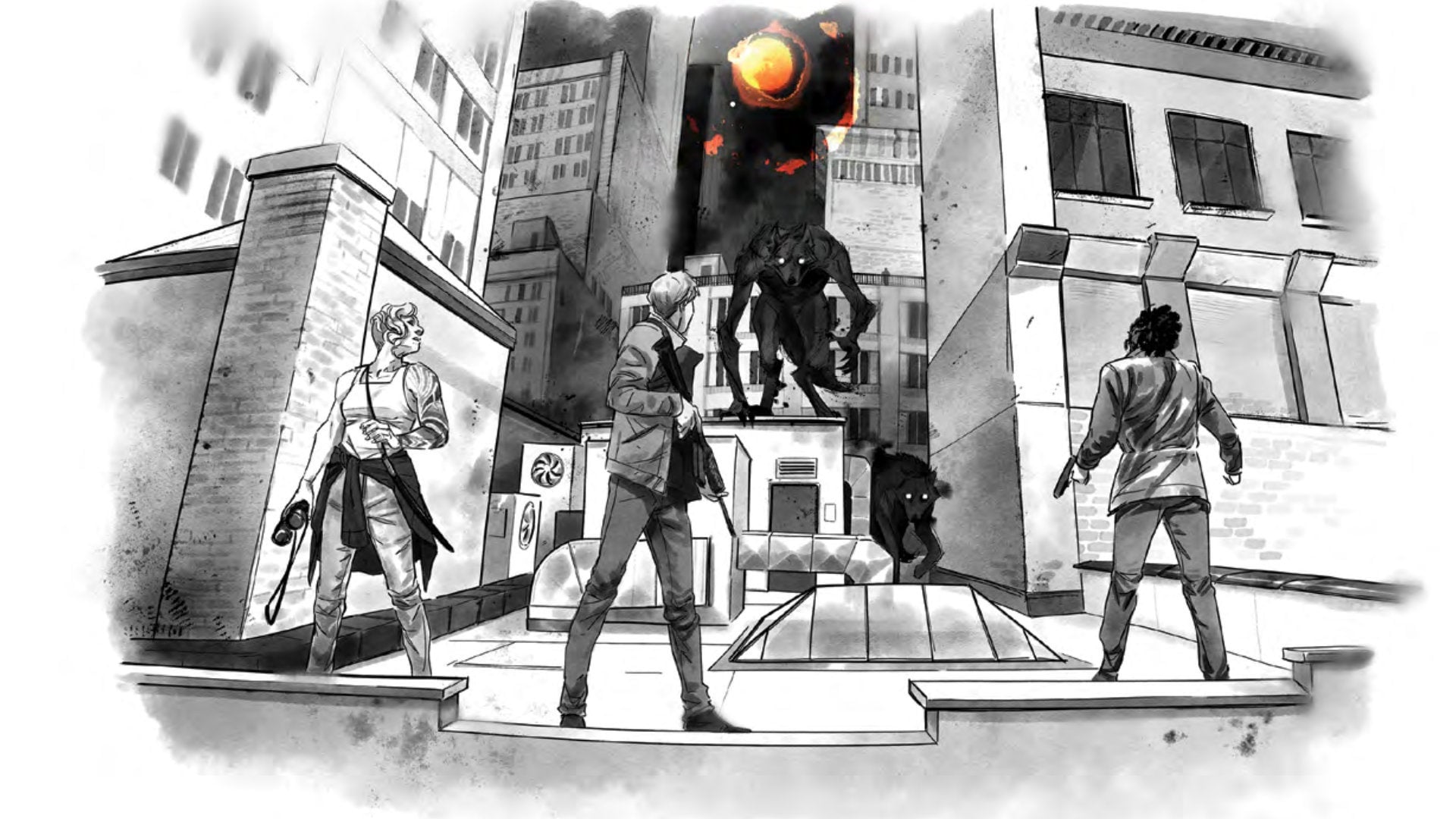
Questions: How do you build a Character? What mechanically defines a Character in this game? What are the main stats in the game?
Where To Look: Many games will have sections labeled “Characters” or even “Character Creation.” Find those sections and go from there.
If All Else Fails: Determine the choices available to a player when making a Character. Note those choices down.
Steps three and four might overlap and you are likely to make progress on step four as you’re going through step three. In certain cases, you may even want to hit step four before three.
Here you want to go over some basics: Does this game have “classes”? How does this game factor “Background” into the stats? What are the core stats of a Character? Do Characters have “Levels?” How do they advance in skill and power?
Standard fifth edition Dungeons & Dragons, for example, relies heavily on classes of characters. Often a party’s chance of success and failure is defined by that group’s class composition, as the classes determine, generally, how good or bad someone is at a certain field. Clerics, for example, are great at healing and matters pertaining to faith and religion, while Rogues are great at sneaking and dealing damage in clever and annoying ways. D&D also adds Race and Background as the main sources of the rest of a character’s information and stats.
A game like Advanced 5th Edition, though, has a different composition: Characters are still made using classes, but they also have Heritage, Background, and Culture as well as Destiny.
The more you can break down the modular components that make up a character, the more you’ll see how they come together to provide all the numbers and important features of the class, but that all starts with understanding what the core “modules,” if you will, of a character are.
5: Tackle Everything Else As Necessary
Questions: How does magic work in this game? How do you grapple an opponent? How does fall damage work? What is THAC0?
Where To Look: Sometimes a section will be named after a particular rule, such as “Crafting” or “Spells.” The Index of the book will become your best friend.
If All Else Fails: Dig through the Index, or try to isolate what the extra rule “is.” For example, you may know that every die that isn’t a d20 in D&D is meant for damage, so for fall damage, the question is what dice to use and how, perhaps, height is taken into account. Go through the mechanics you know to determine what the missing mechanic should be.
This last step is open ended, and that’s because with steps one through four, you basically have everything you need to run the game. Step five, if you’re a player, is probably going to be learning the intricacies of your specific character option. If you’re a sorcerer in D&D, for example, this is why you should learn how magic works. If you’re a GM and you’ve covered the basics, but the game has some intricate map-rules for combat, this is when you should learn those rules.
By and large, everything outside of the “setting,” difficulty settings and task resolution, and character makeup and construction falls under this category, and it likely makes use of those different systems.
Step five is really about learning what systems exist outside the basic ones needed to keep the game going. They might be special-case scenarios, or they could be mechanics like how to craft a magic potion or something.
Magic is a common one. With its spell slots and points and whether a character pulls from a list of spells or chooses which ones they can innately cast, D&D’s intricate magic system is something you can and should learn on its own. Pathfinder second edition has a specific “Action Economy” that determines how many things you can do in a turn; that might be something you want to dedicate specific time to learning. Overland travel and how to handle the game when characters are traveling great distances might require specific rules to learn.
This step is going to be different for everyone. If you’re playing in a very magic-heavy D&D game where almost every character has access to magic, you’re probably going to want to understand how magic works in the game very well. If you’re running an encounter with a monster that has a variety of multiattacks, you’ll probably want to prioritize learning how those get paced out in a turn.
You can handle the lore in this way as well. Say you’re playing Werewolf, which has multiple tribes with their own unique histories. It’s a good idea to familiarize yourself with the tribe your character is from, but maybe you’ll want to understand the tribes of other characters as well, so you can learn those as it makes sense.
Learning the setting, determining how tasks succeed or fail, knowing how Characters improve their chances of success, understanding what systems make a Character, and learning other rules as needed is a sure-fire way to transform a game from a giant intimidating book on the shelf to something you can work with.
These are helpful for breaking down the basics of just about any game you want to check out before committing to learning all of its intricacies. It may also help you dig deeper into games you already know and play. And if you’re looking for some particularly great tabletop roleplaying games to sink your teeth into, we’ve got you covered with the best titles from this year.