In an early mission of The Bureau: XCOM Declassified, a deer clattered across the pavement of a wrecked college town’s main drag as I took my orders. It paused and looked at me, and I at it. Even before this invasion, that deer’s world was under constant threat from death-dealing technology beyond its comprehension. What might it be thinking? I wondered. Am I really any different from these aliens?
William Carter, he of the Eastwood-squint and a voice dragged over sandpaper, is no passive creature, shocked into a trance by the dazzling lights of a frightening machine. He is, as he would be complimented later by an alien intelligence, someone who not only takes action, but also is gifted with a wisdom others do not have, leaving little wonder why he’s the top field agent of the secret Bureau of Operations and Command—rechristened XCOM when the communist invasion envisioned by the United States in the early 1960s was replaced by an extraterrestrial one.
Smart decisionmaking has always been the essential tool of any game under the XCOM name, the beloved strategy title with a 20-year history, reborn with last year’s Enemy Unknown. The Bureau introduces the need to act, skillfully and in real-time, through the perspective and controls of a third-person shooter. The result is tactical challenge that can be unrelentingly tough, and one where an obviously bad idea isn’t as apparent from ground level as it is from a view high above an isometric battlefield.
As Carter, you go back to 1962, the zenith of ring-a-ding postwar America and its Cold War paranoia. Carter, a CIA agent, is a courier bringing a mysterious package to the paranoid chief of The Bureau at a location called Groom Range—an obvious reference to the infamous Area 51 (Groom Lake ). An alien infiltrator releases whatever is inside of it, imbuing Carter with the strange ability to heal himself (and others), and a preternatural ability to see a battlefield and command allies on it.
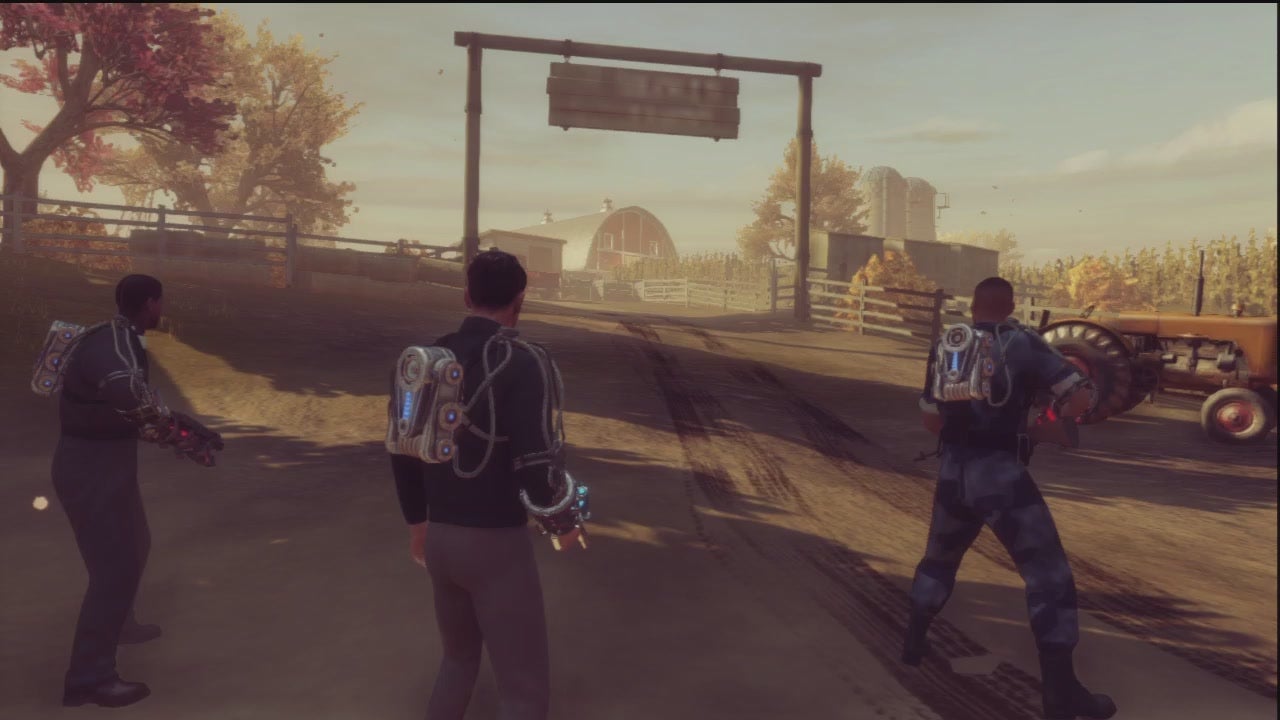
The most obvious comparison of gameplay, made repeatedly in the two years since this game was first shown, is to Mass Effect, but only to a point. You will spend vastly more time issuing commands to your two operatives than in a game like Mass Effect, where you could let teammates fight according to their AI and occasionally butt in to call on a special skill. In The Bureau, your operatives won’t do much on their own other than fire on anything in range and move when their position is overrun, though occasionally I would see an agent take higher ground on his own.
https://lastchance.cc/if-xcom-is-a-shooter-then-so-is-mass-effect-5810536%3C/a%3E%3C/p%3E
The Bureau‘s firefights, great and small, can feel kind of micro-managey and if you can’t or don’t want to handle that obligation, then this game simply will not be for you. Your teammates are also, candidly, a whiny bunch. I ranked up a recon sniper to level 5 and he was one of my most valuable men in the field. But every nick brought a terrified cry and claims that he needed a medic or was a goner even when his health was nowhere near the bleed-out timer. (You can hear it at the end of the gameplay video below, albeit coming from another character). It can also be exasperating to put a guy in a position and order him to attack from there, and then, when the battlefield breaks down and he gets flanked, hear him complain “This is a bad spot boss!” or “They’re pushing forward! Orders?” The chatter is nonstop and when you’re getting really pounded, almost infuriating.
In time you’ll develop your pet methodologies for disposing of a wide variety of enemies—which will themselves cloak, flank, melee and snipe at you, in addition to straightforward fire from cover. They’ll also bring out armored Sectopods and the dreadful Mutons, juggernauts that must be shot apart piece by piece, often with one of the crew drawing off their attention. But when things have really fallen apart, you can’t simply blast your way out with cover-shooter skills alone. The numbers you face—and also the limited amount of ammunition you can carry—mean you’ll be dead in no time. The battlefield perspective also takes some getting used to, and keeping a good sense in your own head of where your men are at all times. This video, of a minor operation early in the game (so it doesn’t give out any main plot spoilers) is a good example of how to tackle things.
I was a big fan of the telekinetic “lift” power Carter had, which suspends an enemy helpless in the air while another agent or two blasts away at him from below. I took a loading screen tip and used lift against aforesaid Muton, and had an engineer agent slide a mine underneath him for a satisfying effect. The special abilities and perks in each class are well chosen; everyone will contribute something uniquely indispensable on the battlefield, and you’ll miss it when you don’t bring them along.
That said, those who are new to squad-based tactical games, particularly ones requiring this much level of command, should be honest with themselves and start off on the Squaddie or the Rookie difficulty levels until they build a familiarity with how to work effectively in bullet time on the battlefield. Agents at low levels, and Carter himself, have low health, few skills, and standard firearms, making cover, elevation and flanking absolutely vital. Fortunately, you can adjust difficulty up or down in the campaign as you get better (or worse.) I played “squookie” because, candidly, I got shot to pieces at veteran, and if I was going to see the full story of The Bureau by my deadline I had to back down the challenge.
As far as enemy behavior, they will move to flank you, so acting with the initiative is vital toward flushing them into choke points or creating distractions that draw them out where an operative may pick him off. While not entirely predictable, the increasing difficulty of the opposition as you moved through a linear stage was somewhat liturgical. Here’s the lighter advance team, here’s a stronger unit, now here’s the armors with the drones to heal them. It places a premium on saving things like grenades and rocket launchers (and special abilities like the commando’s plasma field, or recon’s tactical strike) for the truly big foes, though I found the abilities’ recharge times to be reasonably fast. (Mind control, however, a very high level skill, recharges very slowly—and dropping in and out of bullet time only adds to the desperation of getting that power back.)
Any similiarities to the existing XCOM games are limited largely to the battlefield, which is somewhat disappointing. While you get eight agent slots (two for each class) and can acquire others through operations, choosing perks for them is about the limit of your strategic choices back at the base. The version of this game shown in 2011 called for presenting you with a choice of converting enemy weaponry for use on the battlefield for a huge short-term advantage, or saving it to bring back to headquarters for study, providing you with better gear down the line. There’s no R&D in The Bureau; you will find new weapons and backpack modifiers in the field rather than order scientists to study and repurpose them. Thus there’s no real story for all the cool, chrome-plated gear you’re lugging around in the field. You just get this metal cuff and some wires going up your shoulder, and a backpack that offers additional perks, and that’s it.
There’s a large map in the central operations room showing you the missions you may choose (there are seven “major operations” in the field, some lasting upwards of 90 minutes, and about half a dozen minor operations). But again, those who are familiar with mission choice in XCOM will be disappointed that this is simply selecting the order in which you want to do things, not a decision that bears consequences down the line.
A shrewd feature, however, is the “Dispatch Mission,” a way to earn bonus equipment and personnel and rank up your operatives in the process. A Dispatch Mission simply requires you to designate two agents whose combined levels meet or exceed that mission’s rank. These agents will then be unavailable for your next operation, but when they return they’ll have some kind of prize for you. This somewhat mimics the rewards you’d get for certain jobs in Enemy Unknown
As for the story of the game, there’s not much I can say that wouldn’t be a spoiler—it should be seen for yourself, but suffice to say a good chunk of this game takes place offworld (with Carter in a badass Project Mercury-style space suit, I might add.) I’ll word this carefully, but I wasn’t a big fan of the way Carter became nearly irrelevant by the end of the campaign. In no way was this a role playing game, and I didn’t develop that much of an attachment to his motivations, but his handling in the story’s conclusion left me with a sour taste in my mouth.
The “Erase the Truth” tagline the game carries also appears to be a missed opportunity to deepen your terrestrial operations. I didn’t do any truth erasing—it was handled in a few lines of expository dialogue with the base’s communications officer. A mission or two where you had to quell civilian panic or participated in this coverup would have helped make the origin story of XCOM more intriguing. As I suspected, the big question of keeping a full-scale alien invasion secret and making sure it never made it into the history books was a situation that largely resolved itself in an epilogue. It’s not the most engaging story—but I didn’t find it to be clichéd, either, and all of the parts are very well acted.
The Bureau is by no means a bad game; if 2K Games, however, had published this before Enemy Unknown then I don’t think the reborn XCOM name would be held in as high regard as it is today. Having played Enemy Unknown and now The Bureau, I now understand why the franchise’s longtime fans would have been so upset. These are two completely different games, and comparisons to the original X-COM would be unfair to The Bureau.
Released in this order, the unique qualities of The Bureau are on better display, absent a demanding, almost unfair comparison to one of strategy gaming’s greatest titles. It provides a fresh perspective on a familiar story arc and a new way to experience the tense, playing-for-keeps consequences of an XCOM battlefield.
To contact the author of this post, write to [email protected] or find him on Twitter @owengood