
The puzzle genre is the last place I expected to find a game that makes me feel guilty about killing. I’ve murdered myself a hundred times over in The Swapper, and it never gets any easier.
“They aren’t really me,” I tell myself. “They aren’t alive.” Technically it’s true. The meat of Facepalm Games’ award-winning indie puzzler is artificial; soulless clones created through technology. Mindless golems brought to life, quite literally, from clay — the entire game is hand-crafted using clay and other everyday materials. They move only as I move, mirror images with weight and substance.
At first the Swapper gun my unnamed astronaut discovers after evacuating the doomed Theseus space station is a convenient tool. Seemingly no one else survived the strange plague that swept the facility — a simple research lab dedicated to studying strange alien rocks — so when more than one button needs to be pushed, being able to craft up to four empty shells out of thin air is a godsend (though perhaps that’s not the proper term to use here).
But soon I gained the ability to swap my consciousness into these created vessels, sending my free will spiraling out of my body like a reverse bullet. I was shooting my soul from a gun, leaving a flesh puppet in my wake.
How liberating, to ride a beam of light from one body to the next! Combining the Swapper’s functions, I could do anything. I could squeeze through the narrowest gaps. I could defy gravity. I could even fly, but watch carefully…
https://www.youtube.com/watch?v=jombrBukH4w
See that crumpled form turning to dust in the bottom of the pit? That’s the price I pay for freedom from the laws of nature — I watch myself die again and again. The higher I fly, the more empty corpses I leave to plummet to the ground below.
If a vessel is worthy of containing a soul, isn’t it worthy of continued existence?
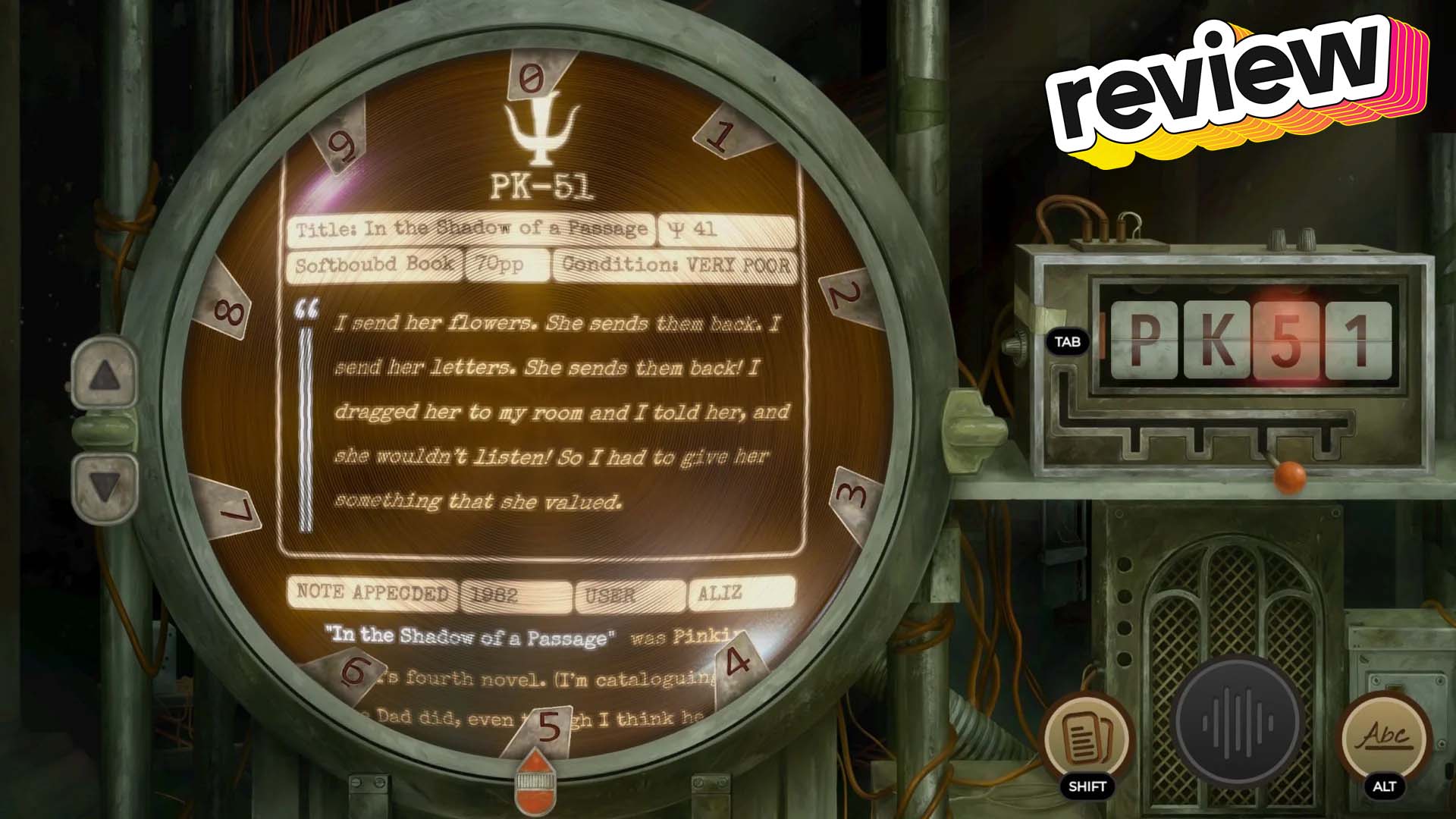
I tried my best to ignore the question as I explored the mostly-deserted space station. I attempted to lose myself in the story of a horrific misunderstanding between scientists and subjects that unfolds through a series of system logs found on flickering computer terminals in the darkness…
…and the song of the strange alien stones that spoke riddles every time I passed.
I focused on the puzzles, brilliantly-built wonders of convoluted logic, where the path from point ‘a’ to point ‘b’ usually involved seeding the level with duplicates and then dancing between them with pinpoint precision. I learned to dread the red and blue lights, the former preventing me from soul-swapping, the latter denying my creations.
I reveled in the atmosphere (or lack thereof, at times) created by developers Otto Hantula and Olli Harjola, a wondrous concoction of hand-crafted scenery, minimalist lighting and ambient music that’s almost too magical for a science fiction title.
And I smirked at the realization that this PC game, like so many mobile puzzle games I’ve been playing late, at its core follows a very simple formula — complete puzzles, earn enough “stars” to open the next set, complete more puzzles, earn more stars. If only the developers of those mobile titles had the time and resources to create a framework around their brain games as Facepalm Games has.
I tried to keep my mind off of my countless careless leavings, but still they haunt me, the same way I’m haunted by the vision of the bottled Jackmans in the movie adaptation of The Prestige, or every Jamie Madrox that’s ever perished in the line of duty.
At the end of The Swapper the player is presented with a difficult choice, but in my case it wasn’t all that difficult. After hours spent creating and destroying countless simulacra, my fate was sealed — there was no question. The gravity of any final decision is far outdone by the hours of existential deconstruction that come before.