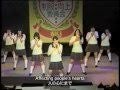
If you’ve played a Japanese video game, watched an anime, or read a manga, you’ve seen them: schoolgirls. Idols, in particular, are the lighter, fluffy end of the spectrum. They stand for the fantasies of their fans.
Not idol collective Seifuku Kojo Iinkai (School Uniform Improvement Committee), or SKi. Those girls are standing up to nuclear power. This summer, Japanese pop music, so often devoid of political meaning, saw one of the brashest protest songs from an unlikely band of singers: schoolgirl idols.
On March 11, everything in Japan changed. A 9.0 magnitude earthquake rocked the nation. Within minutes a tsunami ravaged the coast, destroying lives and in many cases ending them. It was the worst recorded quake in Japanese history and the biggest challenge the country has faced since the War.
https://lastchance.cc/earthquake-crisis-brings-out-the-best-in-japans-gaming-5780916%3C/a%3E%3C/p%3E
Even family friendly Studio Ghibli, the studio behind classics like Kiki’s Delivery Service, publicly voiced its opposition to nuclear power—a brave move considering its rumored blacklisting. Grave of the Fireflies and iPad masturbation remarks aside, Studio Ghibli doesn’t seem like its pushing any sort of agenda—other than kids should play outside and use their imaginations.
https://lastchance.cc/among-rumored-blacklists-studio-ghibli-makes-its-voice-5813919%3C/a%3E%3C/p%3E
Likewise, schoolgirls and Japanese pop culture tropes are a blank slate. I’m not saying real schoolgirls are, but their iconography—namely their uniform. This is one of the things I explored in my book Japanese Schoolgirl Confidential, which was edited and laid out by the designer of Arcade Mania, Andrew Lee. Schoolgirls exist in a myriad of incarnations throughout popular culture—from cute and cool to tough and scary. The uniform itself is used as both an identifying marker and a point of contrast. One of the things that made Chiaki Kuriyama’s Gogo Yubari character in Kill Bill so memorable was that she was a lethal assassin in a schoolgirl uniform. The same dynamic is at play here.
https://lastchance.cc/gogo-is-a-good-gundam-singer-5486439%3C/a%3E%3C/p%3E
The uniform itself is used as both an identifying marker and a point of contrast.
Idols do not typically write their own music. They don’t write their lyrics. They are mouthpieces for their producers, managers, and lyricists. Here, their being alone makes the message that much more potent.
During the summer, a controversy broke out over this song. The group said it was banned from performing at the Fuji Rock Festival, because sponsors buckled over the idea of an anti-nuclear power song. Japan, with its history of nuclear destruction, does depend on nuclear energy to power its cities and factories. From a production standpoint, many businesses have a vested interest in nuclear power, because without it, they cannot operate.
SKi, which doesn’t consider itself a group but a family, was never formally announced for Fuji Rock. SKi has been around since 1992, churning out “pure idols”, save for the occasional member who went on to star in hardcore pornos. It’s never quite reached the heights that other schoolgirl groups like Morning Musume or AKB48 have. Since SKi was never officially announced for Fuji Rock, some were left wondering if this wasn’t a publicity stunt. Apparently, the girls were not announced because they were supposed to be special guests.
https://lastchance.cc/rhythm-heaven-is-where-idols-go-to-press-buttons-5826821%3C/a%3E%3C/p%3E
Several members of SKi marched at an anti-nuke demonstration Tokyo in late July. The group also held live events to protest nuclear power.
There doesn’t seem to be a “ban” on anti-nuclear songs at Fuji Rock per se, as the show permitted one of Kiyoshiro Imawano‘s anti-nuke songs to be performed in 2009. That was before March 11. Before everything changed, back when idols were content to sing about nothing.
Watch the protest song’s video in the gallery above.
Culture Smash is a daily dose of things topical, interesting and sometimes even awesome—game related and beyond.
(Top photo: SKi | Japan Idol Records)
You can contact Brian Ashcraft, the author of this post, at [email protected]. You can also find him on Twitter, Facebook, and lurking around our #tips page.
Promoting a song and protesting at the same time.