This War of Mine starts off feeling like the most depressing variation of The Sims ever, one where any happiness or woohoo has been bombed out of existence. And, very quickly, it gets to feeling even worse.
Like the famous EA simulator series, This War of Mine puts players in charge of a group of interconnected lives. However, the circumstances under which you’re steering these characters’ existence is the big difference. Here, you’re playing god in the middle of a war.
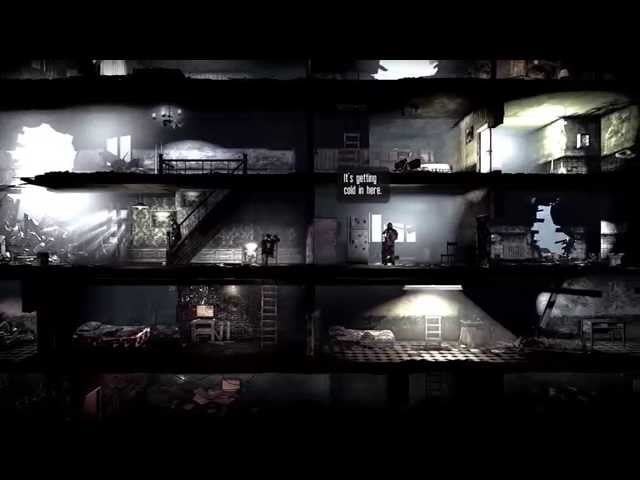
When This War of Mine starts, the game delivers unto you three lost souls who’ve banded together to try and survive the Eastern European civil war that surrounds them. They’re civilians—not survival-trained, battle-hardened soldiers—and ill-equipped to suddenly live without running water, heat or readily available food. During the daytime, you manage their actions inside a cracked, multilevel structure. It’s barely livable at the onset, with holes in the walls and piles of rubble obstructing part of the building. Command them to dig through rubble and you’ll open up more space and start finding organic and scrap materials that will help them scrape by day to day.
The feeling of hopelessness is unrelenting. Your initial trio of survivors start off hungry, tired or wounded and, no matter how much scavenging, bartering or crafting as you do, those states of being are never too far away. Just to make your shelter moderately livable, you’ll have to have them patch walls, build beds, grow vegetables, filter rainwater, bait and catch small animals for food.
Of course, all of that comes after finding the necessary resources themselves, which is a chore in and of itself. There never seems to be time enough in the day cycle to do everything that needs to be done, to say nothing of making sure the survivors get enough rest, food or distraction to stop from getting despondent. And the night cycle is equally stressful, bringing you into contact with people just as desperate to wheedle, steal or threaten. You can travel to different locations on the map, each with their own embedded dramas, threat levels and resource advantages. Decisions like stealing from a church or risking a scavenging cycle while snipers lurk in the vicinity will await you in each spot. An actual barter deal is one of the best interactions you can have with the strangers you meet across This War of Mine‘s cratered map.
I quit and deleted my first playthrough of TWOM because my survivors got too sick and too dejected far faster than I was expecting. Part of that disastrous session was a raid on day two. Raids are when outsiders come and force their way into your shelter, taking what they want and assaulting your survivors. They happen off-screen and overnight—like the crucial scavenging gameplay—and the player can best prepare for them in advance by patching walls, making weapons and setting up someone to guard the shelter. However, none of that guarantees you won’t get raided. And the person on guard duty won’t get as much rest as those sleeping, which potentially leaves you with one less pair of hands for crafting, cooking or repairing things during the next day cycle.
You can send off a survivor to help others grab stuff from remote locations but, again, you lose him for a day cycle until he comes back. You might find yourself refusing desperate entreaties for help from people who come to your door—like aiding in digging out people trapped in rubble. Selfish and more than a little fucked-up? Yeah, but war does that to a person.
On the next try after my initial attempt, I was so spooked by that raid that I sent skilled scavenger Marko out with a nearly-full backpack. I figured if he had the shelter’s best resources on him, then any would-be thugs wouldn’t be able to get their hands on them if they tried to strong-arm the friends left behind. Because there was no raid, that decision backfired on me in two ways: I didn’t add to my crew’s pool of resources and had an over-tired person as a result. Cowardly and overly cautious? Yeah, but war does that to a person.
This War of Mine shares psychological commonality with The Last of Us, in that you know almost immediately that you’re probably not ever going to be operating from a position of strength. But it does away with the layer of fiction pulled over that game’s narrative lens. This isn’t a fungal zombie apocalypse. TWOM feels like it’s happening somewhere right now, somewhere where boots just stomped and bombs just fell.
I felt shame when I went to the ruined villa and stole things that didn’t belong to me, shame that deepened when I got back home to my own shelter and found that my mates had been wounded in another raid. The bandages and medicine I’d hoped to snatch from the other location? I never even found them.
As they go out into the world or contend with their smaller, more desperate lives, sadness and depression can set in. Since this is a strategy game, there are means to stave off these changes in attributes but they almost always come at the cost of something else. For example, having a drink of moonshine means you won’t have homemade booze to trade in exchange for something else.
There was the time that the military came to my house looking for persons of interest in my neighborhood who’d taken food from an air drop. They said that the food was property of the state and they offered me cigarettes, canned food and fresh water in exchange for any info. Faced with three people who were either in “hungry” or “very hungry” states, I ratted out the neighbor. Despicable? Certainly, but war does that to a person.
In another playthrough, I let in another survivor in my shelter and immediately regretted it. Cveta was a schoolteacher and her skill was being good with children. She didn’t have assets my crew needed and ultimately wound up becoming just another mouth to feed. I ran her around doing tasks while I fed and rested my ‘original’ crew. Yes, she’d die eventually but I felt like I wouldn’t miss her much. Cold-hearted? Yeah, but war does that to a person.
During one scavenge run, it’s strongly implied that a girl that I stumbled upon gets sexually assaulted by soldiers at a supermarket scavenging location. I could have helped her, maybe, but I was there to try and grab as much food and supplies for my shelter. The horrible misdeed kept the soldier from stopping my rooting around. Katia, my scavenger for that night, went back home feeling terrible. So did I. But she did so with a fresh stock of food and supplies. We’d survive one more day at least, with just a little less of our souls.
This War of Mine is the first video game where I’ve stopped playing because of how depressed it made me feel. I’d hit the point where I just couldn’t keep on grinding on anymore. I’d pause, turn to something else for a while, take a deep breath and steel myself to jump back in. Part of the exhaustion comes from what TWOM‘s grind actually is. It’s not killing rats for XP or smashing pots to find rubies. It’s deciding to deny sleep to people who feel real so that they can build another heater or cook food. I didn’t really get why I was continuing to play until I hit Game Over for the first time and the reasons that each character is trying to make it to another day are revealed. The broken threads of their lives—daughters, husbands or friends scattered by the same awful war—serve as motivation to start another game. Your decisions also scroll by at the end of a campaign, prodding you to see if you can be a better person this time.
I had to ask myself why I was playing This War of Mine, because the traditional feedback loops of mastery and dominance of game mechanics were elusive at best. The eventual answer I came up with was that 11-Bit’s creation let me explore wretched realities of the human condition in a safe space, something that you can’t really do in too many games. As broke or depressed as I’ve ever been—with the exception of one time—it’s never been to the point where I would have given up on life itself, like Marko did in my worst TWOM session. But I haven’t lived in an active warzone and probably never will.
This War of Mine‘s developers have livedthrough a war like the one inside the game. And their creation, if only in the smallest way, made me understand the kinds of choices, consequences and emotions that run through those that do. I was aghast at how quickly my empathy eroded in a video game, which made me more cognizant of its fragility in real life. It’s the kind of game that could potentially change the way you watch the news, treat others or cast a vote in an election.