
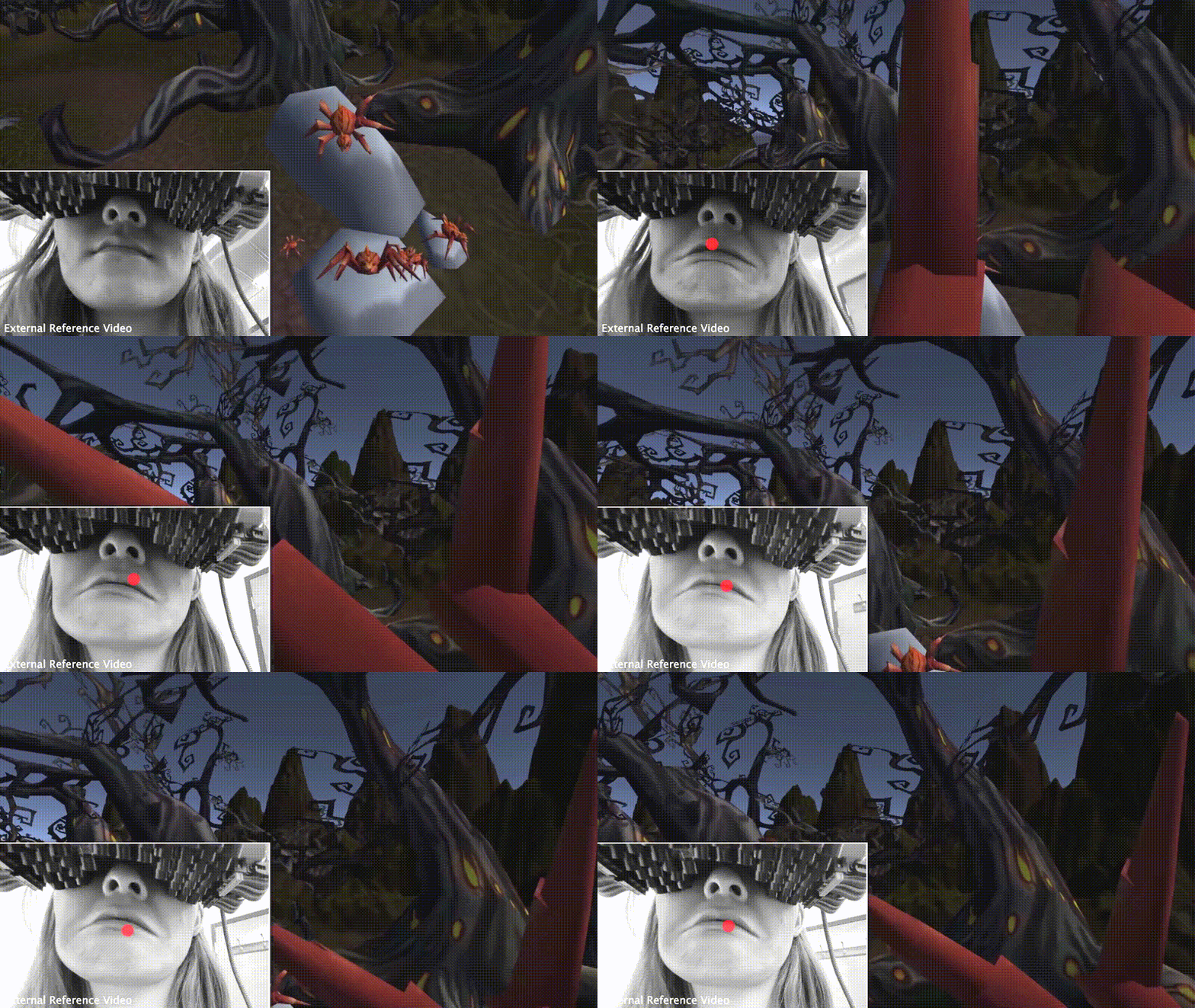
Off the top of your head, what’s the best way to increase immersion while using virtual reality? Flawless, controller-free hand tracking? Direct brain integration? Maybe some kind of smell-o-vision? Nope, sorry, the answer we’re looking for is “literally being able to feel spiders crawling on your face.”
That’s the goal, believe it or not, of the Future Interfaces Group, an “interdisciplinary research lab” at Carnegie Mellon University. Okay, their work isn’t just about spiders, but eight-legged freaks play a large role in the group’s latest study (h/t PC Gamer), wherein they experimented with producing “mouth haptics” by way of an ultrasound array attached to a regular VR headset and directed at the user’s face.
“Today’s consumer virtual reality systems offer limited haptic feedback via vibration motors in handheld controllers,” the Future Interfaces Group’s paper reads. “Rendering haptics to other parts of the body is an open challenge, especially in a practical and consumer-friendly manner. The mouth is of particular interest, as it is a close second in tactile sensitivity to the fingertips, offering a unique opportunity to add fine-grained haptic effects.”
As shown in the video above, the technology was used to simulate several, arachnid-related scenarios. Who wouldn’t want to feel the wispy caress of webs on their lips, or a spider try to forcibly enter their mouth? Why even play a video game if you can’t experience the tactile sensation of a spider’s guts splashing against your face after shooting it with a flare gun? Apparently, not even internal anatomy like teeth and tongues are safe from this ultrasound array’s “new and interesting VR experiences.”
Other examples include feeling the water as you drink from a fountain and sensing the wind breeze past you while riding a motorcycle.
“We found that mouth haptics boosted immersion, realism, and other important factors in virtual reality experiences,” the paper concludes.
It’s honestly a pretty cool piece of work, spider stuff aside. Not only would this ultrasound array give developers a whole new sense to seriously consider when making games, it’s also compact enough to work with most existing VR headsets without inconveniencing the user. A lot more study and research is required until this is ready for a consumer market, of course, but even for someone like me with little interest in virtual reality, it’s hard not to imagine the possibilities