Newspapers have offered puzzles in some capacity for as long as anyone can remember, with crosswords being the most renowned. But when The New York Times bought Wordle at the start of 2022, things shifted up a gear. Only earlier this week, The Atlantic magazine announced it was launching daily challenges, and yesterday when I opened Wikipedia on my phone, it suggested I might want to take part in a game.
And it’s a great game! Called Which Came First, it’s a slick, simple and extremely informative quiz that fully embraces the wonder of Wikipedia. But how did we get here?
Obviously, when a newspaper’s website offers such free puzzles, they exist not as some sort of altruistic form of entertainment for the masses, but as a way of harvesting your data and luring you in to their paid ecosystems. The NYT’s purchase of free web game Wordle was seen as utterly bizarre on its surprise announcement, and was inevitably followed by crappy changes and spiteful legal action, but in hindsight it was an extraordinarily canny decision. Since then, the newspaper has built a suite of daily puzzles (not all of them exactly its own ideas), with players encouraged to register accounts and indeed take out subscriptions.
It’s hard to remember just how big of a deal Wordle had become by the end of 2021, providing a much-needed daily distraction and reason to text your friends to a populace that was locked down again and facing the monstrous Omicron variant of covid. A squillion variants were born, and everyone had their little collection of Wordle clones and riffs on the concept that they’d play through each day. Other companies followed the NYT in buying the more popular versions, and the present-day result is that it’s quite normal to find your preferred news website offering a smattering of distracting puzzles, with more joining all the time.
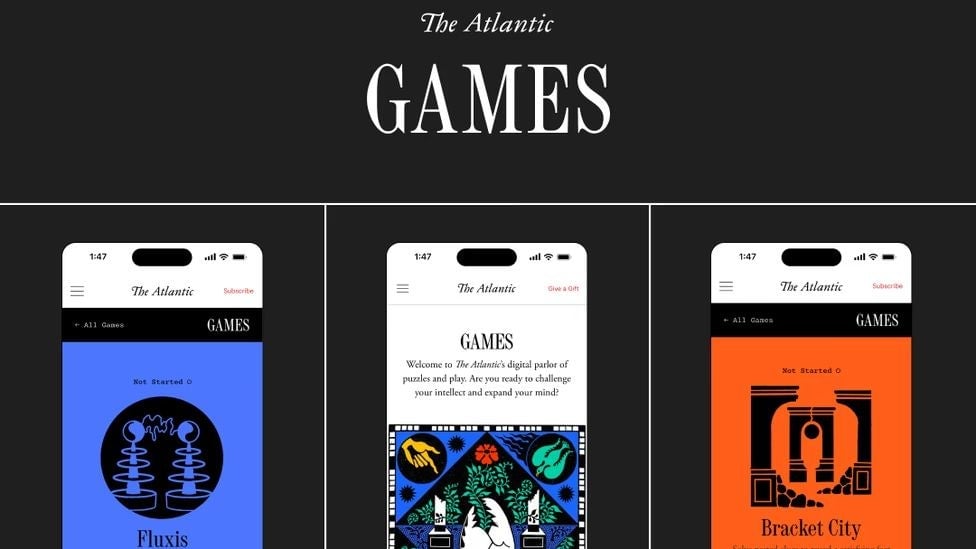
As I mentioned, for those centrists who can’t get enough mealy-mouthed apologetics for the extremism of the right, The Atlantic announced this week it was adding a new section for what it places its spectacles on the tip of its nose and calls “Challenges. Curiosities.” These are five games, two of which are crosswords that have been running for years, one is a bought-in game called Bracket City, and two are brand new, called Stacks and Fluxis. They’re all word games, presumably launching now to try to keep some momentum after the magazine lucked out in March of this year by having its editor-in-chief, Jeffrey Goldberg, added to a group chat in which the still-in-his-job Pete Hegseth was sharing top-secret attack plans.
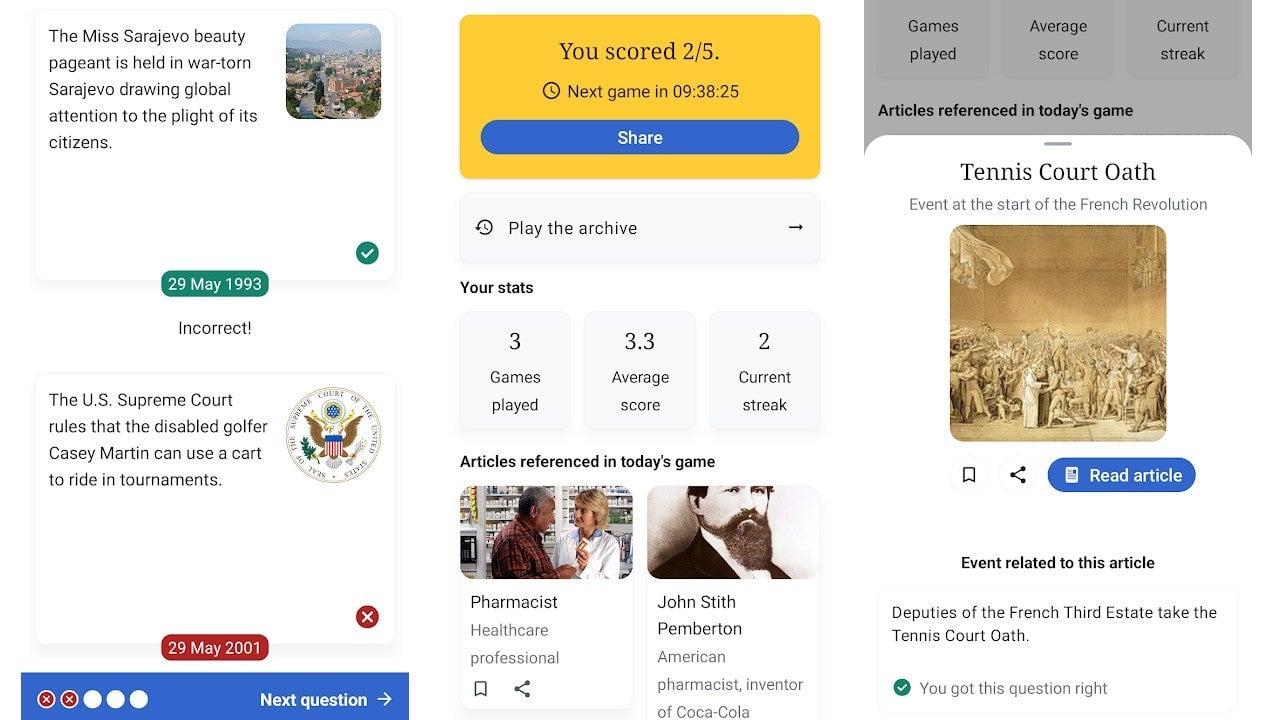
Now it seems that online encyclopedia (and one of humanity’s most extraordinary achievements) Wikipedia is getting in on the action. Yesterday, when having coffee with a friend, I opened the app to try to remember what it was that the director of the extraordinary sci-fi film Primer had done that meant he wouldn’t be working again. (Accrued repeated accusations of domestic violence, if you’re wondering.) But before I could, I was asked by Wikipedia if I would like to play a game. Um, sure! So my chum and I were entirely sidetracked into playing Which Came First, an incredibly simple concept in which the app gives two short descriptions of historical events, plus sometimes a small picture clue, and asks you which happened first. That’s it. It’s great!
Which came first?
Deputies of the French Third Estate take the Tennis Court Oath.
The U.S. vessel SS Savannah arrives at Liverpool, United Kingdom. It is the first steam-propelled vessel to cross the Atlantic, although most of the journey is made under sail.
That’s the first question of today’s edition. I haven’t the faintest idea! I didn’t have a clue about any of the five questions yesterday, either. My historical knowledge is, without question, atrocious. Thankfully, Paul’s a far more rounded, smarter man than me, and was able to make educated or even informed guesses, and “we” got four out of five! Woo!
OK, so obviously this isn’t the most groundbreaking of puzzle ideas. But actually, it’s a perfect addition to Wikipedia, because it’s entirely about finding out something new. I may be sitting here wondering literally which century we’re in with that above question, but I’m also dying to know more about the “Tennis Court Oath” now! It’s also wild to realize that the United States Congress adopted the Great Seal around the same era King Louis XVI was trying to flee the French Revolution. I mean, you may say “Duh,” and deeply worry about the standard of British education in the ‘80s and ‘90s, and you’d likely be right to. If my dad were alive to hear my ignorance, he’d be immediately dead again. But, and this is a lifelong philosophy of mine, you never mock someone for not knowing something if they’re willing to learn it now
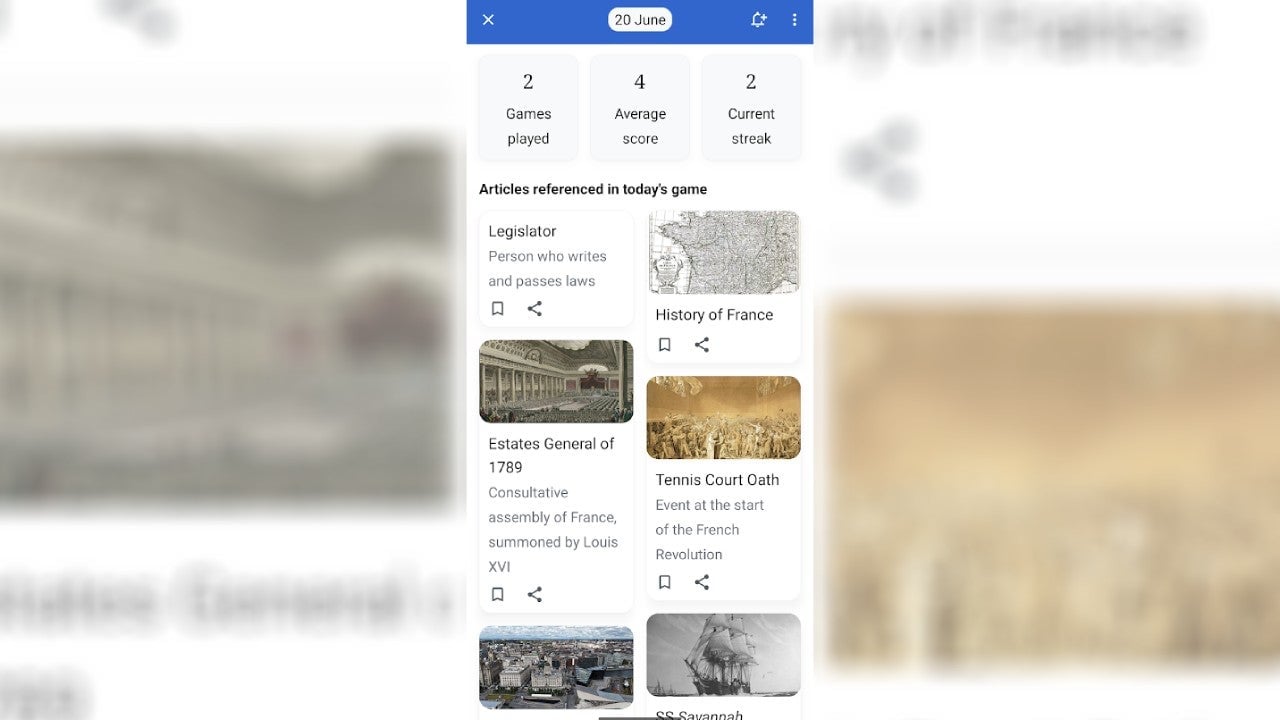
And, with respect to that, Wikipedia’s little game offers direct routes toward some knowledge. At the end of the five questions you’re given your score and streak as you’d expect, but also a nicely presented list of all the articles relevant to the questions you were asked, and indeed dictionary definitions for specific words and terms. Today’s has an excellent 34 boxes to click on for more information, as general as “The Holocaust” and as specific as “Kazimierz Piechowski.” And indeed, I’m pleased to say, a tile for the Tennis Court Oath
When trying to find out more information about Wikipedia’s game, not least whether I’m embarrassingly late to discovering it or one of the first to be offered it, I find there’s the weirdest lack of information out there. When I Googled the term “wikipedia games ‘which came first’,” the second result was, inexplicably, the Wikipedia page for explosive Pokémon Voltorb. The first is a two-month-old Reddit post asking if a German version of the game from two months ago can be played in English, and no one having a clue.
It’s not included in the current list of semi-official “games” created by Wikipedians, and everyone involved seems to be very shy about it all. In fact, the game’s own “more info” link goes to an empty page! (I have, of course, reached out to Wikipedia to ask all about it.) However, I have discovered that it began on May 20, 2025, because that’s how far back the archive of daily games goes. So a month today! Hopefully you can now find it yourself by opening the updated version of the Wikipedia app on your phone. And hopefully it’ll catch on and become a whole section within the app.